Home Blog Page 169

NYC dad shot to death at Knicks block party just minutes after historic victory


A Brooklyn father of four was shot to death at a Knicks block party just minutes after the hometown team’s historic victory over the weekend, according to authorities and reports.

Emanuel Spencer, 44, was discovered with multiple gunshot wounds steps from his home on Lincoln Road in Prospect Lefferts Garden around 11:40 p.m. on Saturday, according to the NYPD.

Emanuel Spencer, 44, was shot to death at a Knicks block party just a few minutes after the hometown team’s historic victory. Kyle Mazza/Shutterstock

Spencer was rushed to the hospital in critical condition, where he was later pronounced dead, police said.

“His day was going good,” Spencer’s younger brother told the New York Daily News. “Everybody was just
watching the basketball game, relaxing.”

“He was a gentle person. Laid back. Family man. Liked to spend time with his daughters,” the brother said. “He loved everything. He loved sports. He loved music.”

A neighbor told the outlet she saw a crowd of ecstatic Knicks fans celebrating the NBA Finals Championship win outside her apartment before the chaos unfolded.

“I heard probably like two or three [gunshots] and then the crowd running,” she said.

Spencer was rushed to the hospital in critical condition, where he was later pronounced dead. Kyle Mazza/Shutterstock

“When I was out there, I heard the fireworks, the gunshots, and I grabbed my child, and I went inside…. There were so many people. I don’t understand what the hell happened.”

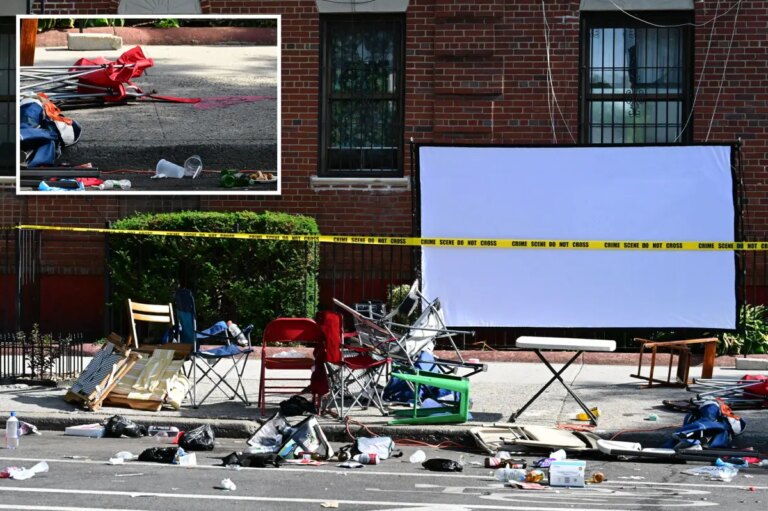
Photos at the scene captured crime scene tape around abandoned plastic cups and barbecue grills left from the block party.

Sources told the Daily News that the father of four had several robbery and narcotics arrests, including a most recent March 2024 arrest for reckless endangerment.

Neighbors described Spencer as calm, respectful, and a loved member of the neighborhood.

Neighbors and family said Spencer was a gentle and respectful father of four. Kyle Mazza/Shutterstock

“What I know is a guy I loved and respected is no longer here,” Burnett Coburn, 68, told the outlet. “That’s painful.”

Rowdy mobs celebrating the Knicks’ NBA title across the Big Apple trashed NYPD cars and torched FIFA buses in Times Square, leaving 10 cops hurt and 63 people in handcuffs. 

A 17-year-old boy was also shot in the foot, and four people were stabbed during the overnight mayhem, the NYPD said. 

No arrests have been made in connection with the shooting, and an investigation remains ongoing.


Source link

Alex Pereira sets sights on unprecedented UFC history


Alex Pereira is not one for bombast. He’s not much of a braggart. He doesn’t actively denigrate his foes.

All he does is fight better than just about any human of his size in the history of sanctioned combat sports.

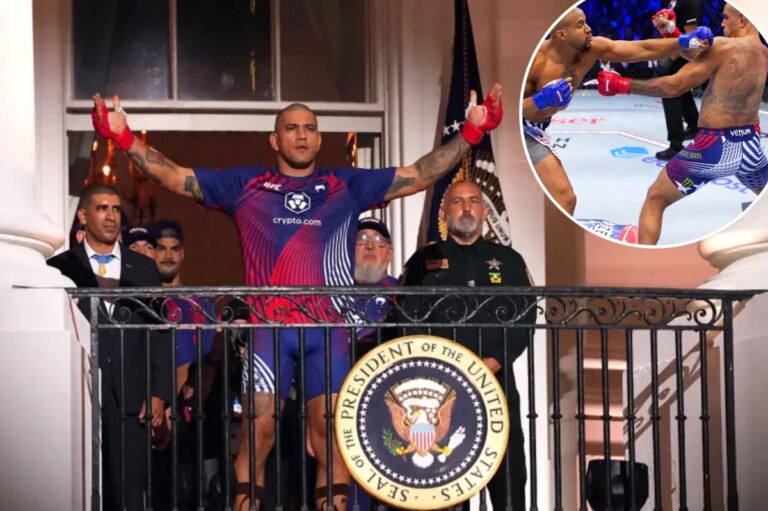
Already a two-division champion by the time he descended upon Washington last week in advance of Sunday night’s UFC Freedom 250 spectacle on the South Lawn of the White House, Pereira was poised to become the first in UFC history to challenge for gold in a third weight class. Forget winning for a moment; nobody had even attempted to make this sort of history.

Conor McGregor never did it, growing satisfied with success not long after adding a lightweight crown to his featherweight belt nearly 10 years ago at Madison Square Garden.

Alex Pereira of Brazil walks to the Octagon in the UFC interim heavyweight championship fight during the UFC Freedom 250 event on the South Lawn at the White House on June 14, 2026 in Washington, DC. Zuffa LLC

Ilia Topuria, who on Sunday sought to unify the lightweight championship against interim champion Justin Gaethje, just may one day follow Islam Makhachev up to welterweight in a bid to add it to his belt collection. For now, he’s merely a two-division king after previously reigning at featherweight.

Pereira, who’s not even reached the five-year mark in the UFC, already has middleweight and light heavyweight gold to his name, matching in MMA what he’d accomplished in the realm of elite kickboxing. He sized out each weight class, and heavyweight is his final frontier.

Unlike McGregor and Topuria, whose time as champions is not known for a high level of activity, Pereira’s workmanlike approach to defending his crown made it more of a mandate that he move on to bigger and better things.

“I think everything that I’ve been doing gave me enough credentials to fight for this third belt,” Pereira told The Post through an interpreter in the leadup to the event.

Say what you will about the interim championship that was up for grabs between Pereira and Ciryl Gane at the residence of President Trump, but UFC gold is UFC gold. The title was created with heavyweight champion Tom Aspinall still sidelined by the highly damaging double eye pokes he absorbed from Gane in their October no-contest. Couple that with some potential contractual disagreements between Aspinall and the UFC, and it’s conceivable that the interim title gets upgraded to undisputed status before long.

(L-R) Ciryl Gane of France strikes Alex Pereira of Brazil in the UFC interim heavyweight championship fight during the UFC Freedom 250 event on the South Lawn at the White House. Zuffa LLC

The interim title bout was the only one on the seven-fight docket between a pair of men not native to this country, though the Brazilian holds this land dear to him. Pereira has planted roots in Connecticut, training at the gym of his countryman and former UFC light heavyweight champion Glover Teixeira. His kids are growing up here and speak the language, although he has been slow to pick up English himself.

The prospect of one day becoming a citizen of the U.S. appeals to him. “I’ve had so many opportunities here. I’ve been able to accomplish so many things here,” Pereira said. “As I like to say, America is the land of opportunity; I’ve had a lot of opportunity here.”

Sunday offered perhaps the greatest opportunity of his career, one that figured to introduce his very fan-friendly style to a whole new audience. The fights at the White House have crossed over from the typical major UFC event into the realm of crossover curiosity.

Alex Pereira walks out prior to his fight against Ciryl Gane (not pictured) during UFC Freedom 250 at White House South Lawn. IMAGN IMAGES via Reuters Connect

Pereira’s charisma extends beyond his hands of stone — the translation of his nickname “Poatan” in the Tupi language spoken by indigenous peoples of Brazil. From his native warrior-inspired walkout — punctuated by miming the launch of an arrow at his opponent — to embracing how much he resembles an Easter Island statue, he’s easy to get behind. Hollywood took notice, too, casting him in a key role in the upcoming action thriller “Onslaught.”

Just don’t expect Pereira to “go Hollywood.” He’s a fighter to the core, one who had designs on being as active a heavyweight champion as the UFC has ever seen. The bar is low, given that it’s the least-frequently defended belt of them all.

Win or lose Sunday night, get used to seeing more of Pereira. He’s built for the UFC’s biggest stage in the nation’s capital. He’s built for the movies. He’s built to last with an unparalleled legacy after humble international beginnings.

Does it get more American than that?


Source link

Russian attack sets fire to centuries-old religious site in Kyiv and kills 5 in Kharkiv


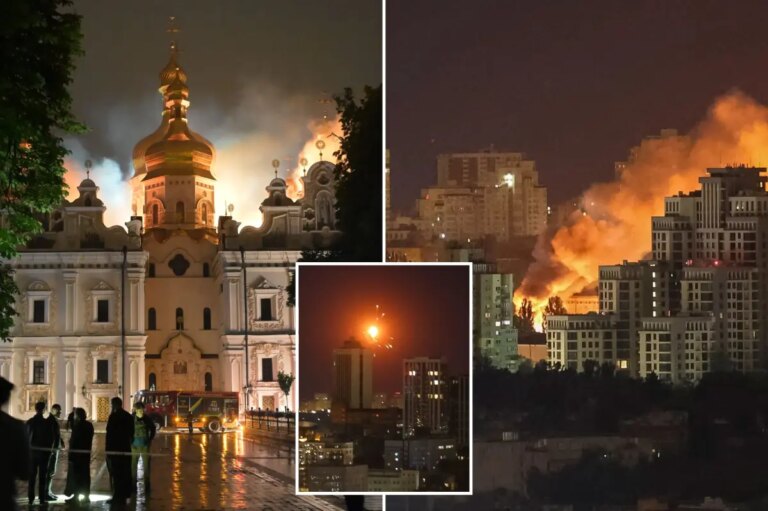
A large-scale Russian attack on Ukraine killed five rescuers in Kharkiv and wounded at least 20 people in the capital Kyiv on Monday as strikes set apartment buildings ablaze and sparked a fire at one of the country’s most significant religious landmarks.

The rescuers were killed in Kharkiv by a second Russian strike as they fought a blaze caused by an earlier attack, Interior Minister Ihor Klymenko said.

At least five other emergency workers were wounded.

The roof of the Dormition Cathedral of the Kyiv-Pechersk Lavra burns on Monday, June 15, 2026. AP Photo/Danylo Antoniuk

A series of powerful explosions echoed across Kyiv, with a wave of ballistic missiles followed by Shahed drones as many people sought shelter underground and officials urged residents to take cover.

“Kyiv is under the main strike. There is significant destruction of civilian infrastructure,” Klymenko said.

Twenty people, including a child, sought medical help in the capital, said Tymur Tkachenko, head of the Kyiv City Military Administration.

Five strikes hit civilian sites in the city’s Shevchenkivskyi district in less than 30 minutes, he said, including a 25-story apartment building, while a market and a grocery store caught fire. In the Obolonskyi district, a nine-story residential building took a direct hit.

Tkachenko accused Russia of striking apartment blocks on purpose.

Fire and smoke rise in the city during a Russian missile and drone strike, amid Russia’s attack in Kyiv on June 15, 2026. REUTERS
Ukrainian servicemen hit a Russian drone during a Russian missile and drone strike, amid Russia’s attack on Ukraine. REUTERS
The roof of the Dormition Cathedral caught fire during the overnight attack, said Metropolitan Epiphanius, head of the Orthodox Church of Ukraine. AP Photo/Evgeniy Maloletka

“This is their deliberate decision,” he said.

Damage at the Kyiv-Pechersk Lavra, a monastic complex, was substantial and a serious fire had broken out, said Tkachenko, who accused Russia of deliberately striking “the heart of one of the largest Christian shrines.”

The roof of the Dormition Cathedral caught fire during the overnight attack, said Metropolitan Epiphanius, head of the Orthodox Church of Ukraine. He condemned the strike as another Russian crime “against humanity, against history, against Christianity” and appealed for prayers to save the site.

The Kyiv-Pechersk Lavra, also known as the Monastery of the Caves, is a sprawling complex of monasteries and churches, including some underground, built from the 11th to the 19th century.

Some of the churches at the UNESCO-listed World Heritage site are connected by a labyrinthine complex of caves spanning more than 600 meters (2,000 feet).

The cathedral, churches and other buildings overlook the right bank of the Dnipro River and have been a pilgrimage site for centuries.


Source link

Trump warns France in exclusive interview with The Post: Kill tech tax or face 100% wine tariffs


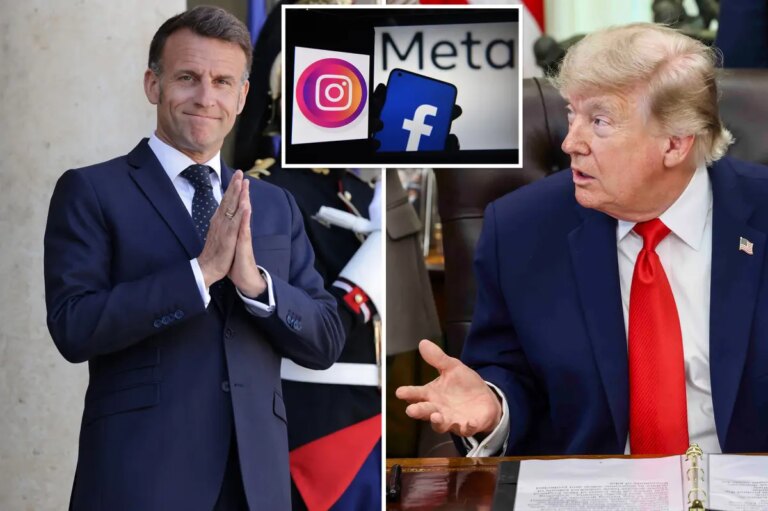
President Trump warned that France is at risk of a fresh trade war with America — declaring in an exclusive interview with The Post that unless Paris axes its digital tax on American tech giants, the US will “have no choice” but to slap 100% tariffs on French wines.

Trump said he gave the blunt warning directly to outgoing French President Emmanuel Macron, demanding he ditch the 3% tech levy or face devastating duties in the American market, which accounts for a fifth of the French wine industry’s global sales — worth more than $2 billion annually.

“I asked him not to charge American companies, and if they do, I have no choice but to charge a 100% tariff on all champagnes and all wines coming out of France,” Trump told The Post. “All [Macron] has to do is get rid of the sales tax, and he wouldn’t have that kind of pressure.”

tPresident Trump slammed the French tech tax in an interview with The Post, saying it must be scrapped or the country’s winemakers will face a 100% tariff if they want to sell their products in the lucrative US market. AFP via Getty Images

The ultimatum sets the stage for a bitter showdown at Monday’s G7 summit in Évian-les-Bains, the annual meeting of seven of the world’s wealthiest democracies to set the rules on global trade, security, and economic policy that helps move markets.

His comments also shatter claims made last week by Macron’s office, the Élysée Palace, that the two nations had quietly settled their long-running spat over taxing Silicon Valley.

A senior source close to the French president told reporters last week that the issue was “no longer up for debate” amongst G7 countries — an account a US official immediately dismissed as “not accurate.”

France’s digital services tax, commonly known as the GAFAM tax, has been on the books since 2019. It imposes a sweeping 3% levy on the local revenue generated by the likes of Google parent Alphabet, Amazon, Meta, and Apple.

Because the policy targets gross revenue rather than profits, it hits US tech titans the hardest, raking in roughly $700 million last year alone according to the French finance ministry.

The French digital sales taxes raked in as much as $700M last year, according to the country’s finance ministry. diy13 – stock.adobe.com

The pressure intensified in October when France’s deeply divided National Assembly, the country’s answer to the House of Representatives, voted 296-58 to double the tax to 6% and narrow the threshold to exclusively target the largest global players. The move was eventually vetoed by ministers.

Lawmakers had even originally floated a punitive 15% hike before scaling it back under industry pressure. Then-Economy Minister Roland Lescure warned at the time that a “disproportionate” tax would invite “disproportionate” American reprisals.

That reprisal is now taking shape. Trump’s latest threat revives the punishing 100% tariff level first proposed by the US Trade Representative during a 2019 investigation into the French tax.

While Macron has previously been dubbed a “Trump whisperer” capable of cutting deals with the billionaire real estate mogul — including an eleventh-hour truce at the 2019 G7 in Biarritz — the Trump administration is now taking a harder line globally.

Aside from this year’s hosts France and the United States, the other G7 countries Canada, Germany, Italy, Japan, and the UK.

French President Emmanuel Macron has been described at times as ‘a Trump whisperer’ who is able to cut deals with the billionnare real estate mogul. POOL/AFP via Getty Images

When approached for comment, White House spokesman Kush Desai pointed The Post to a presidential memo from February 2025 stating that American businesses would no longer “prop up failed foreign economies through extortive fines and taxes.”

The memo tasked US Trade Representative Jamieson Greer and the Treasury Department with deciding whether to reopen a formal probe into the French levy. Neither department responded to requests for comment.

France’s aggressive tax hike isolates it from several key allies who have bowed to Washington’s pressure. Canada shelved its own digital tax in 2025 after the US broke off trade talks, and Italy is reportedly weighing a repeal of its levy.

Britain, however, has retained its digital services tax under its current trade arrangements with America.

The G7 (Group of Seven) summit runs until Wednesday in the French lakeside town of Evian.

The club of the world’s seven largest so-called “advanced” economies, which dominate global trade and the international financial system, includes Canada, France, Germany, Italy, Japan, the UK and the United States.

Russia joined in 1998, creating the G8, but was excluded after it seized Crimea. China has never been a member, despite its large economy and having the world’s second-largest population


Source link

A history of Iran’s nuclear program and tensions with the US as an interim deal is reached


The United States and Iran have reached an interim deal aimed at ending the war and reopening the Strait of Hormuz.

There are plans for a signing of the deal on Friday in Switzerland. However, previous announcements fell through, and what the deal contained remained in dispute Monday.

Here’s a timeline of the tensions over Iran’s atomic program:

1967 — Iran takes possession of the Tehran Research Reactor supplied by America under the “Atoms for Peace” program.

1979 — U.S. ally Shah Mohammad Reza Pahlavi, fatally ill, flees Iran as popular protests against him surge. Ayatollah Ruhollah Khomeini returns to Tehran and the Islamic Revolution sweeps him to power. Students seize the U.S. Embassy in Tehran, beginning the 444-day hostage crisis. Iran’s nuclear program goes fallow under international pressure.

August 2002 — Western intelligence services and an Iranian opposition group reveal Iran’s secret Natanz nuclear enrichment facility.

June 2003 — Britain, France and Germany engage Iran in nuclear negotiations.

October 2003 — Iran suspends uranium enrichment under international pressure.

February 2006 — Iran announces it will restart uranium enrichment following the election of hard-line President Mahmoud Ahmadinejad. Britain, France and Germany walk out of stalled negotiations.

June 2009 — Iran’s disputed presidential election sees Ahmadinejad reelected despite fraud allegations, sparking protests known as the Green Movement and a violent government crackdown.

October 2009 — Under U.S. President Barack Obama, the U.S. and Iran open a secret back-channel for messages in the sultanate of Oman.

July 2012 — U.S. and Iranian officials hold secret face-to-face talks in Oman.

July 2015 — World powers and Iran announce a long-term, comprehensive nuclear agreement that limits Tehran’s enrichment of uranium in exchange for the lifting of economic sanctions.

May 8, 2018 — U.S. President Donald Trump unilaterally withdraws the U.S. from the nuclear agreement, calling it the “worst deal ever.” He says he’ll get better terms in new negotiations to stop Iran’s missile development and support for regional militias. Those talks don’t happen in his first term.

May 8, 2019 — Iran announces it will begin backing away from the accord. A series of regional attacks on land and at sea blamed on Tehran follow.

Jan. 3, 2020 — A U.S. drone strike in Baghdad kills Gen. Qassem Soleimani, the architect of Tehran’s proxy wars in the Middle East.

Jan. 8, 2020 — In retaliation for Soleimani’s killing, Iran launches a barrage of missiles at military bases in Iraq that are home to thousands of American and Iraqi troops. More than 100 U.S. service members suffer traumatic brain injuries, according to the Pentagon. As Iran braces for a counterattack, the Revolutionary Guard shoots down a Ukrainian passenger plane shortly after takeoff from Tehran’s international airport, reportedly mistaking it for a U.S. cruise missile. All 176 people on board are killed.

July 2, 2020 — A mysterious explosion tears apart a centrifuge production plant at Iran’s Natanz nuclear enrichment facility. Iran blames the attack on Israel.

April 6, 2021 — Iran and the U.S. under President Joe Biden begin indirect negotiations in Vienna over how to restore the nuclear deal. Those talks, and others between Tehran and European nations, fail to reach any agreement.

April 11, 2021 — A second attack within a year targets Iran’s Natanz nuclear site, again likely carried out by Israel.

April 16, 2021 — Iran begins enriching uranium up to 60% — its highest purity ever and a technical step from weapons-grade levels of 90%.

Feb. 24, 2022 — Russia launches its full-scale invasion of Ukraine. Moscow ultimately will come to rely on Iranian bomb-carrying drones in the conflict, as well as missiles.

July 17, 2022 — An adviser to Iran’s supreme leader, Kamal Kharrazi, says Iran is technically capable of making a nuclear bomb, but has not decided whether to build one.

Oct. 7, 2023 — Hamas militants from the Gaza Strip storm into Israel, killing around 1,200 people and taking 251 others hostage, beginning the most intense war ever between Israel and Hamas. Iran, which has armed Hamas, offers support to the militants. Regional tensions spike.

Nov. 19, 2023 — Yemen’s Houthi rebels, long supported by Iran, seize the ship Galaxy Leader, beginning a monthslong campaign of attacks on shipping through the Red Sea corridor that the U.S. Navy describes as the most intense combat it has seen since World War II. The attacks mirror tactics earlier used by Iran.

April 14, 2024 — Iran launches an unprecedented direct attack on Israel, firing over 300 missiles and attack drones. Israel, working with a U.S.-led international coalition, intercepts much of the incoming fire.

April 19, 2024 — A suspected Israeli strike hits an air defense system by an airport in Isfahan, Iran.

July 31, 2024 — Ismail Haniyeh, a Hamas leader, is assassinated during a visit to Tehran after the inauguration of reformist President Masoud Pezeshkian. Israel later takes responsibility for the assassination.

Sept. 27, 2024 — An Israeli airstrike kills Hezbollah leader Hassan Nasrallah in Lebanon.

Oct. 1, 2024 — Iran launches its second direct attack on Israel, though a U.S.-led coalition and Israel shoot down most of the missiles.

Oct. 16, 2024 — Israel kills Hamas leader Yahya Sinwar in the Gaza Strip.

Oct. 26, 2024 — Israel openly attacks Iran for the first time, striking air defense systems and sites associated with its missile program.

Jan. 20, 2025 — Trump is inaugurated for his second term as president.

Feb. 7, 2025 — Iran’s Supreme Leader Ayatollah Ali Khamenei says proposed talks with the U.S. are “not intelligent, wise or honorable.”

March 7, 2025 — Trump says he sent a letter to Khamenei seeking a new nuclear deal with Tehran.

March 15, 2025 — Trump launches intense airstrikes targeting Houthi rebels in Yemen, the last members of Iran’s self-described “Axis of Resistance” capable of daily attacks.

April 7, 2025 — Trump announces the U.S. and Iran will hold direct talks in Oman. Iran says they’ll be indirect talks.

April 12, 2025 — The first round of talks between Iran and the U.S. take place in Oman, ending with a promise to hold more talks after U.S. Mideast envoy Steve Witkoff and Iranian Foreign Minister Abbas Araghchi “briefly spoke” together.

April 19, 2025 — The second round of talks between the U.S. and Iran are held in Rome.

April 26, 2025 — Iran and the U.S. meet in Oman a third time, but the negotiations include talks at the expert level for the first time.

May 11, 2025 — Iran and the U.S. meet in Oman for a fourth round of negotiations ahead of Trump’s trip to the Mideast.

May 23, 2025 — Iran and the U.S. meet in Rome for a fifth round of talks, with Oman saying the negotiations made “some but not conclusive progress.”

June 9, 2025 — Iran signals it won’t accept a U.S. proposal over the nuclear program.

June 12, 2025 — The Board of Governors at the International Atomic Energy Agency finds Iran in noncompliance with its nuclear obligations. Iran responds by announcing it has built and will activate a third nuclear enrichment facility.

June 13, 2025 — Israel launches its war against Iran. Over 12 days, it hits nuclear and military sites, as well as other government installations.

June 22, 2025 — The U.S. intervenes in the war, attacking three Iranian nuclear sites.

June 23, 2025 — Iran responds to the U.S. attack by targeting a military base in Qatar used by American troops, causing limited damage.

June 24, 2025 — Trump announces a ceasefire in the war.

July 25, 2025 — Iranian and European diplomats hold talks in Istanbul over Iran’s nuclear program.

Aug. 8, 2025 — France, Germany and the United Kingdom warn Iran in a letter that it will reimplement U.N. sanctions if there is no “satisfactory solution” to the nuclear standoff by Aug. 31.

Aug. 28, 2025 — France, Germany and the United Kingdom say they’ve started the process to “snapback” U.N. sanctions on Iran.

Sept. 9, 2025 — Iran and the International Atomic Energy Agency reach a deal over potentially starting inspections, but questions remain over its implementation.

Sept. 19, 2025 — U.N. Security Council declines to stop “snapback” sanctions on Iran.

Sept. 26, 2025 — U.N. Security Council rejects China and Russia’s last-minute effort to stop “snapback.”

Sept. 28, 2025 — U.N. reimposes “snapback” sanctions on Iran barring any last-minute diplomacy.

Dec. 28, 2025: Protests break out in two major markets in downtown Tehran after the Iranian rial plunges to a record low — 1.42 million rials to one U.S. dollar — compounding inflationary pressure and pushing up the prices of food and other daily necessities.

Jan. 3, 2026: Khamenei says “rioters must be put in their place,” in what is seen as a green light for security forces to begin more aggressively putting down the demonstrations.

Jan. 8, 2026: Following a call from Iran’s exiled crown prince, a mass of people shout from their windows and take to the streets in nationwide protests. The government responds by blocking the internet and international telephone calls to cut off the country from outside influence. An ensuing security force crackdown kills thousands and sees tens of thousands detained.

Jan. 13, 2026: Trump says he has called off any meetings with the Iranians and promises that unspecified “help is on its way.”

Jan. 26, 2026: The aircraft carrier USS Abraham Lincoln and three accompanying warships arrive in the Middle East amid Trump’s threats to attack.

Feb. 3, 2026: A U.S. Navy fighter jet shoots down an Iranian drone approaching the Lincoln in the Arabian Sea. Iranian fast-attack boats attempt to stop a U.S.-flagged ship in the Strait of Hormuz.

Feb. 6, 2026: Iran and the U.S. hold indirect nuclear talks in Oman, with the head of the U.S. military’s Central Command also coming.

Feb. 17, 2026: Iran and the U.S. hold talks in Geneva while Tehran says it has temporarily closed the Strait of Hormuz, the narrow mouth of the Persian Gulf through which a fifth of all oil traded passes.

Feb. 26, 2026: Iran and the U.S. hold another round of talks in Geneva as America assembles the largest fleet of warplanes and aircraft in the Mideast in decades.

Feb. 28, 2026: Israel and the United States launch a war on Iran, killing Khamenei in the conflict’s first moments.

March 9, 2026: Iran names Ayatollah Mojtaba Khamenei, the late supreme leader’s son, as country’s new paramount ruler.

April 7, 2026: A fragile ceasefire in the Iran war is announced, with talks to continue. Israel is not included in negotiations.

April 8, 2026: Israel bombards Lebanon’s capital, Beirut, killing over 300 people in a 10-minute attack.

April 11, 2026: U.S. Vice President JD Vance leads an American delegation to Islamabad, meeting with Iranian team led by parliament speaker Mohammad Bagher Qalibaf, the highest-level direct talks between the two nations since the 1979 Islamic Revolution. The talks end after 21 hours without a deal.

May 31, 2026: Israel’s ground invasion of Lebanon makes its deepest incursion in over a quarter century.

June 15, 2026: The United States and Iran reach an initial agreement to open the Strait of Hormuz and further extend a shaky ceasefire in the Iran war.


Source link

World Cup 2026: Ex-England boss Gareth Southgate not a TV pundit as he thinks it is ‘best to keep out of the way’


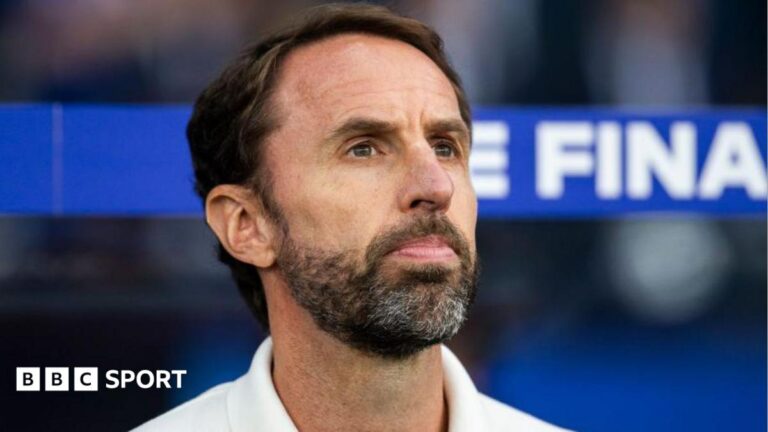
Former England manager Sir Gareth Southgate says he turned down work as a pundit at the World Cup because he did not think it would be “helpful” to the side’s chances.

Southgate resigned from his position after England were defeated by Spain in the Euro 2024 final.

The 55-year-old led England for 102 games over eight years, guiding them to the finals of two European Championships and the 2018 World Cup semi-final.

“It’s obviously a very different tournament for me this one, I’ve been at the last seven World Cups as a player, as a broadcaster, a scout and then as the manager,” Southgate said in a post on Instagram, external.

“So this time I took a conscious decision not to do the TV. I didn’t think it would be helpful for me to be talking about the team and I don’t want anything to be misconstrued or thrown at them at press conferences, so best for me to keep out of the way.”

England’s World Cup campaign begins on Wednesday (21:00 BST) when they take on Croatia in Arlington, Texas.

They then have matches against Ghana on Tuesday, 23 June (21:00 BST) and Panama on Saturday, 27 June (22:00 BST).

Sir Alf Ramsey, 1966 World Cup winner, is the only other manager to have guided England’s men’s team to a major tournament final.


Source link

US-Iran deal eases uncertainty over the war – but there is much still to play out


Pakistan says the deal includes Lebanon, but recent ceasefires there have failed to take hold.


Source link

Delhi heatwave: The temperature in Indian capital showed 43.5C. Why did it feel hotter?


For several weeks now, the Indian capital, Delhi, has been battling a severe heatwave, with temperatures routinely rising above 40C. The real feel, the weather apps helpfully tell us, is always a few degrees higher. But how hot do you feel when you hit the streets?


Source link

Trump heralds Iran deal but questions – and risks – remain


The announcement of an Iran deal was a welcome birthday gift for the president – but its success or failure may hinge on the details.


Source link

OnlyFans ‘agents’ exploit creators while taking half their earnings, BBC finds


OnlyFans has “strict onboarding processes, payment controls and ongoing account moderation”, the company spokesperson says. If concerns about an account are raised, OnlyFans will immediately restrict the account, investigate, and take action to ensure the creator is in control of their account, they added.


Source link