

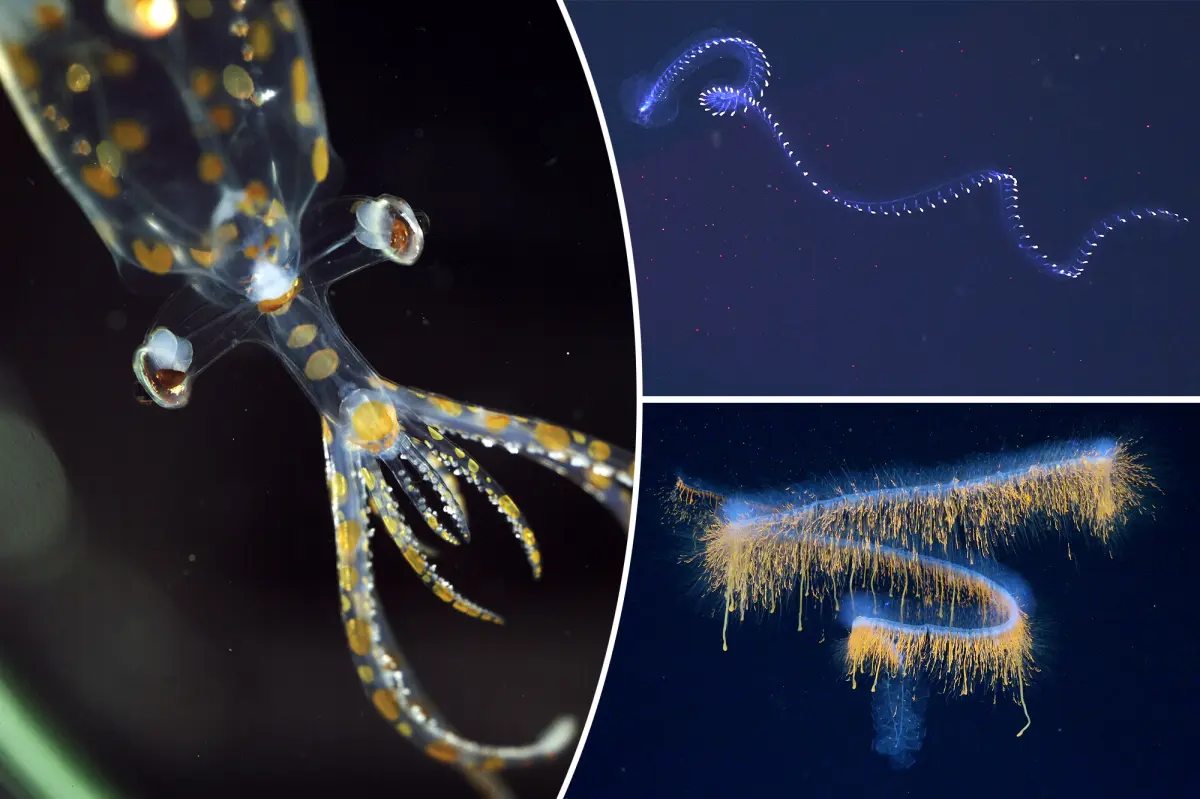

The ocean’s hiding some deep secrets.
An oceanic expedition off Brazil has discovered 31 otherworldly new critters, including ghostly invertebrates, animals living inside their own bodily fluids and other creatures seemingly better suited to deep space than the deep blue sea.
“The largest habitat on Earth, the midwater, is filled with incredible animals we are only just starting to understand,” said the expedition leader, Dr. Karen Osborn of the Smithsonian National Museum of Natural History in a statement.
The international team of researchers, who were stationed aboard the Schmidt Ocean Institute’s research vessel Falkor (too), happened upon the marine menagerie while surveying the tropical South Atlantic Ocean.
They were specifically investigating the midwater — the segment of ocean situated between the sunlit layer and the ocean floor, which is Earth’s “largest and least explored habitable ecosystem,” per the survey.
Using advanced imaging systems and genome sequences, they were able to confirm and describe the aforementioned dozens of denizens of this aquatic lost world.
Finds included ghostly gossamer worms, comb jellies that propel themselves along with glittering appendages, and single-celled organisms that were paradoxically big enough to see with the naked eye, Science Alert reported.
The team also discovered siphonophores, colonial organisms related to jellyfish and corals, and tadpole-like critters called larvaceans that erect houses from mucus and are more closely related to humans than invertebrates.
Also present in this remote environment, which is one of Earth’s least understood ecosystems to its volume and inaccessibility, were some familiar faces: a translucent glass squid and a pelagic octopus consuming a bright red sea jelly.
“I continue to be fascinated by the fantastic variety of solutions they have evolved to survive in this formidable environment,” Osborn gushed.
These miraculous finds were a credit to state of the art tech that allowed scientists to study the inhabitants in a matter of days rather than years.
Part of the challenge was studying these critters delicate, gelatinous bodies without damaging them.
To circumvent this, the researchers outfitted the remotely operated vehicle (ROV) SuBastian with the DeepPIV (particle image velocimetry) instrument and the EyeRIS (remote imaging system).
These employed laser scans to generate 3D images of the critter, precluding the team from having to wrest the animals from their homes.
Meanwhile, a shadowgraph camera, developed by the Japan Agency for Marine-Earth Science and Technology, allowed the researchers to snap the critter’s silhouettes, revealing some features that didn’t show up in the laser scans.
The researchers deployed Stanford University’s Squid microscope to observe the interaction between living cellular structures and the glass skeleton of a single-celled microbe called a protist.
This marked the first time this device has been used in this manner.
“It’s an incredible honor to not only view and experience this rare and inspiring midwater life, but also to be able to work towards describing and sharing that life broadly through the use of novel, non-invasive technologies,” exclaimed Dr. Kakani Katija, principal engineer of the Bioinspiration Lab at the Monterey Bay Aquarium Research Institute.