


It’s a real head-scratcher.
Archaeologists are struggling to put together the pieces after 77 headless skeletons were discovered in a Stone Age gravesite in Slovakia, per a grisly study in the journal The Proceedings of The Prehistoric Society.
“We must assume that these practices were embedded in completely different contexts of meaning than those of modern societies,” lead author Martin Furholt, a professor of archaeology at Kiel University, said in a statement, Popular Mechanics reported.
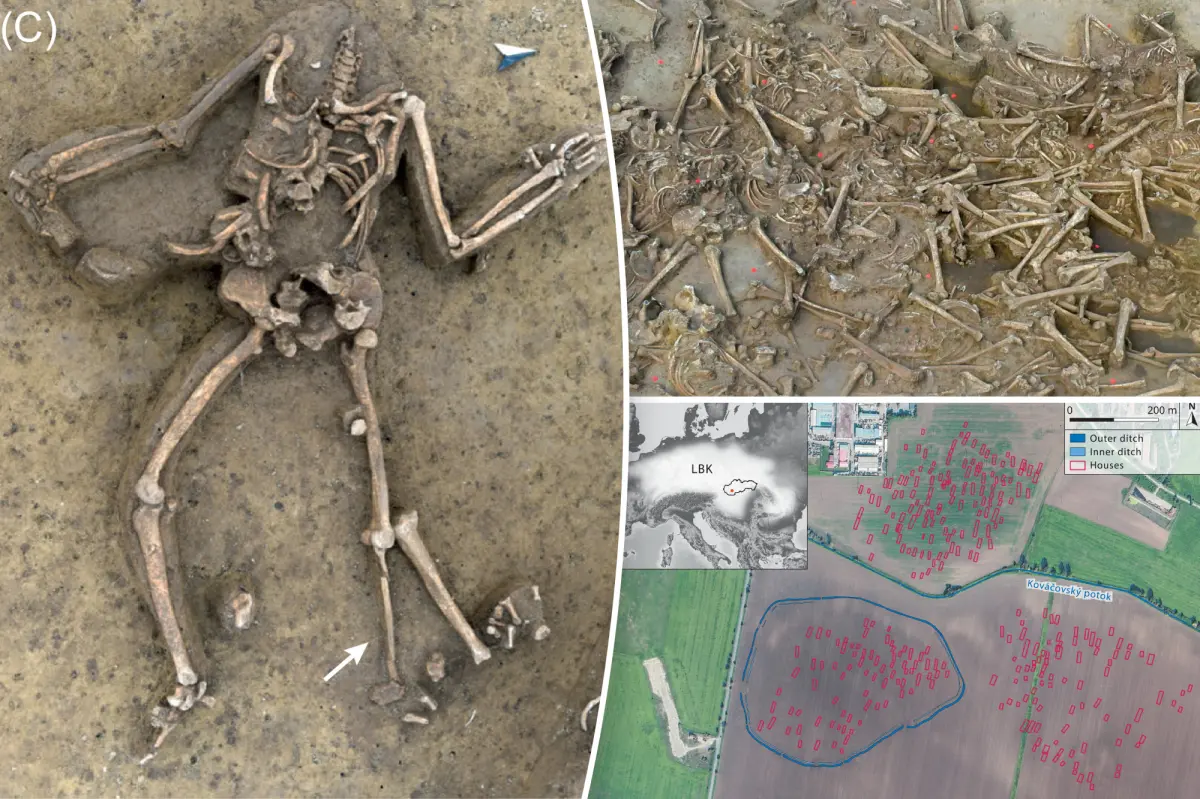
The macabre caper dates back to 2022, when archaeologists excavated a 7,000-year-old settlement near Vrable that belonged to the Linear Pottery Culture (LBK), one of Europe’s earliest farming communities.
This particular Neolithic site was bigger and more complex than its counterparts, boasting 350 house layouts, approximately 80 of which were inhabited during the society’s zenith.
However, it also harbored a dark secret. While investigating the site, the scientists stumbled across a ghastly scene — 78 skeletons piled atop each other.
All of the bodies were missing a head, save for the skeleton of a child that had been curiously placed among the adults.
Archaeologists initially assumed that the grave’s inhabitants, who were buried soon after they died, must’ve been the victims of an act of violence such as war or human sacrifice.
“It may seem obvious to assume a massacre with human sacrifices, perhaps even in connection with magical or religious ideas,” posited Maria Wunderlich, Kiel University project leader, in 2023.
However, through examining the remains, Furholt and his team concluded that the decapitated skeletons were not the result of a massacre but rather some mysterious ritual for which we lack context.
For one, the skeletal markings suggested that the skulls were not haphazardly hewn using blunt instruments, but rather carefully extracted with sharp tools, researchers noted.
“The features clearly exhibit an intentional manipulation of the bodies,” noted Katharina Fuchs, a biological anthropologist at Kiel University.
Furthermore, the fossil forensicists didn’t find any jaw bones at the repository, indicating that the culprits meticulously removed the entire noggin in order to keep it intact.
The discovery of vertebrae near a ditch wall further suggested that these were extricated with care post-decapitation.
These pieces of evidence spawned several theories ranging from head-hunting practices to, perhaps most notably, a tradition intended to honor ancestors or deities.
As headless interments were ubiquitous throughout Neolithic Europe, researchers concluded that these post-mortem decapitations were an established custom.
Furholt said that interpreting these practices remains challenging as they’re rooted in systems of belief that differ drastically from those of modern societies.
Researchers hope that further analyses of the skeletons and the artifacts interred with them will shed light on the relationships between the individuals and other aspects of this post-mortem ritual.