

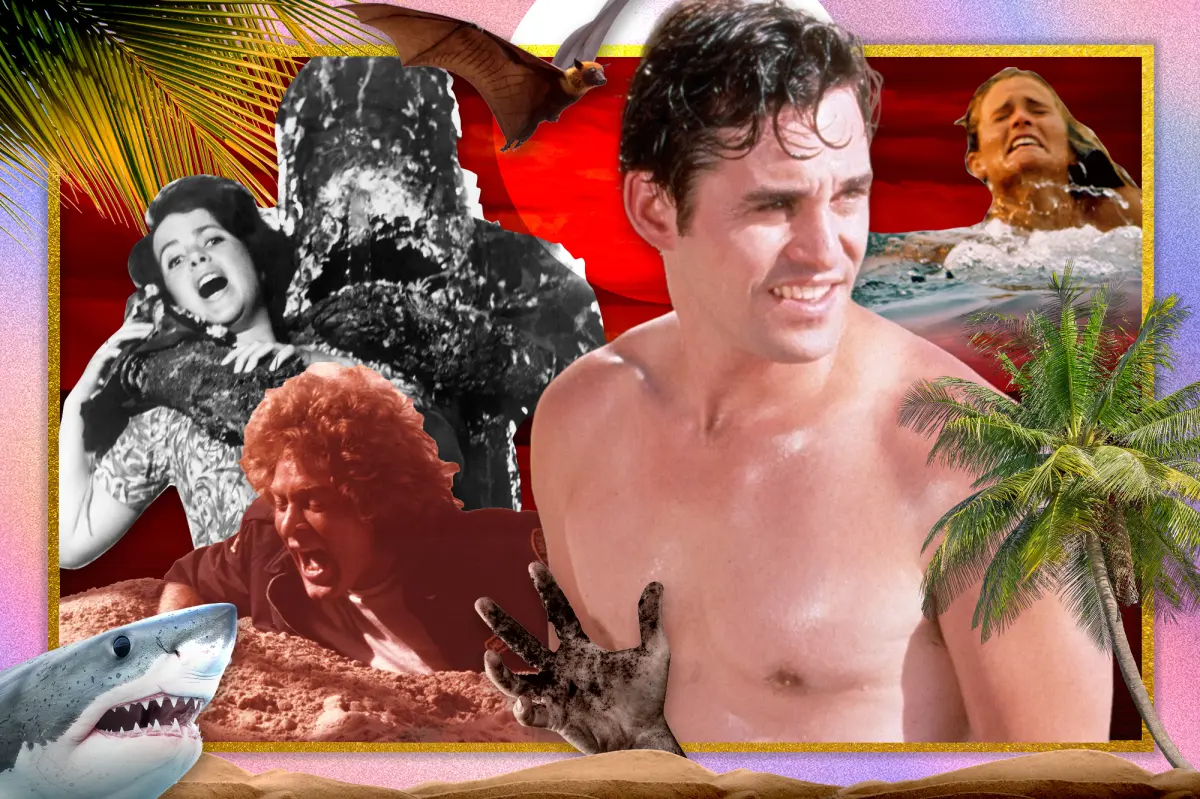
Summer is finally here, and nothing evokes the spirit of the season like sand, sun, sweat, and surf. Here, in DECIDER’s A Brief History of Beach Movies, critic Glenn Kenny charts the evolution of one of the most iconic and idiosyncratic genres in cinema… We’ve witnesses innocence found and lost, and even seen how revisionists reinvented the genre. Today? Horror stalks the beach…
The ultimate beach horror movie is of course Steven Spielberg’s 1975 Jaws, which requires no recommendation from this reporter. As it happens, the earliest horror beach movie was released a mere month after the March 1959 premiere of Gidget. The raison d’etre for April’s The Monster of Piedras Blancas came from its producer, a fellow named Jack Kavan, who during his tenure at Universal Picture designed the Mole People and the titular Creature From the Black Lagoon. (Which is not a beach movie, because it takes place in, like, a lagoon.)
Determined to strike out on his own, Kavan came up with a truly gnarly looking beach predator, one with frog-inspired facial features, a long stride, and a penchant for decapitating his victim. Shot not in the actual Piedras Blancas but a town some ways south of it, the picture is initially a real “local color” kind of movie, especially in that it quite credibly depicts the utter boredom of living in a sleepy beach village. Then the severed heads start showing up in the vicinity. They’re pretty convincing looking, especially for the time, and there’s one really gnarly shot of a crab trying to feast on one. The monster is notably a heavy breather. Perhaps thirsty, given that his main quarry, Jeanne Carmen’s Lucille, is quite a dish. (Carmen was a famed trick-shot golf artiste before being lured to Hollywood.) The movie also features Les Tremayne, looking even more harried than he does at the auctioneer in Hitchcock’s North by Northwest.
1964’s The Horror of Party Beach is, if you look at it a certain way, one of the first cautionary eco-thrillers. The monsters come into being when radioactive waste dumped into the ocean re-animates human skeletons at the waters’ bottom. Why there are so many skeletons down there is a question the movie deigns to ignore, but it can keep one awake at night for sure. Anyway, the monsters have google eyes and seem to have a bunch of uncooked hot dogs poking out of their mouths. Our eventual hero Hank is introduced being humiliated by his slut-dancing alkie girlfriend, who will soon be nailed not by the rough-looking bikers she teases but one of the monsters. Once enough murders have happened, a group of actors looking like they’re auditioning for Blast of Silence show up as detectives. The songs are provided by a real group called the Del-Aires, who are rather versatile in their mediocrity, going from the bouncy “Zombie Stomp” (‘it’s the living end”) to the tender “Not Just A Summer Love.” Stamford Connecticut really had it going on back in the day, one guesses. Once the key to dispensing with the creatures is discovered (no spoilers but it’s hilarious) there’s a great montage of Hank driving his MG through Manhattan and passing the Guggenheim, The Met, Washington Square, Times Square (where one movie house is showing 8 ½), and so on, with no real continuity.
The menace is subterranean in 1980’s Blood Beach, a primo bit of “what were they thinking” filmmaking starring John Saxon, who played the love interest to future Gidget Sandra Dee in Vincente Minnnelli’s 1958 The Reluctant Debutante. “Grown men don’t believe in monsters,” his beleaguered cop says to fellow beleaguered cop Burt Young near the end of this mess, in which beachgoers are literally sucked into the sand by an unknown thing. In any event, it’s certainly hard to believe in this movie’s monster, which looks like one of the worms in Dune (any version), only with the head of Audrey, the giant Venus Flytrap in both Little Shop of Horrors movies.
John Carpenter’s follow-up to the 1978 stone classic Halloween, 1980’s The Fog, flummoxed a lot of horror mavens who expected more of the same. The human (but perhaps superhuman) psycho killer of Halloween is here supplanted by an ancient curse and the title meteorological phenomenon, which brings death wherever it rolls in. Check out the scene with the trawler fishermen saying, “No fog bank out there…no fog bank out there…hey, there’s a fog bank out there.” And then…yikes. Halloween’s Jamie Lee Curtis goes against the grain of her virginal character in that film by hopping in to bed with Carpenter regular Tom Atkins after he picks her up hitchhiking. These characters are cogs in a wide-ranging ensemble whose individual narratives keep the horror of undead sailors oozing into the beach town of Antonio Bay building almost symphonically. Carpenter’s directorial confidence is magnificent to behold, and the movie is commendably slim and trim, a hair under 90 minutes.
Coming full circle, Charles Busch’s 2000 Psycho Beach Party, adapted from his theatrical parody, is exactly what the title offers, and while it never reaches the sublime lows of a John Waters movie, it’s got camp if you want it. Nicolas Cage’s title character in last year’s The Surfer, continuously humiliated on an Australia beach as we eventually learn of the horrible heartbreak that afflicts him, takes his punishment the way Nicolas Cage characters are accustomed to. It’s not a bad movie, but one wants a new-fangled kind of cinematic beach romp to wash out the bitter briny taste.
Veteran critic Glenn Kenny reviews new releases at RogerEbert.com, the New York Times, and, as befits someone of his advanced age, the AARP magazine. He blogs, very occasionally, at Some Came Running and tweets, mostly in jest, at @glenn__kenny. He is the author of the The World Is Yours: The Story of Scarface, published by Hanover Square Press, and now available for at a bookstore near you.