
In Map, Polish Nobel laureate Wisława Szymborska writes:
I like maps, because they lie.
Because they give no access to the vicious truth.
Because great-heartedly, good-naturedly
they spread before me a world
not of this world.

It is the kind of cartography that Maggie O’Farrell has always been fascinated by: not just the sort that traces landscapes, pencils in borders and marks out empires, but also the kind that maps what lies within — the particular topography of grief, of longing and loss, of small cruelties and a hundred indecisions.
It is what had led the British-Irish novelist to Hamnet, her moving pandemic novel on the life and death of William Shakespeare’s only son from bubonic plague at the age of 11, its devastating effect on his mother Agnes and how it led Shakespeare to one of his greatest works, Hamlet. Now, six years and another novel later, it has brought her to Land, a novel sparked by the discovery that O’Farrell’s great-great grandfather was an Irish cartographer, drafted in by the British Ordnance Survey to map Ireland in the early 1860s, soon after the country had been blighted by the Great Hunger.
“I’ve been thinking about writing about it for 10-15 years. But for a long time, I couldn’t see a way to fictionalise it. It was when I went to the archives in Dublin, there was so much information — field notes, draft maps, drawings and measurements — that it became real. Even then, I couldn’t tell which of it might have been my great-great grandfather’s work because the British did not let the Irish cartographers sign their work. I did find his signature on an administrative memorandum that was sent to labourers — the Irish people were called labourers — even though my great-great-grandfather was educated. Just finding that piece of paper with his signature on it and holding it in my hands was extraordinary. It was also proof that the family myth did have seeds in truth,” says O’Farrell, 54, over a Zoom interview.
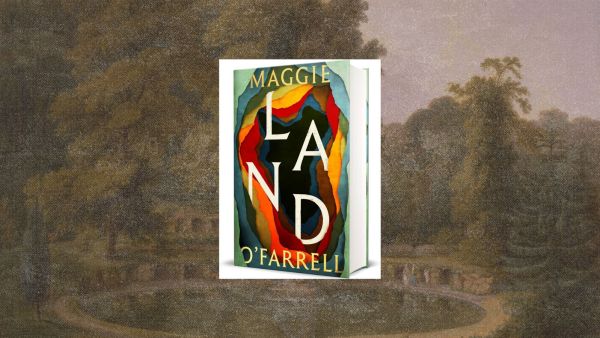 The latest novel Land is sparked by the discovery that Maggie O’Farrell’s great-great grandfather was an Irish cartographer. (Express Photo)
At its heart, Land is a novel about who gets to write history, whose labour is recorded, whose grief makes it on to the page. The act of mapmaking becomes a subversive form of resistance against erasure. From abandoned towns to mass graves, O’Farrell’s protagonist Tomás puts in the maps the human cost of the famine that devastated the land.
He is assisted by his 10-year-old son Liam, the writer’s great grandfather, who later becomes, for a brief period, a Jesuit priest travelling to Kerala. As it happened, O’Farrell had also been there herself about 25 years ago. “It’s vivid in my mind, Cochin — the colours, the spices and the fishing nets,” she says. But there was more to it. The same colonial impulse that sent O’Farrell’s ancestor into the Irish countryside to measure and record had earlier also driven the Great Trigonometrical Survey of India, the 19th-century project to grid and possess the Subcontinent. “During my research, I came across an awful lot about the mapping projects in India. Of course, there were other obvious parallels, both countries are hugely diverse, both were occupied by the same Empire, both suffered from famines.” The novel, she says, does not labour the point. But it recognises colonialism for what it is — a machinery of dispossession wearing different faces in different lands.
When accents don’t match passports
This attunement to displacement is not merely political for O’Farrell, it is also deeply personal. Born in Northern Ireland, she moved with her family to Wales at the age of two, then to Scotland at 13, and has long called Edinburgh home. “If you don’t grow up where you were born, or as in my case, your accent doesn’t match your passport, you do always have a sense of displacement, but there’s also a kind of ghost-self or a doppelganger that walks alongside you. You always think who would I have been if we’d stayed? What would my life have been like if I’d grown up there? I would sound completely different, and I think I’d be a different person,” she says. It is the lives not lived, the selves not become, the maps of what might have been that forms the heart and soul of her novels.
Hamnet, her eighth novel, made O’Farrell one of the most celebrated novelists of her generation. It won the Women’s Prize for Fiction in 2020, and Chloé Zhao’s cinematic adaptation — for which O’Farrell co-wrote the screenplay — became an awards-season phenomenon this year: actor Jessie Buckley won Best Actress at the Oscars, BAFTAs and Golden Globes, and the film took Best Picture at the latter two. The same production company has now optioned Land for the screen.
The question of what comes after such a moment is one O’Farrell has thought about carefully. “I made a conscious choice for it not to be daunting. What happened with Hamnet was so extraordinary, it’ll probably never happen again. If you look at it in terms of pressure, you’re coming at it the wrong way. You have to see it as a joyful, extraordinary thing, a bit like winning the lottery. You can’t really think you are going to carry on in that same trajectory. You have to look at the joy of it — and then go on and write new books.”