

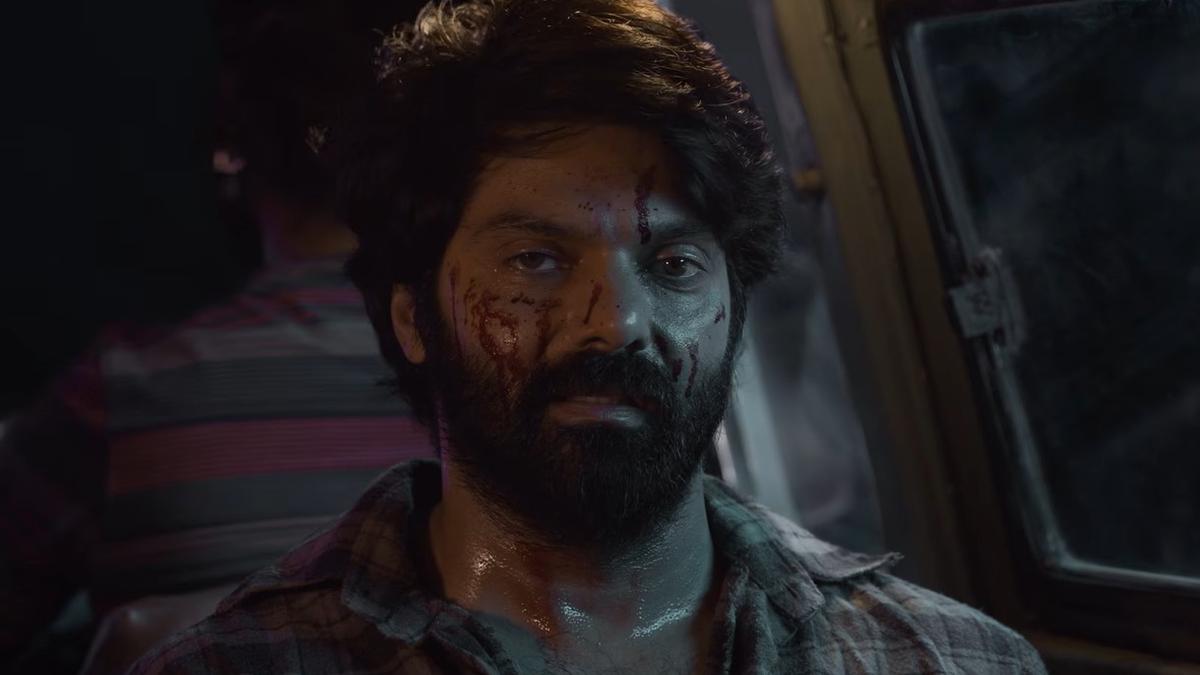

A still from Ananthan Kaadu.
One of the highly charged sequences in Ananthan Kaadu, directed by Jiyen Krishnakumar and written by Murali Gopy, happens inside a college campus in Thiruvananthapuram in the early 1990s. This “mass” scene featuring the screenwriter himself in a highly imaginary scenario, hardly has any connection with the main plot, almost as if it accidentally got mixed into this film from the edits of some other film.
Its only intention appears to be to inject some regressive political points into the narrative. This particular sequence might not be surprising for those who have watched Tiyaan (2017), the previous team-up of Jiyen Krishnakumar and Murali Gopy, which had its share of regressive politics packaged in the garb of a progressive film.
The rest of Ananthan Kaadu is a typical, old-fashioned socio-political potboiler with some cosmetic touches to make it seem updated. The film revolves around the much-overused theme of political bosses using the underprivileged to carry out violent acts while themselves maintaining a squeaky clean public image. Also part of the mix are some violent police officers who do the bidding of their political masters as well as commit cruel acts just for fun, such as a high-ranking officer who takes pleasure in inflicting burn wounds on the woman he sleeps with.
Ananthan Kaadu (Malayalam)
Director: Jiyen Krishnakumar
Cast: Arya, Murali Gopy, Santhi Balachandran, Nikhila Vimal, Sunil, Indrans, Dev Mohan, Appani Sarath
Plot: A gang of underprivileged men, who have put behind their violent past, are forced to commit one last violent act for a major political leader.
Duration: 157 minutes
For the sake of scale and grandness, the script has a sprinkling of Tamil nationalism and the atrocities faced by those owing allegiance to the Liberation Tigers of Tamil Eelam in Sri Lanka. This is where actor Arya comes into the picture, with a few choreographed action sequences and a handful of dialogues. One of the few compelling characterisations is of the henchman played by Indrans. The actor clearly finds joy in giving that character a twist of his own, radiating the intimidating calmness of someone who has seen enough blood over the years. He manages to convey this without taking part in much of the violence.
It is Indrans’s presence and expressions which lend some emotion to the final sequences in this rather flatly narrated film. The final portions of heightened drama and emotions give us an inkling of what the makers were probably looking to achieve, but failed to reach for much of the runtime. The political drama is basic, with bumping off people being the most common political move, while the human drama had a lot of promise but remains underexplored. Nikhila Vimal gets a minor role where she can hardly make her presence felt, while Santhi Balachandran gets to essay a moderately impactful character.
The filmmaker and the screenwriter seem to have taken the period setting of the film in the early 1990s a little too seriously, for the writing and making have a visible hangover of that era.
Published – June 25, 2026 05:25 pm IST