
Dadar’s Ashok Vada Pav — better known as Kirti College Vada Pav for its proximity to the institute — was added to TasteAtlas, the global experiential travel guide, late last month. The listing placed vada pav at number 30 in TasteAtlas’ 100 best sandwiches in the world and recommended Ashok Vada Pav as the number one place to try it. Walk down Kashinath Dhuru Marg on any given morning, though, and the queue snaking outside this nearly 50 years old spot will tell you this is old news to everyone in the neighbourhood.
Vada pav itself is a surprisingly recent invention. The apocryphal story credits a man named Ashok Vaidya selling batata vada outside Dadar station in the late 1960s — the problem being that hot vadas didn’t travel well and cold ones weren’t worth eating. The solution, on what food historian Kurush Dalal once described as “an absolute epiphany,” was to stuff the vada into a pav grabbed from a neighbouring omelette vendor. Carbs inside carbs, illogical and irresistible. The pav itself had arrived earlier — carried to Goa by the Portuguese, then to Bombay by Goan migrants who set up bakeries here; Muslim and Irani bakers followed, and ladi pav became a working-class staple. Put the two together and you have a snack that, by Ashok Thakur’s own reckoning, was already a fixture on Dadar’s streets when he set up his handcart in 1978.

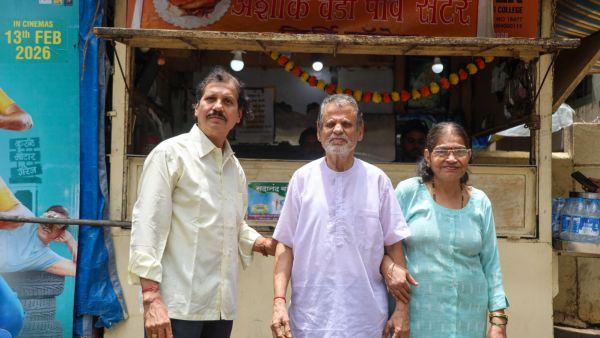 Ashok Thakur with his wife Aparna (R) and brother Manohar (centre). Express photo by Akash Patil
Thakur, 68, was the fourth of five brothers, two of them handicapped, and grew up in a household where one meal a day was sometimes all there was. “When you are a growing up boy, it is not enough,” he said with a sad smile. He started selling newspapers door to door, then came the handcart, and finally, in 1986, the stall — a small BMC-allotted premise given to his brothers Manohar and the late Mahendra under the handicapped quota. He now runs it alongside Manohar, 74, and his son Prasad, 34.
On a Thursday morning, Manohar, who is speech impaired, was quietly working the potato mix while a team deep-fried vadas and made chura at the back. Up front, two young men moved with practiced speed: splitting a ladi pav, stuffing it with vada and chura, drizzling green corianer chutney and a sweet brown one, then finishing with a dry chutney made from ghati masala. It sounds elaborate; it takes seconds. Even then, there’s always a queue.
The chura, now the stall’s signature, arrived by accident.
Thakur tells us the story: “There were a lot of college students in the neighbourhood and they couldn’t always afford a full vada pav. They began buying the leftover deep-fry crumbs alongside pav at a lower price, stuffing it inside and eating it. They liked it enough to suggest it be sold that way.”
Chura pav was born in 1980, and eventually folded into what is now their only item: vada pav with chura inside. What was once a byproduct is today made deliberately — kilograms of besan filtered through a spatula and deep-fried specifically for the purpose. It adds a crunch that’s become non-negotiable to regulars.
Story continues below this ad
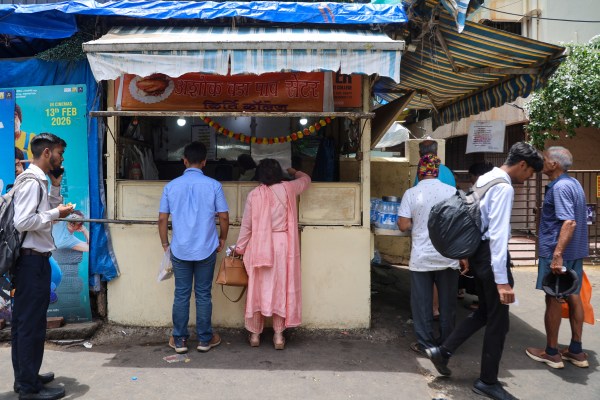 Vada pav recently ranked 30th in TasteAtlas’ list of the world’s best sandwiches, and Dadar’s Ashok Vada Pav is the stall they’ve flagged as the number one place to go. Express photo by Akash Patil
Thakur is particular about his recipe: no baking powder in the vada, only groundnut refined oil.
Behind the stall is another story. His wife Aparna Ashok Thakur hailed from a well-to-do family and was a banker by profession. She fell in love with Thakur and left home against her family’s wishes to marry him. “I came to a small 100 sq ft kholi; we would sleep under the bed,” she said, switching easily between English and Marathi, producing old photos and videos of her husband’s interviews over the years with quiet pride. In the early days, they sold around 50 vada pavs a day at 30 paise each. Today they’re priced at Rs 35. “She has been my strongest support,” said Thakur, and then laughed recounting the time when the business was booming and he was so occupied at the stall that he couldn’t spare her a single word. “It was in the initial years of our marriage. When I reached home that evening, she was crying.”
Thakur won’t say exactly how many vadas he sells. He will only confirm that he uses upwards of 100 kg of potatoes a day. The stall has had its celebrated visitors too: Jackie Shroff came by and later invited the family to a party where Shabana Azmi was also present.
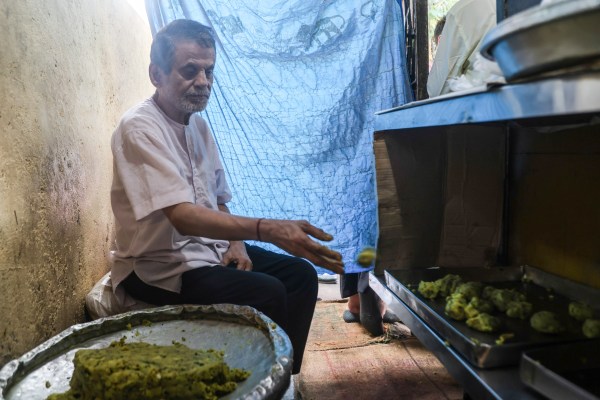 Manohar Thakur, who is speech impaired, quietly working the potato vada. Express photo by Akash Patil
But Thakur keeps the conversation grounded. “People see this and think I am minting money. But it takes a lot of patience — to come here, to run this for so many years, to address every unhappy customer.” The earnings have put his brothers through crises, covered hospital bills, educated his son and fed his large family. He thinks about opening a permanent shop someday. “Running a BMC stall isn’t easy. But the business is good, and this is what has kept the whole family going. Taking care of all my brothers, feeding my family, hospital bills, educating my son, everything is financially demanding. But yes, I am thinking about it and hopefully we will have a shop of ours someday.”
Story continues below this ad
On the TasteAtlas listing, he’s characteristically measured. “Acha lagta hai (It feels good). The win is not mine alone, it is a family business, done with honesty.” Then he added, with the particular satisfaction of a man who has made peace with where he stands: “There are a lot of rich people. I don’t have money like them. But I have earned a name, and perhaps more fame than many of those rich people.”
The queue, as always, keeps growing.