

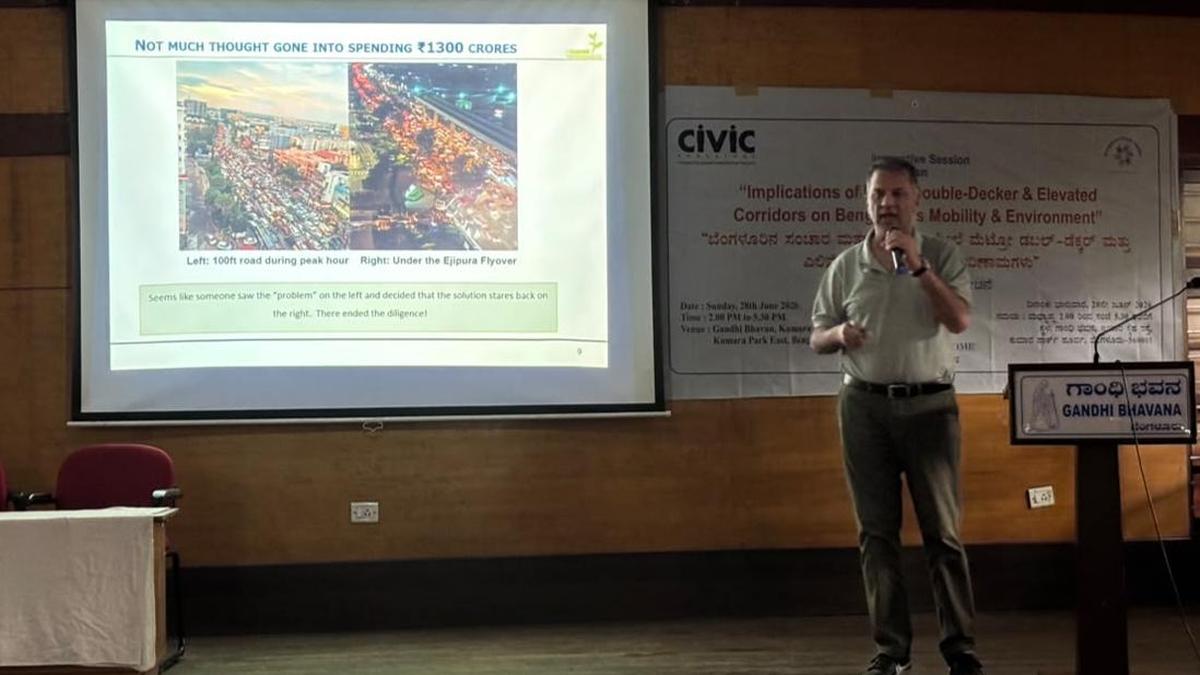

A presentation on ‘Implications of Metro Double-Decker & Elevated Corridors on Bengaluru’s Mobility & Environment’ being organised at Gandhi Bhavan in Bengaluru on Sunday.
| Photo Credit: ALLEN EGENUSE J.
A new technical assessment by researchers at the Indian Institute of Science (IISc) has raised serious concerns over Bengaluru’s proposed double-decker metro corridors, concluding that the projects could undermine the very purpose of expanding the city’s metro network by encouraging greater use of private vehicles while reducing public transport ridership.
The study, ‘Implications of Metro Double-Decker & Elevated Corridors on Bengaluru’s Mobility & Environment’ led by Ashish Verma of the IISc Sustainable Transportation Lab (IST Lab), found that integrating elevated roadways with metro phase-3 corridors is projected to reduce metro ridership, increase traffic-related emissions, fuel consumption and project costs, while weakening the city’s long-term sustainable mobility goals.
The findings are based on a presentation on the implications of metro double-decker and elevated corridors and a detailed technical report submitted to the Ministry of Housing and Urban Affairs (MoHUA).
According to the study, daily ridership on the Bengaluru metro phase-3 corridors is expected to decline from 8.09 lakh passengers under a metro-only scenario to 7.98 lakh passengers if double-decker road infrastructure is introduced.
Shift private vehicles
The researchers argue that the additional road capacity would induce commuters to shift from public transport to private vehicles, contrary to the objectives of mass rapid transit systems.
The assessment projects a significant change in travel behaviour by 2041. Bus mode share is estimated to fall by 6.4%, while metro mode share would decline by 1.4%. At the same time, car usage is projected to increase by 3.8%, two-wheeler trips by 1.28%, and auto and taxi trips by 2.8%, indicating a clear shift towards personal modes of transport.
The study noted that although double-decker corridors may initially appear to improve traffic movement, they ultimately encourage additional private vehicle usage, resulting in higher vehicle kilometres travelled (VKT), increased congestion and greater environmental impacts.
The report estimates that the proposed double-decker corridors would generate an additional 17,012 kg of carbon dioxide (CO₂) every day, besides 85.9 kg of carbon monoxide (CO), 12.6 kg of nitrogen oxides (NOx), 19.5 kg of hydrocarbons (HC) and 1.1 kg of PM2.5 emissions daily. Fuel consumption is projected to rise by more than 7,000 litres per day, translating into an additional daily fuel expenditure exceeding ₹6.45 lakh.
Financial impact
Besides environmental concerns, the study points to a substantial financial impact. It estimates that incorporating double-decker road infrastructure into the metro phase-3 would increase the Bangalore Metro Rail Corporation Limited’s (BMRCL) capital expenditure by ₹2,863.53 crore, primarily due to larger structural components, deeper foundations, elevated stations and higher multimodal integration costs.
The economic viability of the proposal has also been questioned.
According to the technical assessment, the Economic Internal Rate of Return (EIRR) for the BMRCL’s investment in the double-decker component is recalculated at 9.07%, while the EIRR for the overall double-decker project falls further to 5.43%, reflecting increased capital costs, pollution and higher private vehicle dependence.
The assessment also states that the proposed double-decker infrastructure does not form part of Bengaluru’s approved Comprehensive Mobility Plan and warns that proceeding without fresh approvals could expose the project to legal and procedural challenges.
The broader presentation accompanying the report expands the analysis beyond the metro phase-3, arguing that grade-separated road infrastructure such as flyovers, elevated corridors and tunnel roads generally do not eliminate congestion but merely shift bottlenecks elsewhere.
Prof. Verma said that the proposed double-decker project fundamentally undermines the objectives of metro expansion and is technically, economically, environmentally, and institutionally unsound.
“Fundamentally incompatible with metro rail objectives and, at large, with sustainable mobility and livability goals of Bengaluru,” he said.
Published – June 28, 2026 07:01 pm IST