Here are The Post’s 10 plays that best define New York sports.
The Shot Heard ’Round The World
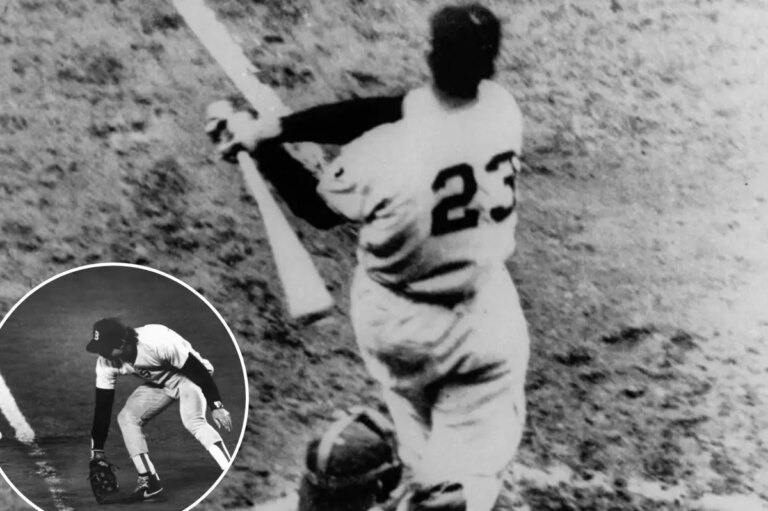
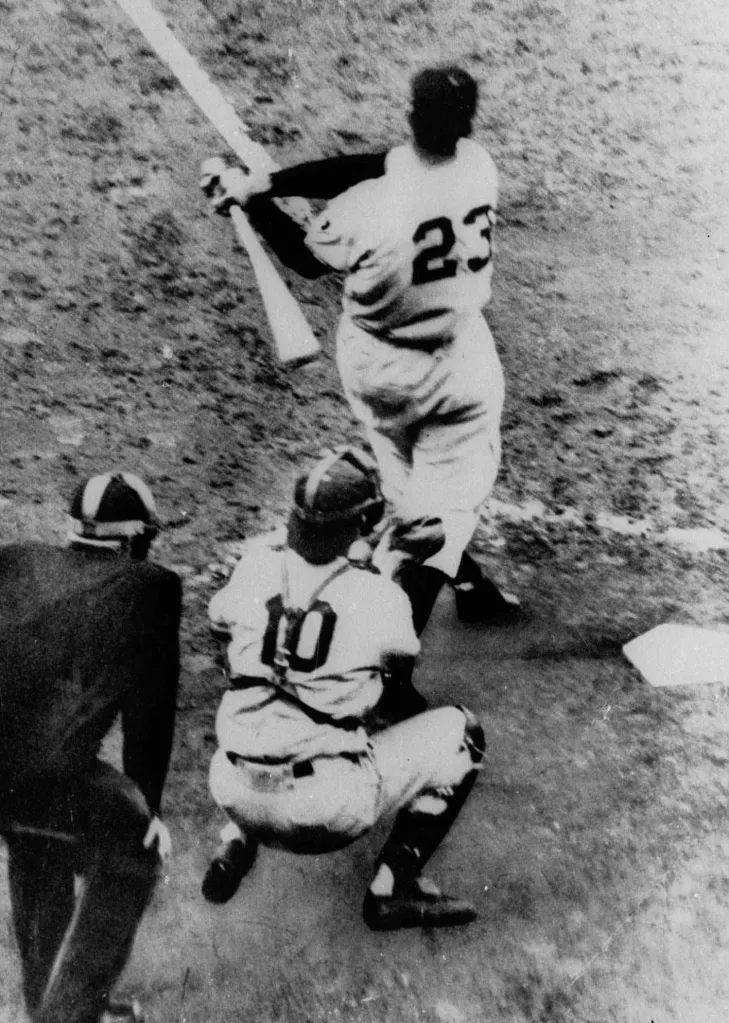
Perhaps the most famous home run in baseball history, the Giants’ Bobby Thomson delivered a three-run shot to beat the hated Dodgers at the Polo Grounds and — you might have heard — win the Giants the 1951 NL pennant.
Bobby Thomson hits a home run in the ninth inning to lead the Giants to an NL pennant-winning victory over the Dodgers at the Polo Grounds. The homer, one of the most famous in MLB history, is known as the ‘Shot heard ’round the world.’ AP
Perfection
There’s only been one perfect game in World Series history — that was Don Larsen’s complete-game brilliance in a 2-0 win over the Dodgers in Game 5 of the 1956 Fall Classic. The forever image is Yogi Berra jumping into Larsen’s arms after the final out.
Here Comes Willis!
Suffering from an injured thigh, Knicks captain Willis Reed missed Game 6 of the NBA Finals against the Lakers. It was a major question if he’d be able to suit up in Game 7 at the Garden — but Reed limped out from the tunnel before the game, with Marv Albert’s call, “Here comes Willis Reed!” The center scored the Knicks’ first four points, inspiring his team to the championship.
Buckner
This one is more an opponent’s mistake as opposed to a New York athlete’s heroics — but it’s no less significant.
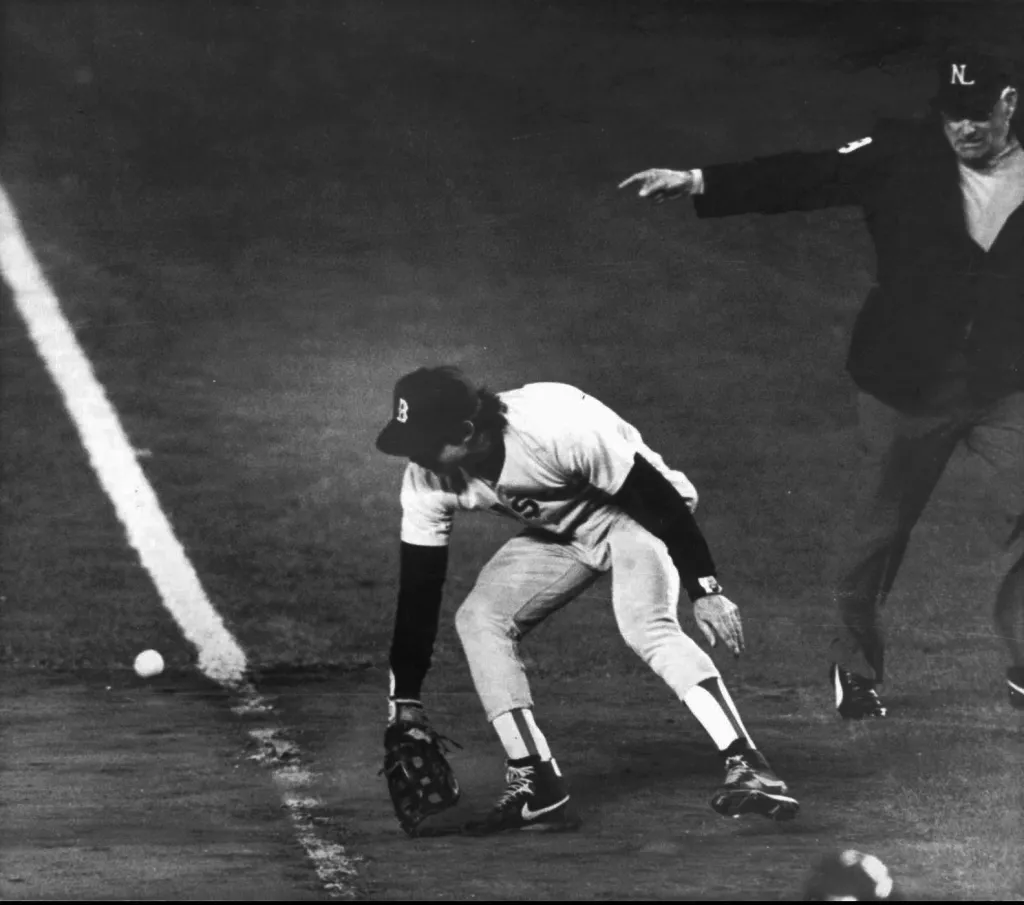
Mookie Wilson’s dribbler to first base scooted through Bill Buckner’s legs, propelling the Mets to an incredible comeback win in Game 6 en route to their 1986 World Series title. AP
Mookie Wilson’s dribbler to first base scooted through Bill Buckner’s legs, propelling the Mets to an incredible comeback win in Game 6 of the 1986 World Series.
The error capped a 10th inning that saw the Mets — their season on the line — rally from a two-run deficit with two outs and nobody on.
Wide Right
How could the Giants beat the high-powered Bills — and with a backup quarterback to boot?
With a ball-control offense that kept Buffalo off the field.
The Giants led 20-19 in the final seconds when they forced the Bills to attempt a 47-yard field goal. Scott Norwood’s miss sailed wide right — and the Giants took Super Bowl 25.
Matteau! Matteau! Matteau!
Howie Rose’s forever call of a forever goal — Stephane Matteau’s double-overtime wraparound winner to beat the Devils in an epic Game 7 to finish a thrilling Eastern Conference final series in 1994.
It sent the Rangers to the Stanley Cup final — you know the rest.
Piazza’s 9/11 Homer
The first baseball game in New York after Sept. 11 occurred at Shea Stadium, and on an emotional night for the city, Mike Piazza launched one of history’s most memorable homers.
Piazza’s two-run shot off Atlanta’s Steve Karsay was a salve to the city, a moment that allowed everyone a euphoric and cathartic release.
The Flip Play
Few have been as quick-thinking or as clutch throughout New York history as Derek Jeter, and this play highlighted both.
What’s happening on and off the Garden court
Sign up for Inside the Knicks by Stefan Bondy, a weekly exclusive on Sports+.
Thank you
In Game 3 of the 2001 ALDS, with Oakland’s Jeremy Giambi bounding around the bases to score the potential tying run, Jeter grabbed Shane Spencer’s wayward throw home on the infield, then flipped it backhanded to the plate to nab Giambi, keep the Yankees ahead and spark them to a series win.
The Helmet Catch
The uniqueness of this play is what makes it so remarkable — David Tyree, a special teams star, caught a critical Eli Manning pass in the final minutes of Super Bowl 42 by pinning the ball to his helmet while being tackled to the ground.
A few plays later, the Giants knocked out the unbeaten Patriots. Unprecedented.
OG’s Tip-In
Karl-Anthony Towns called it the “right hand of God.”
With the Knicks trailing the Spurs by one point in the final moments of NBA Finals Game 4, Jalen Brunson launched a deep 3-pointer that caromed off the rim. Soaring in to tip in the rebound and give the Knicks a one-point lead with 1.2 seconds left was Anunoby, catapulting the Garden into unfathomable delirium and the Knicks to a 3-1 Finals lead.
In a statement, the South African government commended Bafana Bafana for their “spirited performance”, adding that while the final score was not what the nation had hoped for, the team “represented South Africa with unity, determination, and a sense of pride on the world’s biggest stage”.
Also joining were Christopher “Tricky” Stewart, who has written for Beyoncé, Rihanna and Katy Perry; Walter Afanasieff, known for his work with Mariah Carey; Terry Britten, whose songs include Tina Turner’s We Don’t Need Another Hero; and Graham Lyle, who was behind Turner’s What’s Love Got to Do with It?
WASHINGTON — Latin Grammy winner and Texas House Democratic candidate Bobby Pulido once bragged about getting his longtime bandmate Frankie Caballero, who went on to be convicted of sexually assaulting an eight-year-old girl, “out of jail,” The Post has learned.
Pulido told comedian Jose Luis Zagar on a May 2019 YouTube show that Caballero — who had at that point served four years in prison for indecent sexual contact with an eight-year-old girl — was a “master” keyboard player.
“He can do anything with the accordion,” the singer said, according to a translation by Laura Rodriguez O’Dwyer of ProntoTranslations, who also works as a New York State court interpreter. “But get this, they locked him up.”
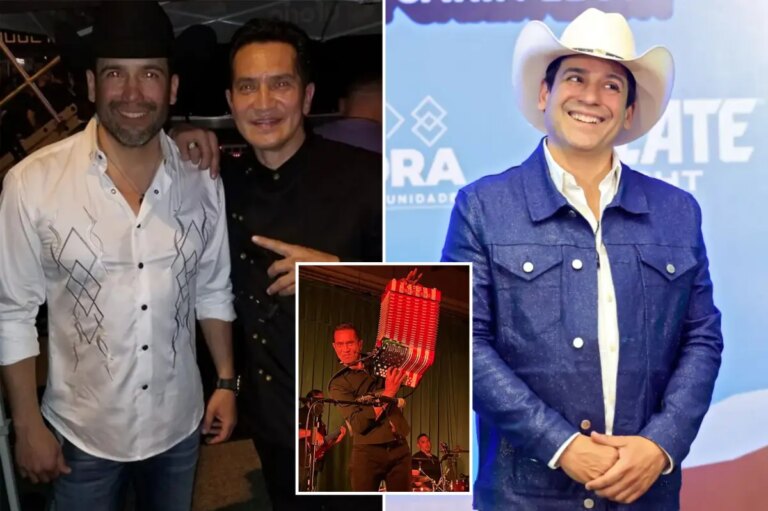
Latin Grammy winner and House Democratic candidate Bobby Pulido (left) once bragged about getting “out of jail” his longtime bandmate Frankie Caballero (right), who has a lengthy rap sheet. Frankie Caballero / Facebook
“I remember when I started out, I went to get him out of jail,” Pulido added, without referencing what charge. Other translators indicated that the word for “jail” was a slang term that could be interpreted as “prison” or the colloquial English “slammer.” It’s unclear whether Pulido visited Caballero in a prison or a jail.
The resurfaced interview suggests Pulido’s knowledge of his bandmate’s criminal history was more extensive than his campaign previously stated — and just the latest instance in which his music background has drawn scrutiny in a close race with his GOP opponent.
Court records indicate Caballero posted bail — either through a personal recognizance bond, surety bond or with cash — after several arrests between 1990 and 2000, as Pulido was ramping up his music career.
The accordionist was also sentenced to four years in prison in May 2014 for indecent sexual contact with a minor that resulted in Caballero registering as a sex offender — but that didn’t stop him from touring with Pulido after his release, The Post previously reported.
The New Yorker, The New York Times, The Wall Street Journal and other outlets have all cited the report in articles highlighting Pulido’s repeated appearances at quinceañeras, a Latino coming-of-age ceremony for teen girls.
Pulido, who is challenging incumbent Republican Rep. Monica De La Cruz in Texas’ 15th Congressional District this November, did not specify to which charge he was referring in the Zagar interview, but his campaign previously acknowledged the singer was aware of Caballero’s drug problems.
As he was launching his career in the mid-1990s, Pulido (pictured) recruited Caballero to play in the band that recorded the Tejano singer’s debut album. Getty Images
A Pulido campaign spokesperson said that the musician’s comments were meant to convey having given Caballero a chance to perform but did not clarify whether he picked him up from a jail or prison. “Bobby Pulido did not post his [Caballero’s] bail,” the rep added.
“This desperate smear campaign won’t distract South Texas voters from the fact Monica voted to gut their healthcare, raise their grocery bills, and drive up gas prices,” the spokesperson also said.
Rene Ortega, Jr., a bondsman and member of the Hidalgo County Bail Bond Board, said that “clerk’s records typically won’t show the name of a bondsman’s client, because that’s a private transaction. But if someone bypasses a bondsman and bails the defendant out directly, their name should be on the bond paperwork.”
As Pulido was launching his career in the mid-1990s, he recruited Caballero to play in the band that recorded the Tejano singer’s debut album, “Desvelado” — months after the accordion player had been released on a personal recognizance bond in a June 1994 sex assault case, according to court documents.
A Hidalgo County grand jury indicted Caballero (pictured) for the second-degree felony in February 1995, which listed a $75,000 bond — but there’s not a record of who paid bail, per the county court clerk’s office. Steven Ray / Facebook
A July 18, 1994, court filing for the sex assault case reveals that Caballero was let out of jail without having to fork over any bail — on the condition that he would be ordered to pay the court $75,000 “in the event I fail to appear and violate the conditions of this bond.”
A former Hidalgo County prosecutor said that the personal recognizance bond in a felony rape case was “outrageous” and “only could have happened with the blessing of the DA’s office.”
Caballero was only held for 10 days over the alleged sex assault — from July 8 to July 18, 1994 — before being released. When he was released, the bond record listed his employment as a musician playing with Arturo Montes.
Pulido has recounted how Caballero joined him in the studio in January 1995 to record the singer’s first album, one month before a Hidalgo County grand jury indicted him for the second-degree felony.
The pair toured together in support of the “Desvelado” album, and they can be seen on stage in a November 1995 appearance on KGBT-TV’s “Aquí Rogelio” show.
Caballero (left) had previously served short jail stints for marijuana possession and burglary charges in 1992, while Pulido was attending St. Mary’s University. Frankie Caballero / Facebook
Three months earlier, Cabaellero had landed back in jail for nine days on a charge of stealing a lawnmower before he was released without having to pay bond again. That resulted in a 15-day sentence and a $100 fine.
The duo collaborated on other studio albums while Caballero had the sex assault indictment hanging over his head before the charge was dismissed by county prosecutors on April 12, 2000.
When contacted, Guerra could not recall details of the case but said either he or the first assistant prosecutor in his office would have had to approve the dismissal.
“The DA’s office, as a general policy, we would not dismiss a sexual assault,” he said.
“Now, if the victim came forward and had some inconsistencies on stories and what have you — whether it was a date rape or a relationship — well, those cases were probably given a harsher look as a matter of policy, OK, depending on motivation, relationship and what have you.”
Pulido’s campaign manager Abel Prado has said the singer was never aware of the sex offender registration but knew his on-again-off-again bandmate “long struggled with addiction issues.” @texmexdj / YouTube
“We did extensive attempts to corroborate,” he added.
Guerra also said his great-nephew Pulido had never retained Caballero as a permanent employee and only used him as a contract player.
“I don’t know that you’re gonna find a better person who’s compassionate than Bobby, OK. And I know because I’ve seen it,” he continued, recalling Pulido’s time studying music in college while recovering from a broken leg.
Asked about federal campaign finance records showing he donated $3,500 to his relative’s campaign, Guerra added: “Oh yeah, and I’m gonna donate some more.”
Over a three-decade period, Caballero was also charged in Hidalgo County with driving while intoxicated, cocaine possession, the 1994 sex assault, indecent sexual contact with a minor and assault on a family member by strangulation.
Start your day with all you need to know
Morning Report delivers the latest news, videos, photos and more.
Thanks for signing up!
The assault by strangulation resulted in a five-year prison sentence, but he was credited with 747 days of previous jail time, allowing him to be paroled out in January 2026.
Cocaine possession charges were dismissed in 2009 as part of a plea agreement involving a federal charge for transportation of an unlawful alien from Mexico into the US. A judge sentenced him to 27 months.
Driving under the influence earned Caballero a 30-day sentence and a $350 fine.
Pulido’s campaign manager Abel Prado has said the singer was never aware of Caballero’s appearance on the sex offender registry but knew his on-again, off-again bandmate “long struggled with addiction issues.”
Pulido is challenging incumbent Republican Rep. Monica De La Cruz in Texas’ 15th Congressional District this November. CQ-Roll Call, Inc via Getty Images
Pulido’s manager, Jimmy Montez, severed ties with Caballero after learning of his criminal history in 2021.
The accordion player was jailed in January, February and October of that year, per Hidalgo County court records.
A Jan. 8, 2021, court record shows that Caballero, when paying bond for charges of failing to comply with his sex offender registration duty, listed his employment as: “Bobby Pullido [sic] Band.”
In public performances and interviews, Pulido has mentioned Caballero’s run-ins with the law, saying in a March 2024 interview that it was a “shame” his bandmate “just can’t stay out of trouble.”
At the time of that interview, Caballero was sitting again in a Hidalgo County jail on new charges of indecency with a child by sexual contact dating back to May 2020. Those were dismissed too, according to Hidalgo County jail records.
In a recent leaked audio recording reported by Punchbowl News, De La Cruz suggested that her campaign’s internal polling has shown her leading Pulido by just one percentage point, a report to which the Democrat’s campaign also drew attention in its statement.
A De La Cruz campaign rep said it was “absolutely pathetic” for Pulido’s team to “talk about some poll” after having “spent decades knowingly bringing a serial predator around our families.”
“Affordability” is going forgotten again as Mayor Zohran Mamdani grabs some extra cash for his agenda by racking water rates.
Over the objections of elected officials, homeowner groups and rate-payers, the city Water Board on Tuesday approved a 6% water-rate hike as of July 1.
GOP gubernatorial candidate Bruce Blakeman rightly slammed it as “a multimillion-dollar backroom deal to bail out Mamdani’s city budget on the backs of hardworking taxpayers.”
The fix was in from the start: Mamdani’s executive budget spending plan had already baked in the rate hike months ago.
The average homeowner can expect to shell out an extra $100 a year, while water and sewer bills for apartment buildings will jump $60 per unit.
Which points to one reason the mayor doesn’t care: Tenants don’t directly feel any pain from the hike, so they won’t blame Mamdani — and the landlords already know he hates them.
Since the days of Ed Koch, City Hall has collected a “rental payment” from the Water Board to “lease” the Big Apple’s water and sewer system; that revenue flows into the city’s General Fund.
The charge has soared in recent years, from $102 million in 2003 to $313 million in the current fiscal year.
Get opinions and commentary from our columnists
Subscribe to our daily Post Opinion newsletter!
Thanks for signing up!
Since 2004, it’s been based not on anything to do with the city’s costs, but on an obscure formula based on various bond-payment rates.
Way back in 2008, city Comptroller William Thompson blasted the change as sneakily exploiting New Yorkers for City Hall’s fiscal benefit; he wanted the lease revenue to go to lowering water rates for customers; naturally, City Hall nixed his recommendation.
And Mamdani, who campaigned on various pledges to make living in the Big Apple less costly, is continuing the rip-off of water customers to help bloat his city budget.
It’s hardly the only area where “affordability” takes a back seat to his urge to splurge: Last week, Mamdani’s Department of Housing Preservation and Development slammed Bronx tenants at Tracey Towers with a proposed 28% rent hike: No freeze for you!
Whenever he thinks he can get away with it, Mayor “Warmth of Collectivism” gives struggling New Yorkers the cold shoulder.
The 12-year-old boy who choked to death at a New York school has been identified — as police confirm they are investigating whether his death was tied to a viral TikTok challenge.
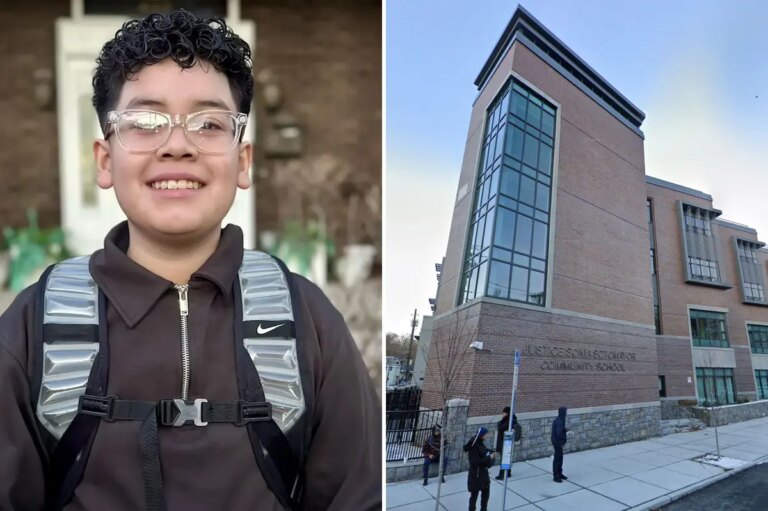
Jacob Medina, a 6th-grader at Sonia Sotomayor Community School in Yonkers, was on his way to a class Wednesday morning when he started choking in the hallway on what officials said may have been a doughnut.
Nearby adults immediately jumped in to help, Yonkers Public Schools Superintendent Anibal Soler Jr. told NBC New York.
Jacob Medina, 12, choked to death at his school in Yonkers on Wednesday. Courtesy Medina family
“He was actually with an adult when he started to exhibit some of these signs of choking,” Soler Jr. said.
“So immediately there was actually somebody with him and within seconds — probably less than 10 seconds — additional adults came to try to administer emergency life-saving procedures on the young man.”
However, they were unable to save him, and Jacob was pronounced dead after being rushed to St. Joseph’s hospital.
Investigators are now probing whether his death was tied to the popular “One Bite” social media trend, in which users attempt to eat as much as possible in a single bite.
“Anything about a TikTok challenge, anything about witness statements, we are going to investigate,” confirmed Yonkers Police Commissioner Christopher Sapienza.
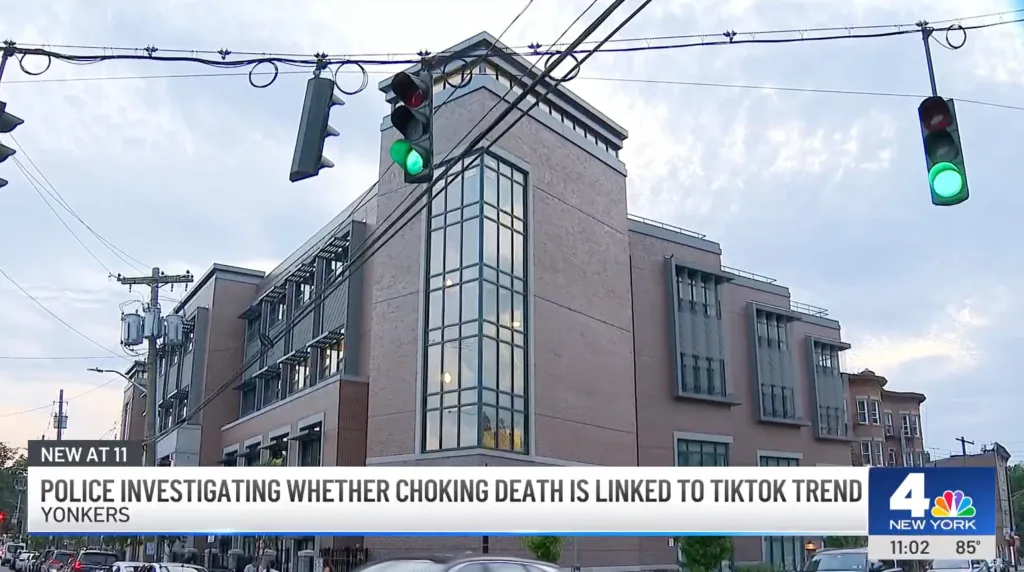
He began choking in the hallway at Sonia Sotomayor Community School while going to class. WNBC
School officials stressed that they are not certain the internet challenge was involved in the tragedy.
Investigators are looking into Jacob’s health history, including whether he had any allergies.
He started choking just before noon on the fourth-floor hallway and may have bought the doughnut at school as part of a fundraiser, sources told CBS News.
On Thursday evening, flowers and candles were placed in front of the school by family members in tribute to Jacob, who they remembered as a loving boy who cared about his cousins.
“This young man was a bright light in the building,” Soler Jr. said Thursday. “Everybody loved him, everybody knew him. He was energy, he was joy.”
Pierre Gasly’s third place in last weekend’s Monaco Grand Prix has been reinstated after the stewards rescinded the two penalties he received during the race.
Alpine successfully requested a right of review into two separate five-second time penalties for speeding in the pit lane.
Those penalties had dropped him from third place down to seventh.
Frenchman Gasly, 30, was one of a number of drivers to be penalised for speeding in the pit lane in Monaco.
Thundering bass rattled the dance floor as a sea of sweat-soaked revelers threw their heads back and belted in unison: “Let’s make the most of the night like we’re gonna die young.”
The irony was impossible to miss.
Just hours earlier, many of the same people had been on a mission to outsmart Father Time, packing into lectures on longevity science, testing cutting-edge health technology and trading tips on how to add years — if not decades — to their lives.
But when celebrity DJ Steve Aoki cranked up Kesha’s 2012 hit at Dave Asprey’s BEYOND Biohacking Conference at the Fairmont Hotel in downtown Austin, the crowd wasn’t thinking about biological age, mitochondrial health or life expectancy.
The Beyond Biohacking Conference was held in Austin, Texas from May 27-29, 2026. Courtesy of Beyond Biohacking Conference
They were too busy partying like immortality could wait — which, oddly enough, may be part of the secret they traveled to the Texas capital to learn in the first place.
“If you look at the numbers for longevity, having a community and a place where you belong makes you live longer,” Asprey, the founder of biohacking, told The Post. “So does movement and so does dance.”
Researchers agree that social connection helps people live longer, healthier and happier lives, with the impact of isolation on mortality comparable to major health risks like smoking.
Yet many Americans seem to be missing out. A recent poll found that 48% of US adults say their lives lack fun, and just as many report being lonely on a regular basis.
It’s part of the reason Asprey encourages attendees to cut a rug alongside 5,000 fellow biohackers at his conference every year.
“People come here to change their state,” he said. “It’s not just about learning — it’s about being in a room full of people who care about it as much as you do, walking around, experiencing serendipity and curiosity, and then actually getting to go play.”
And play they did.
More than 5,000 people attended the symposium, which just finished its 14th year. Courtesy of Beyond Biohacking Conference
This year’s party theme was “Spirit Animal,” with a multigenerational crowd donning leopard suits, peacock feathers and butterfly wings and dancing to electronic remixes of Fleetwood Mac, Lana Del Rey and Pink Floyd.
“We don’t need no education,” guests sang out. “We don’t need no thought control.”
“We want to live long, but we also want to live a vibrant life.”
BEYOND Biohacking attendee
That anti-establishment spirit runs through much of the biohacking world, a do-it-yourself culture that encourages people to take charge of their own biology — often outside conventional healthcare systems, research environments and regulatory oversight.
Asprey was inspired to start the movement after struggling with severe health and weight issues in his 20s, finding that traditional advice wasn’t working and turning instead to personalized treatments, experimental technology and holistic medicine to upgrade his mind and body.
Dave Asprey is the founder of biohacking, a movement dedicated to longevity and optimizing human potential. Courtesy of Beyond Biohacking Conference
Today, he’s aiming to live until 180. And while biohacking was once dismissed by the establishment, the practice is increasingly moving into the mainstream.
When Asprey joined Aoki on stage in devil horns and wings, the crowd’s reaction bordered on rock-star frenzy, with fans clamoring to join the 52-year-old who claims to have rolled back his age — though he still hasn’t quite figured out how not to look like an awkward dad while dancing.
Behind the throng of bodies, bartenders passed out cans of TRU KAVA, a sparkling beverage made from the root of a tropical plant used ceremonially by Indigenous communities across the South Pacific for thousands of years.
Kava has gained popularity among sober and wellness-minded people in recent years as a “functional” alternative to alcohol, said to promote relaxation, mental clarity and a more positive outlook on life.
Guests drank functional beverages, loaded up on hangover cures and used recovery tools — and, of course, they danced. Courtesy of Beyond Biohacking Conference
For those still drinking, the evening’s sponsor offered a helping hand. Instead of house shots or themed cocktails, attendees were invited to try De-Liver-Ance, an herbal elixir said to support liver detoxification and fend off hangovers.
Across the floor, the scene shifted from rave to medspa.
Attendees could be seen with cannulas threaded below their noses as they tried the NanoVi, a device that produces water vapor infused with electromagnetic waves and is marketed as a tool for supporting the body’s natural repair processes.
Nearby, others watched the DJ set while gathered around a BioCharger, a gadget that looked straight out of a science fiction movie and claimed to revitalize cells using light, voltage, frequencies and harmonics.
The conference hosts a themed dance party each year, inviting attendees to blow off steam and connect with fellow biohackers. Courtesy of Beyond Biohacking Conference
And as if the strobes on the dance floor weren’t enough, some partook in BrainTap sessions during the party, a form of neurofeedback training that uses light, binaural beats and guided audio to support focus, sleep and stress reduction.
And, of course, no rave would be complete without body paint, with hordes of scantily clad attendees lining up to be turned into walking pieces of art.
In the end, the evening blurred the line between nightclub and wellness expo, where lasers, lab-grade gadgets and raucous merrymaking all collided under one roof.
Most importantly, perhaps, it gave a group of people focused on the future a chance to live in the present — together, in a way only biohackers could.
“It’s just so nice to be on the same frequency as other people,” said one attendee, a sparkling unicorn horn perched on her head. “We want to live long, but we also want to live a vibrant life.”