

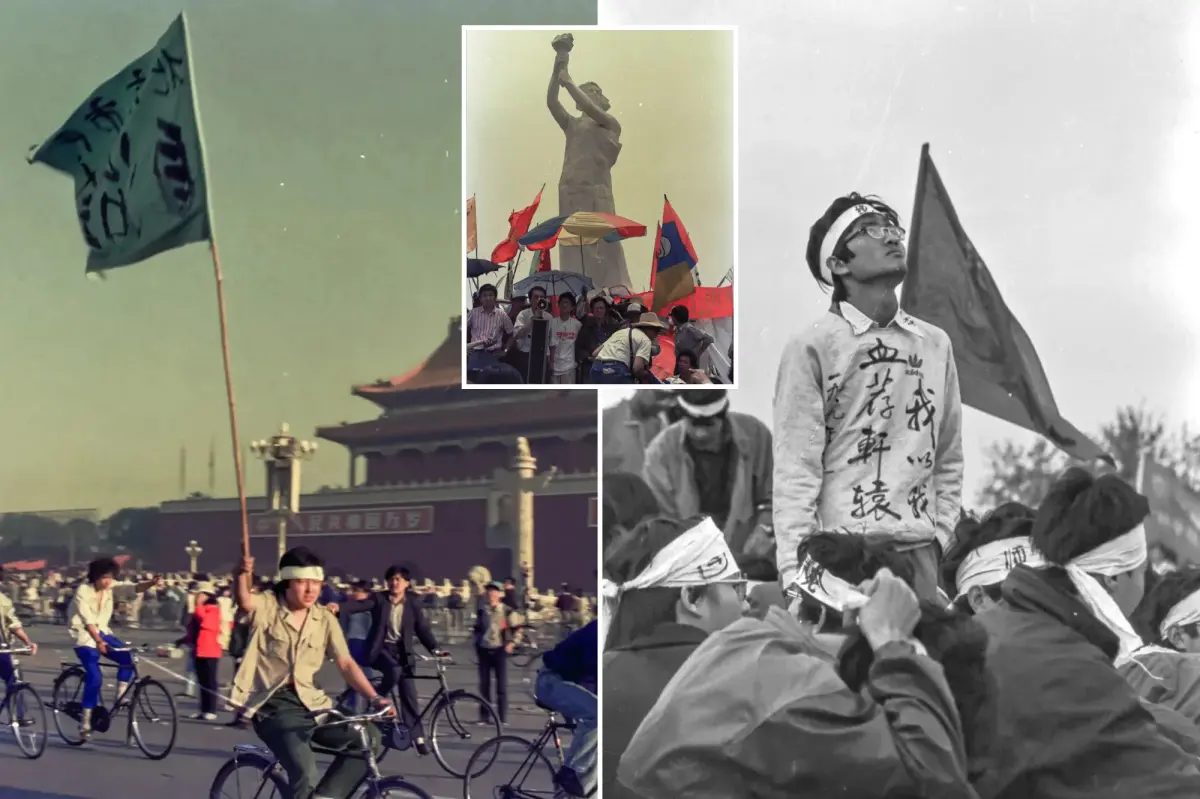

The Chinese military massacred over 2,000 peaceful protesters at Tiananmen Square in Beijing in 1989, but very few images of what happened have ever been seen publicly.
That’s because — despite an estimated million students, workers and civilians attending the protests — the communist regime has gone to great lengths to suppress any documentation of its brutality.
But now a trove of some 2,000 photographs have been smuggled out of China and shared with The Post, showing the lead up to and aftermath of the June 4 massacre.
The pro-democracy protests had started weeks earlier, when groups peacefully demanded political reform, an end to corruption and greater freedoms.
Upset at the unrest and the message it was sending to the rest of the country and the world, the Communist party sent soldiers and armored vehicles into Beijing to crush the movement.
The Chinese government’s official death toll stands at 200 civilians and several dozen security personnel, but human rights groups say that is a dramatic undercount and peg the number at around 2,000 to 3,000.
These photos were taken by a Chinese state media photographer and had remained hidden for decades on rolls of film stored inside a metal box. The photographer’s family has faced pressure from Chinese authorities to prevent publication of the images, according to The Epoch Times, which obtained and first published the pictures.
The photos show students on hunger strike, wearing white cloth bands around their foreheads. They also show the protesters, which included academics, workers and professionals linking arms to block troops.
Communist statues are decorated with protest banners and people held up banners in support of their cause.
In photos taken before troops were ordered to storm the square and fire on protesters indiscriminately, military members are seen waving to protesters. One image shows soldiers gratefully accepting brown fried dough sticks from a protester.
However, after the massacre the photographer captured the carnage. Flaming and burned out vehicles, streets scattered with debris following the panic, bloodied bodies on stretchers.
In one picture a woman lifts a boy’s shoulder to show the bullet wound where he was shot.
“There were smashed heads, ruptured stomachs, and spilling intestines. Around them were mangled arms and legs, some still bleeding,” according to one eyewitness who wrote their account on a public poster dated June 4, according to the Epoch Times.
The witness also said everyone around apart from the soldiers was crying in the aftermath of the massacre.
It was on June 5 that the most widely circulated and well-known image related to the massacre was taken. As tanks tried to leave the square, a lone man carrying shopping bags stood in front of the column of Chinese tanks, then sidestepped when they tried to go around him.
The haunting “Tank Man” picture became one of the most iconic photographs of the 20th century, a symbol of courage in the face of tyranny.
The man’s identity has never been found out and the image is censored in China, which does not allow any acknowledgement or commemoration of the massacre.
“By burying the past, the Chinese government is also burying respect for fundamental rights in the future,” said Yalkun Uluyol, China researcher at Human Rights Watch.
In recent years the Chinese government has cracked down on commemorations of the massacre in Hong Kong, which used to attract hundreds of thousands of people.
The Hong Kong Alliance and the June 4 Museum have been closed by the government and two of its leaders are awaiting sentencing on charges of “inciting subversion,” which could see them jailed for up to 10 years.
“Despite Beijing’s censorship, intimidation, and severe repression, Chinese and Hong Kong people around the world continue to commemorate the Tiananmen Massacre,” Uluyol said.
“Concerned governments should recognize their efforts and press the Chinese government to accept responsibility for the massacre, provide reparations, and hold the officials responsible to account.”