
Centum Electronics ended FY26 with a reported net loss of nearly Rs 52 crore. On paper, that leaves the company with a negative price-to-earnings ratio.
Yet the market appears to be telling a different story.

The stock trades near Rs 3,634, up roughly 58% over the past year, and continues to trade near record highs. Investors, it seems, have looked through the headline numbers.
The reason is straightforward. The reported loss says less about the business today than it does about decisions made years ago. For years, Centum’s profitable India operations were weighed down by loss-making subsidiaries in Europe and Canada. In FY26, management finally drew a line under those businesses, taking a one-time exceptional charge that pushed the company into the red.
Strip out that accounting hit, and a different picture emerges. India business grew 25%, margins improved, and the company built a record order pipeline.
Three things are worth understanding here:
- The cleanup that caused the loss, and why it is good news.
- How Centum is climbing the electronics value chain, and what is funding that climb.
- The growth engines underneath, and the operating leverage they could unlock.
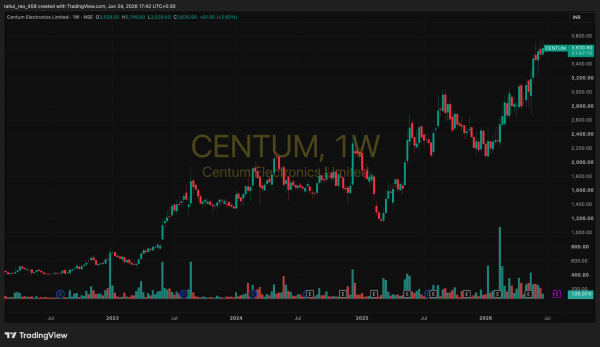 Centum Electronics – Historical Price chart (Source: http://www.tradingview.com)
But first, how does Centum actually make money?
Understanding the business
Centum operates across two segments that look similar on the surface but generate returns differently.
Build-to-Specification (BTS) is the company’s design-led business. Centum owns the intellectual property and develops products from concept to finished hardware for customers such as DRDO, ISRO and the armed forces. The segment contributed about 28% of FY26 standalone revenue and generates EBITDA margins of roughly 20%.
Electronic Manufacturing Services (EMS) is a build-to-print business, where Centum manufactures products designed by customers, largely for export-oriented global equipment makers. EMS accounts for around 72% of revenue but operates at lower EBITDA margins of 10-11%.
However, EMS requires less capital and generates return on capital employed (ROCE) of more than 20%. BTS, by contrast, offers higher margins and stronger intellectual property protection but demands more capital and longer cycles.
The mix between them drives blended profitability.
The work itself is the moat: tolerances in microns, multi-year qualification, and single-source status on roughly 80% of what it makes. Customers rarely switch suppliers when the part sits inside a mission-critical missile or a satellite.
Segment-wise revenue and EBITDA margins
The engines underneath
While BTS climbs, two quieter engines are scaling.
The first is semiconductor manufacturing. A new anchor customer contributed nearly $10 million in revenue during FY26, and management expects that figure to reach $30 million within two to three years. With India investing heavily in semiconductor manufacturing and global supply chains diversifying beyond China, this could become a meaningful growth vertical.
The second is defence exports. Higher defence budgets in Europe and the Middle East, and capacity constraints abroad, are pushing existing global customers to route more orders through Centum, which builds electronics for platforms, including the Rafale fighter. This revenue is margin-friendly and does not depend on the domestic cycle. Behind both sits a broader trend: global manufacturers indigenising production in India.
Order book and operating leverage
The investment case ultimately rests on operating leverage.
Centum ended FY26 with a standalone order book of about Rs 1,645 crore, up 23%, giving revenue visibility for about a year and a half. The bigger point is what happens as it converts. Centum’s cost base is largely fixed, so as revenue grows and the higher-margin BTS share rises, the same costs spread over a larger base and the blended margin lifts. Management targets a standalone EBITDA margin of 13-15%, against 12.4% in FY26.
The cleanup has also left a healthier balance sheet. Borrowings are just 0.28 times equity, ROCE has risen to about 21%, working capital has improved, and the company declared a Rs 5 dividend.
Valuation and Outlook
On continuing operations earnings, the stock trades at about 53 times. On a standalone profit before the one-off, about 62 times, and price-to-book (P/B) is steep at roughly 15 times.
However, premium valuations are common across the defence-electronics ecosystem. Defence-electronics design houses like Astra Microwave and Data Patterns trade at 60-65 times earnings, with Apollo Micro Systems higher still, and broad electronics manufacturers like Kaynes Technology command rich multiples too.
The sector is pricing a multi-year structural growth cycle in defence, space, and electronics manufacturing, and Centum now sits inside it with a cleaner story than a year ago.
Peer-to-Peer comparison
The maths is simple. If standalone revenue compounds at the 25-30% management targets and the margin climbs toward 15%, earnings grow fast enough such that today’s multiple looks less stretched on forward numbers. If growth slows or margin expansion stalls, however, the current multiple leaves little room for disappointment.
The risks are real. The semiconductor ramp leans on a single anchor customer. BTS is lumpy, and its FY26 order intake was soft. Development orders drag margins before they help. Moving to the system level, it will sometimes compete with its own customers. And a thin book value sits beneath a high price-to-book.
Investors should watch four indicators closely: standalone growth in the 25-30% range, progress towards the 15% EBITDA margin target, scaling of the semiconductor business, and clean consolidated financials once the overseas exits are fully reflected from FY27 onward.
If those targets are achieved, FY26 may ultimately be remembered as the year Centum cleaned up its past. If not, the valuation could prove difficult to defend.
Note: We have relied on data from http://www.Screener.in and http://www.tijorifinance.com throughout this article. Only in cases where the data was not available, have we used an alternate, but widely used and accepted source of information.
Rahul Rao has helped conduct financial literacy programmes for over 1,50,000 investors. He has also worked at an AIF, focusing on small and mid-cap opportunities.
Disclosure: The writer or his dependents do not hold shares in the securities/stocks/bonds discussed in the article.
The website managers, its employee(s), and contributors/writers/authors of articles have or may have an outstanding buy or sell position or holding in the securities, options on securities or other related investments of issuers and/or companies discussed therein. The content of the articles and the interpretation of data are solely the personal views of the contributors/writers/authors. Investors must make their own investment decisions based on their specific objectives, resources and only after consulting such independent advisors as may be necessary.