


For years, Jim Harbaugh’s preferred brand of football felt almost old-fashioned.
While much of the NFL chased lighter personnel groupings, spread formations and smaller, faster defenses, Harbaugh continued to build offenses around physicality, versatility and tight ends.
Now, the rest of the league appears to be catching up.
One of the more intriguing observations from Albert Breer’s latest offseason notebook centered on the Chargers’ revamped tight end room. Breer suggested Los Angeles’ overhaul at the position could end up being one of the most important developments of the offseason — and it speaks to something much larger than a player or position group.
The Chargers finally are becoming a complete reflection of Harbaugh’s football identity.
You can see it throughout the roster.
There’s first-round running back Omarion Hampton, a physical downhill runner capable of carrying a heavy workload. There are massive offensive tackles Joe Alt and Rashawn Slater. The defense is built around rugged edge players including Khalil Mack, Tuli Tuipulotu and Akheem Mesidor.
And then there are the tight ends.
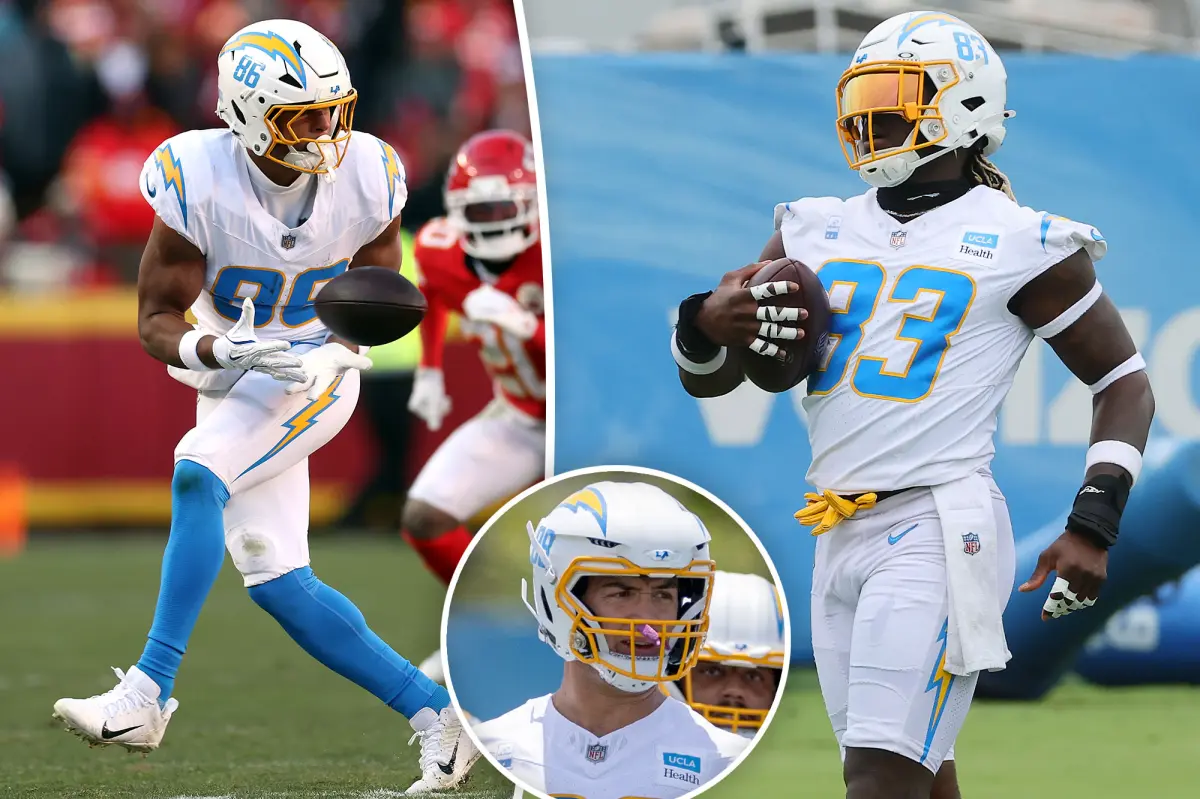
Breer highlighted the additions of Charlie Kolar and David Njoku alongside second-year hybrid weapon Oronde Gadsden II. Kolar arrives from the Ravens as one of the league’s better blocking tight ends and gives the Chargers a true in-line presence. Njoku can align all over the formation, creating matchup problems while allowing offensive coordinator Mike McDaniel greater flexibility in how he deploys personnel.
That flexibility has always been central to Harbaugh’s offenses.
At Stanford, tight ends were featured weapons. Future NFL players Coby Fleener, Zach Ertz, Levine Toilolo and Jim Dray all flourished under Harbaugh. At Michigan, Jake Butt became a Mackey Award winner, while Colston Loveland developed into one of the nation’s premier tight ends.
Harbaugh’s offenses consistently treated the position as more than an extra blocker. Tight ends were foundational pieces capable of influencing the run game and passing attack.
What’s changed is that the NFL is beginning to value those players similarly.
League-wide usage of 12 personnel — one running back and two tight ends — has climbed from 17.3% of offensive plays in 2022 to more than 22% in 2025. Even more dramatically, 13 personnel packages featuring three tight ends exploded last season, increasing nearly 50% from the previous year.
The catalyst may have been right up the 405.
Sean McVay’s Rams shocked the league by leaning heavily into 13 personnel during the second half of the 2025 season. The results were devastating. Matthew Stafford threw 22 touchdowns and zero interceptions from those looks, forcing defenses to choose between matching size against the run or risking favorable passing matchups.
This created a catch-22 for most teams. The Rams also generated positive expected points added (EPA) on more than 50% of their rushing attempts in 2025, becoming just the second team since Pro Football Focus began tracking the metric in 2006 to reach that mark.
The copycat effect was immediate. Twenty-two tight ends were selected in the 2026 NFL Draft, the most since 2002.
That’s where McDaniel’s arrival becomes particularly fascinating.
McDaniel’s offenses in Miami weren’t rigidly built around tight ends, but they were remarkably adaptable. When the personnel justified it, the Dolphins became one of the NFL’s most efficient teams targeting the position, consistently ranking in the top 10 of the league in EPA per play.
That marriage between Harbaugh and McDaniel could be exactly what makes the Chargers dangerous.
Harbaugh provides the blueprint. McDaniel supplies the creativity.
Together, they have assembled a roster capable of playing multiple styles without substituting personnel. They can line up in traditional formations and run power football. They can spread out defenses. They can force opponents into uncomfortable personnel decisions before the ball is snapped.
In many ways, the Chargers aren’t simply building an offense around tight ends.
They’re building an offense around where the NFL is heading next.
And for perhaps the first time since Harbaugh returned to the NFL, the league is moving in his direction.