

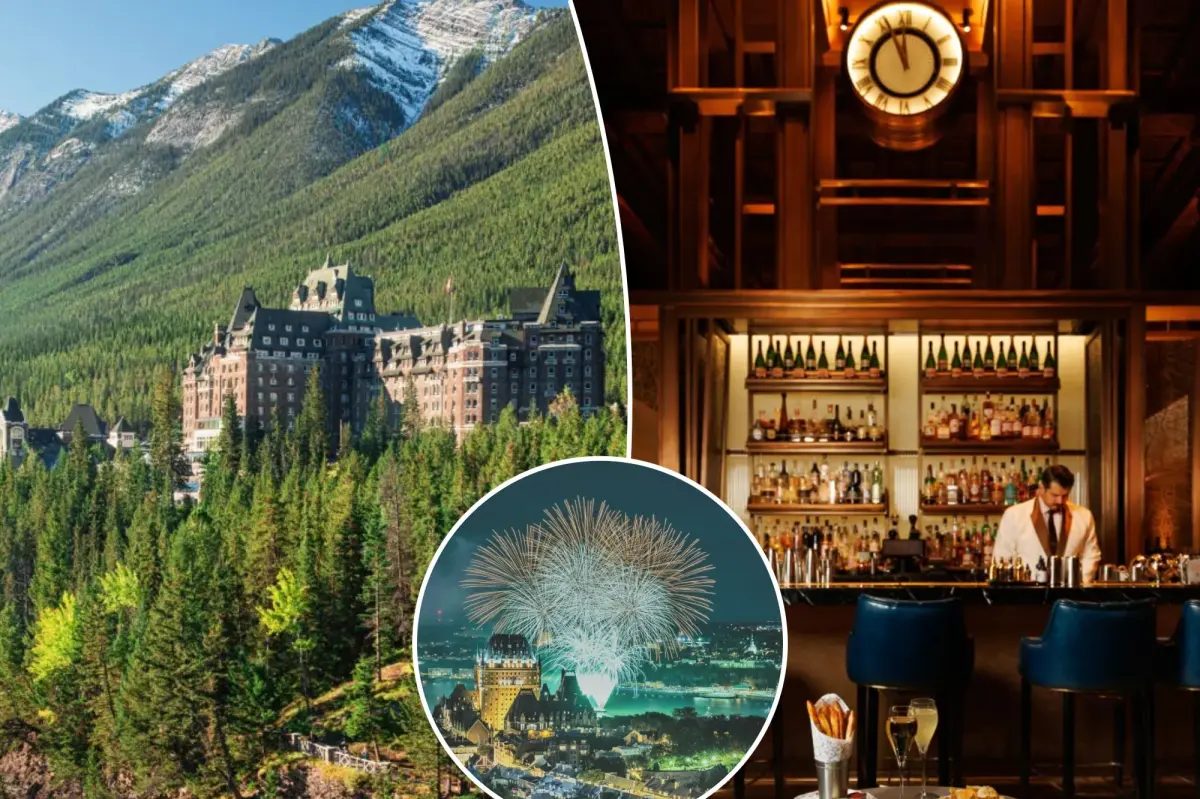

In the late 19th century, Queen Victoria was desirous of a railway network across her then-dominion of Canada that would connect settlements on either coast for the first time
But canny Canucks didn’t just want cheap freight lines; they had far grander designs.
“All of them are haunted. Every single one.”
Podcaster Craig Baird
The railroad would drive tourism from coast to coast, while offsetting the enormous cost of construction.
To lure travelers, hotels were built as pilgrimage-worthy landmarks.
“If someone gets off in the middle of a journey, and spends the day in the hotel? It’s more revenue for the company,” said architectural historian Hal Kalman, who wrote the definitive history of these hotels.
Most were deliberately designed in a mash-up of styles that nodded back to Europe.
“It was to show we were a serious nation,” added Craig Baird, host of the “Canadian History Ehx” podcast. “They were created in a uniquely Canadian style, perfect for making posters to encourage people from Britain to come here.”
The network of palace-style properties expanded rapidly across the country from Nova Scotia to British Columbia, with dozens dotting the route by World War II. They fell from favor as car ownership became widespread in the 1950s, and many were demolished or repurposed for other commercial uses. A few managed to dodge the wrecking ball, though, and survive into this century; Baird says around a dozen are still operating across the country.
Below, we’ve rounded up the seven best — all of which today fly a Fairmont flag, save for the Marriott-managed Algonquin Resort in St. Andrews) — with cheat sheets, as well as a primer on the unauthorized guests you’re likely to encounter.
“All of them are haunted. Every single one,” said Baird.
Date opened: 1888
Vibe: Scottish Lord on the prairie
Quick hit: The 757-room property was built after railway workers discovered natural hot mineral springs here, inside what became Banff National Park. With its own bowling alley, five tennis courts and a 40,000-square-foot spa, it’s arguably the most famous of the former railway hotels.
Need to know: No, you’re not imagining it: The building doesn’t make the most of the views across the valley to Mount Rundle. The original architect snafued on the orientation, designing the H-shaped structure backwards.
Spook factor: You might spot the Ghost Bride, who supposedly tripped on her dress and fell down a marble staircase to her death in the 1920s; or bellman Sam McCauley, the helpful ghost of the Scottish head bellman who died 50 years ago.
Date opened: 1929
Vibe: Jazz Age giant
Quick hit: The limestone-clad, 28-story skyscraper sits right across from Union Station, in a prime perch downtown. With more than 1,000 rooms, plus its own concert hall and hospital, it had underground walkways to funnel guests to the train.
Need to know: This is where boldface confabs take place in Canada, from hosting the 2010 G20 summit to a luxe crash pad for celebs during the film festival each fall.
Spook factor: Idle on the eighth floor and you may spot the hotel’s most frequent spectral guest: an older man with gray hair, wearing a maroon smoking jacket, who glides silently along the hallway in the dormitory tower.
Date opened: 1893
Vibe: Urban fairytale
Quick hit: The imposing, turreted wedding cake of a building dominates the skyline of Quebec City with its Loire Valley-inspired design. You might recognize it as the location of the final scene of Hitchcock’s 1953 movie “I Confess.”
Need to know: The Céline Dion Suite, which honors French Canada’s beloved songbird, is decorated with images taken by her own family photographer.
Spook factor: The namesake French nobleman, an early governor of New France in the 1680s, allegedly sits and stares out the window here, yearning for his never-to-arrive fiancée, more than three centuries later.
Date opened: 1914
Vibe: Old-school skyscraper
Quick hit: The four-star, 407-room hotel was named after Captain John Palliser, who surveyed Western Canada in the 1850s and was an instant landmark, helping to establish Calgary’s rep as more than just a pioneer town.
Need to know: Margaret’s Hope, the cuppa served at afternoon tea here, is the hotel’s own signature blend. It’s grown in Darjeeling in a plantation named after the expat British owner’s daughter who died on her way home from India to England.
Spook factor: Look for a man dressed in a railway conductor’s uniform wandering the halls or a socialite scampering down the stairs in 1940s dress to the former drawing room.
Date opened: 1889
Vibe: Henry VIII on holiday
Quick hit: Baird says this smaller, 233-room hotel is “the really beautiful, overlooked one,” sitting right on New Brunswick’s Bay of Fundy. The existing structure is a replacement for the OG, which burned down 25 years after it opened; this incarnation opened a year later. It’s part of Marriott’s Autograph Collection.
Need to know: Of course, there’s great golf in the Canadian town named after its spiritual home. The game has been played here since 1894, but the par-72 you can play today was set out in the last decade by Rod Whitman.
Spook factor: Want a few sleepless nights? Ask for rooms 308 and 373, where strange phenomena has been noticed. Or book room 473, where you might hear the sobs of the Jilted Bride. Stood up at the altar, she jumped out the window.
Date opened: 1908
Vibe: Versailles in the Highlands
Quick hit: The farthest west of the railway palaces, the 431-room property sits right on Victoria’s Inner Harbour with a wide veranda to maximize the views of the water. It was aimed not only at railway travelers but also steamship arrivals from Asia and beyond, connecting across to the east coast by train.
Need to know: It escaped demolition via a 1960s fundraising effort nicknamed Operation Teacup, after its famed afternoon tea — always served, so WAGs report, on cups wide enough that genteel ladies could gossip behind them without their mouths being seen.
Spook factor: Francis Rattenbury, the architect behind the original building, was murdered by his wife’s lover at his home in England, but is reputed to roam his beloved hotel as an apparition. Ask for room 712 if you fancy company.
Date opened: 1912
Vibe: Neuschwanstein on the Ottawa
Quick hit: Baird calls this outpost “the most famous” of the hotels, sitting right next to Parliament, with more than 400 rooms across six stories. Its debut wasn’t without controversy — the prime minister, after whom it’s named, had approved the use of public parkland to build the hotel.
Need to know: It opened just weeks after the death of the man who built it, and so many other of these landmark properties: Grand Trunk Railway magnate Charles Melville Hayes, who perished on the Titanic.
Spook factor: Sure, some staff have claimed to see Hayes haunting the halls of the hotel he never saw, but more common reports suggest a little girl here who’s likely behind the breaking of furniture and opening doors that happen without human help.