

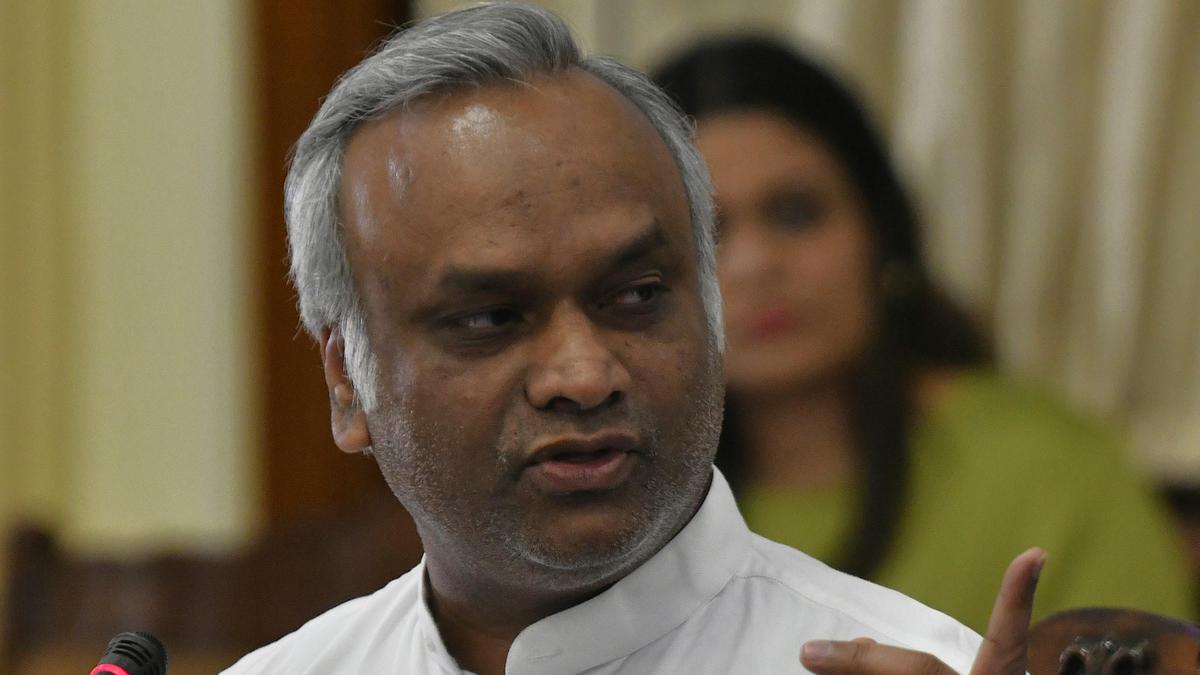
In a setback to Home and IT&BT Minister Priyank Kharge, a special court in Bengaluru has rejected his contention that no member of the Rashtriya Swayamsevak Sangh (RSS) can maintain a criminal defamation complaint because the RSS is “not a registered organisation and it does not maintain any registered membership”.
The court termed Mr. Kharge’s contention as “wholly untenable and devoid of merit” while referring to various past judicial precedents, in which the High Courts and the apex court have clearly declared that “the RSS is a definite, determinate, and identifiable body or class of persons; and consequently, where defamatory imputations are made against the RSS as an organisation, an individual member of the RSS is competent to maintain a complaint for defamation.”
Sandeep Patil, judge of the special court of magistrate for criminal cases against former and present MPs and MLAs in Karnataka, made these observations in his June 27 order of taking cognisance of the offence of criminal defamation under Section 356 of the Bharatiya Nyaya Sanhita (BNS) against Mr. Kharge, and Mohammed Haris Nalapad, son of Congress MLA N.A. Haris, on a defamation case filed by Bengaluru-based RSS member Tejas A.
The complaint was filed arraying Mr. Kharge, Mr. Nalapad and the then Minister Dinesh Gundi Rao as accused persons for allegedly making false, baseless and derogatory remarks against the RSS, its members and their activities through various media platforms in October 2025.
However, the court, after hearing the arguments on behalf of all the three accused, dropped proceedings against Mr. Rao while taking cognisance of offence only against the other two on finding that materials produced in the complaint are prima facie sufficient to constitute an office under Section 356 of BNS against them.
Meanwhile, the court said that the accused cannot be permitted to “approbate and reprobate simultaneously” while pointing out that on the one hand, they justify their statements by referring to the RSS and its members using descriptions “RSS members” and “swayamsevaks” and thereby acknowledging the existence of an identifiable group, while on the other hand they deny the existence of such members of RSS for want of its registration solely to defeat the maintainability of the complaint.
Relying on Section 2(26) of the BNS, the court pointed out that the definition of “person” expressly includes “any company or association or body of persons, whether incorporated or not”, and “the statute does not prescribe any requirement of formal membership, registration, incorporation, or documentary proof of affiliation as a condition precedent for recognising a body of persons under the law”. Whether the complainant is part of such identifiable group is a matter to be established by evidence during trial, the court said.
It is significant to note, the court said, that “the accused have not specifically denied the allegation that they have used or made the alleged derogatory statements and imputations against RSS and its swayamsevaks. The defence raised by the accused are not a categorical denial of the act of publication or making of the impugned statements, but is confined to the contention that the complainant has no locus standi to maintain the complaint and that there is no personal defamation against him”.
However, the court clarified that at the cognisance stage, it was is not required to evaluate the truthfulness of allegations in detail, and all disputed questions — including the complainant’s membership status and the intention of the accused persons — would be determined during the trial.
Published – July 01, 2026 09:24 pm IST