

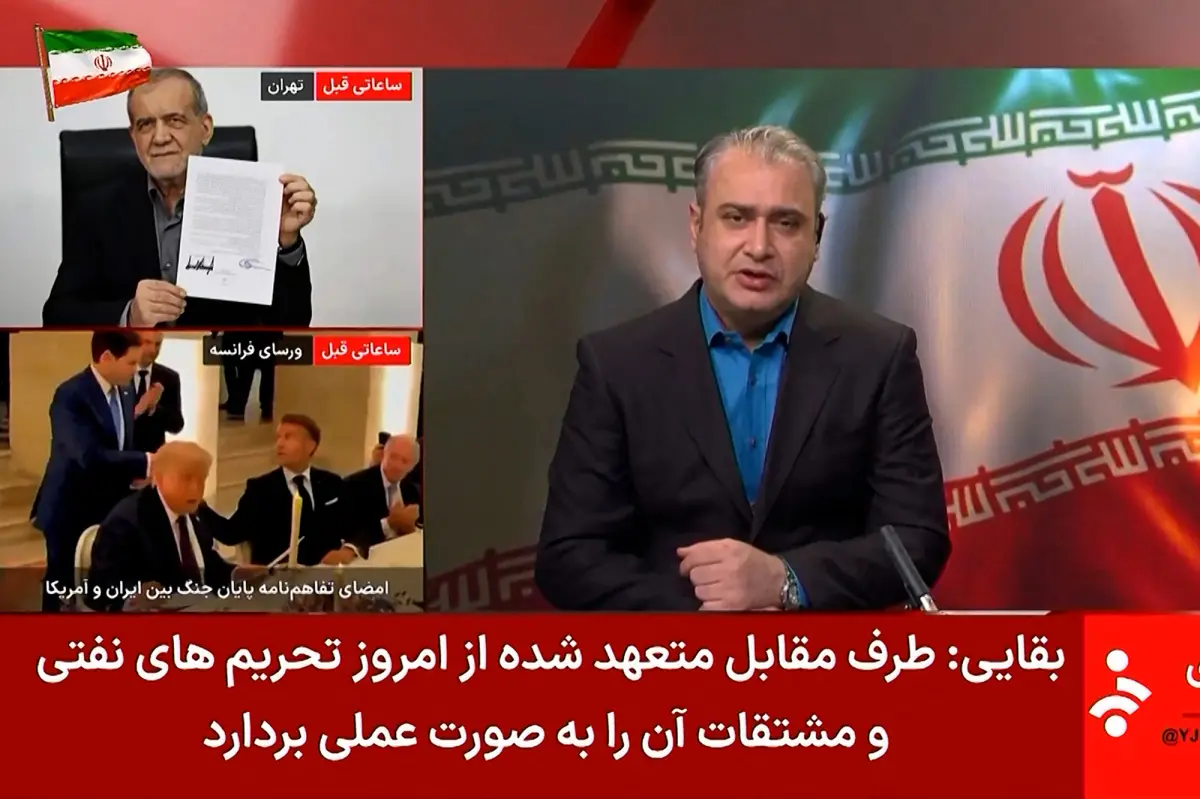

“Versailles is the real deal,” said President Trump when his French counterpart Emmanuel Macron invited him to dinner at the royal palace during this month’s G-7 conference. G-7 leaders praised the US’ latest agreement with Iran as a “breakthrough,” but if anyone thinks the Trump-touted “deal” Vice President Vance negotiated with Iran is “real,” they should have another thing coming — a massive attack.
Vance spent last week defending the deal, which isn’t even a deal but a “memorandum of understanding.” Typically, “MOUs” are “good faith” documents issued to express non-binding notions of future relationships. Upon the signing of this MOU’s official text ahead of schedule on Wednesday, US officials reportedly said it was a “political document” that failed to account for undisclosed backchannel discussions. Even Vance admitted its terms are “very general.”
That’s a generous assessment since many of them are worryingly vague. The Strait of Hormuz, for example, is to be opened, but only for 60 days, after which the Iranians can engage in “dialogue” with other Gulf states to “define the future administration and maritime services” international law nominally prohibits. Iran has suggested this could include resuming its illegal toll regime.
The US will fully unfreeze Iran’s foreign assets, but on terms to be negotiated later and with no enforcement mechanism to ensure Iran doesn’t spend the funds on its depleted military. Iranian oil can flow under US waivers, though existing sanctions will remain in place, also pending later negotiation.
The Iranians will theoretically benefit from “at least $300 billion” in “reconstruction and economic development” for which the US will facilitate “financial transactions.” The MOU is mum on where those funds will come from, though Vance has promised no taxpayer cash will go to Tehran. That could be true. Or not.
American warships will stop blockading Iran’s ports but not withdraw from the region until after a final agreement is reached. War Secretary Pete Hegseth said last week that the ships will linger offshore and could return to blockade duty at a moment’s notice.
The MOU includes Lebanon, from which Iran has said it expects Israel to withdraw, possibly, its leaders have suggested, under American compulsion. The Israelis have said they’re not a party to the agreement and will act in self-defense. As they continued to exchange fire with Hezbollah last week, some Israeli hardliners said they are prepared to continue the war on their own.
The MOU creates a new 60-day cease-fire window, which can be extended by mutual agreement for an apparently unlimited time, to discuss the intractable issue at the heart of the US-Iranian conflict: whether or not Iran will become a nuclear power.
The MOU says Iran “reaffirms that it shall not procure or develop nuclear weapons” and maintain its general nuclear program’s “status quo.” We’ve heard that one before. The mullahs hiding deep underground are the same fanatics who have wanted the bomb for more than 40 years and just killed 40,000 of their own people to stay in power. In any case, the MOU unpromisingly relegates resolution of all relevant nuclear issues to further negotiation.
Assuming all this succeeds, the MOU provides that the final deal will be enforced by a “binding resolution” . . . of the UN Security Council. Home of the brave, indeed.
We can continue negotiations until we are blue in the face, but there is no guarantee that Iran’s leaders, who survived decades of isolation and the massive air war earlier this year, will ever give up their nukes. Even if they do sign a deal “guaranteed” by some toothless UN resolution, their regime has a long history of pocketing any concessions and then renegotiating terms at the last minute, or just ignoring them on the sly, as with Obama’s failed nuclear deal of 2015.
With tough midterms looming less than five months from now and the prospect of what Trump on Wednesday called “economic catastrophe,” the mullahs have every reason just to wait him out.
Iran poses an existential threat. Even after the MOU’s terms were agreed on, into this weekend Israel and Hezbollah exchanged fire — prompting Iran to threaten to call off the whole deal, suspend the negotiations before they even began and, on Saturday, to announce that they had closed the Strait of Hormuz again after less than 72 hours of traffic going through.
Nobody knows, moreover, how long it will take the Iranians to get at the near-weapons grade enriched uranium under the rubble of their nuclear facilities.
But the longer diplomacy drags on, the more time they will have to do that and, potentially, emerge fully nuclearized. That’s not a chance we should take, especially when we have the military muscle for the massive attack Trump has repeatedly promised if the mullahs don’t play ball. When they say, “Death to America,” I believe them. And so should you.
Paul du Quenoy is president of the Palm Beach Freedom Institute.