

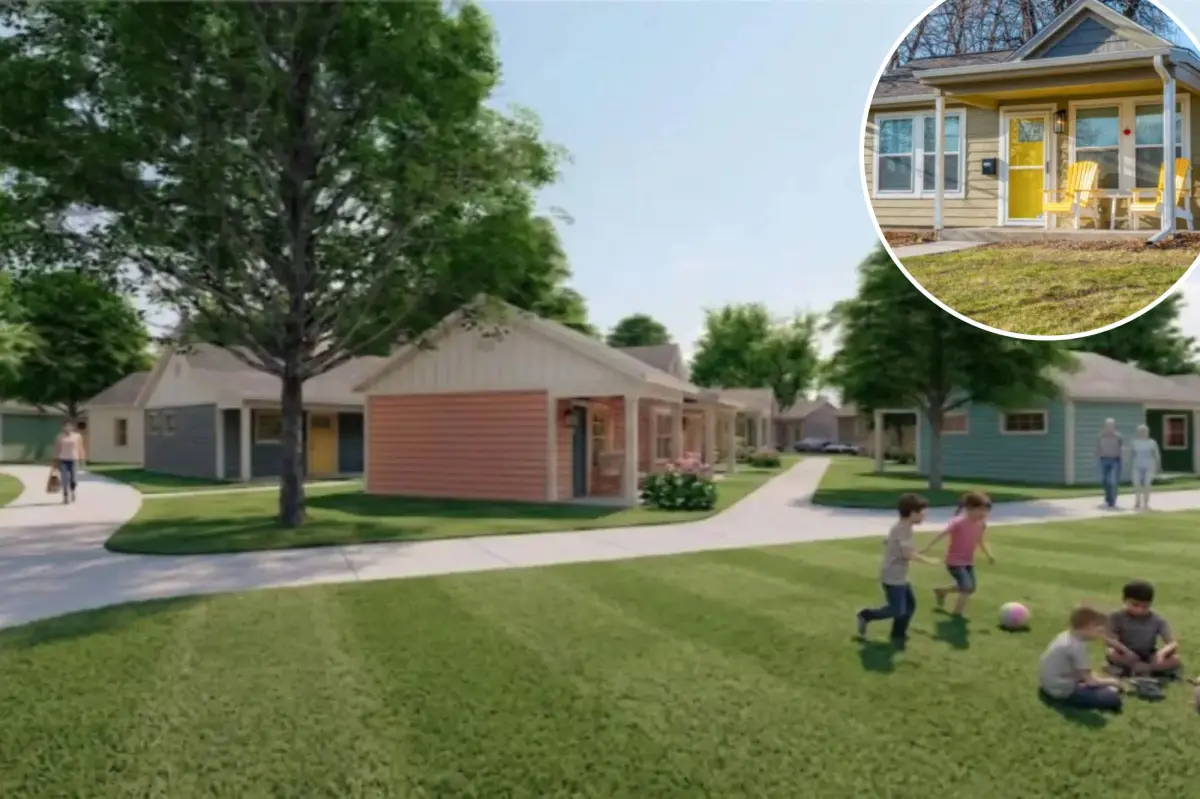

In Iowa, a brand-new village of tiny homes is rising where rent starts at just $300 a month. Homes come with their own bedroom and kitchenette, and a 19th-century schoolhouse is being transformed into a community hub with a gym, a chapel and free healthcare.
There’s a catch, though — and it’s the best kind.
The village is reserved exclusively for people who have been living on the streets.
Joppa, a Des Moines-based homeless outreach nonprofit, has cleared its final regulatory hurdles to build what it’s calling Joppa Village, a 54-unit tiny home community at 2501 Maury St. designed to give the city’s chronically homeless population a permanent place to land.
City officials have signed off on plans to gut and repurpose the long-vacant former Chesterfield School — a structure that dates to around 1890, built just as the surrounding town of Chesterfield was being absorbed into Des Moines — into the beating heart of the new neighborhood.
The Des Moines Zoning Board of Adjustment approved a conditional-use permit allowing the 15,000-square-foot building to be converted into a full community center, complete with a 5,000-square-foot gymnasium addition.
City planning documents envision the space offering communal dining, a kitchen, worship facilities, storage and on-site healthcare services for residents.
“We are grateful for the Des Moines City Council and City staff’s support of the Joppa Village project to help address homelessness in our community,” Joe Stevens, Joppa’s CEO and co-founder, said in a press release.
“This approval allows us to provide permanent supportive housing to individuals who would otherwise be chronically homeless. Addressing such a complex issue requires collaboration, and we are excited to work alongside the City and other community partners to deliver one of many needed solutions.”
The homes themselves run between 192 and 384 square feet and include a full bedroom, a bathroom and a kitchenette.
Monthly rents range from $300 to $700 depending on size. The 54 units will be spread across a mix of single homes, duplexes, and triplexes, with four set aside for Joppa staff and volunteers who will live among the residents.
To qualify, prospective residents must meet federal criteria for chronic homelessness, which means having a disability or substance use disorder, enduring at least a year of continuous homelessness, or cycling through three or more separate homeless episodes within the last three years.
No income is required to move in. The village will offer on-site employment at $15 an hour in groundskeeping, gardening and janitorial work to help residents get back on their feet.
“The goal of the community is to lift folks that have been chronically homeless off the streets permanently and help them discover their God-given gifts,” Stevens told local outlet We are Iowa.
The number of chronically homeless people in Des Moines reached 178 last summer, up from 128 the year before. The project will cost taxpayers nothing, funded entirely through private donors and partners, and is projected to save the city nearly $3 million annually once its first 50 residents are housed.
Total development costs are estimated between $7.5 million and $10 million.
The model is borrowed from Austin’s Community First! Village, a 400-person development on 27 acres outside the Texas capital that has become the national gold standard for housing the chronically homeless, The Post previously reported.
The Austin community posts a 99% rent collection rate and an 83% housing retention rate among formerly homeless residents, according to the Council of State Governments.
“It’s a proven model in helping chronically homeless people find their forever home and stay there until they die,” Stevens said.
Joppa is an official replicator of the Austin program. Getting to this point has taken more than a decade. Stevens spent 12 years and evaluated over 500 properties before landing on the Maury Street site, after city leaders nudged the nonprofit away from an earlier County Line Road location that sat too far from essential services.
Every dollar raised for that previous site is being reinvested into the new one.
Des Moines City Council member Joe Gatto called it an overdue investment.
“Improving lives for people experiencing homelessness in our community is an effort that requires collaboration from partners who are invested in finding solutions,” he said. “People living in our community deserve safety and shelter, and projects like the Joppa Village will help our residents experiencing homelessness start on the path to a better future.”
Some neighbors near the Maury Street site have raised concerns about cleanliness, foot traffic, and crime. Others are simply relieved the eyesore on the block is finally getting a second life.
“I think it’ll be nice,” Melanie Hernandez, who has lived in the neighborhood since 2018, told local outlet Who13. “The building is kind of like an eye sore because it is a little old. But I think it will be nice to have, you know, homeless people actually have a home and be safe and, you know, feel secure. And maybe that will give them motivation to get a job, you know, make something for themselves.”
Stevens said final plans for the schoolhouse conversion are still being refined. Joppa is targeting a groundbreaking later this year, with the first residents potentially moving in by 2027.
“Being able to have your own home and pay your own rent will be a big deal to a lot of these people,” he said. “They will have a lot of pride in home ownership.”