

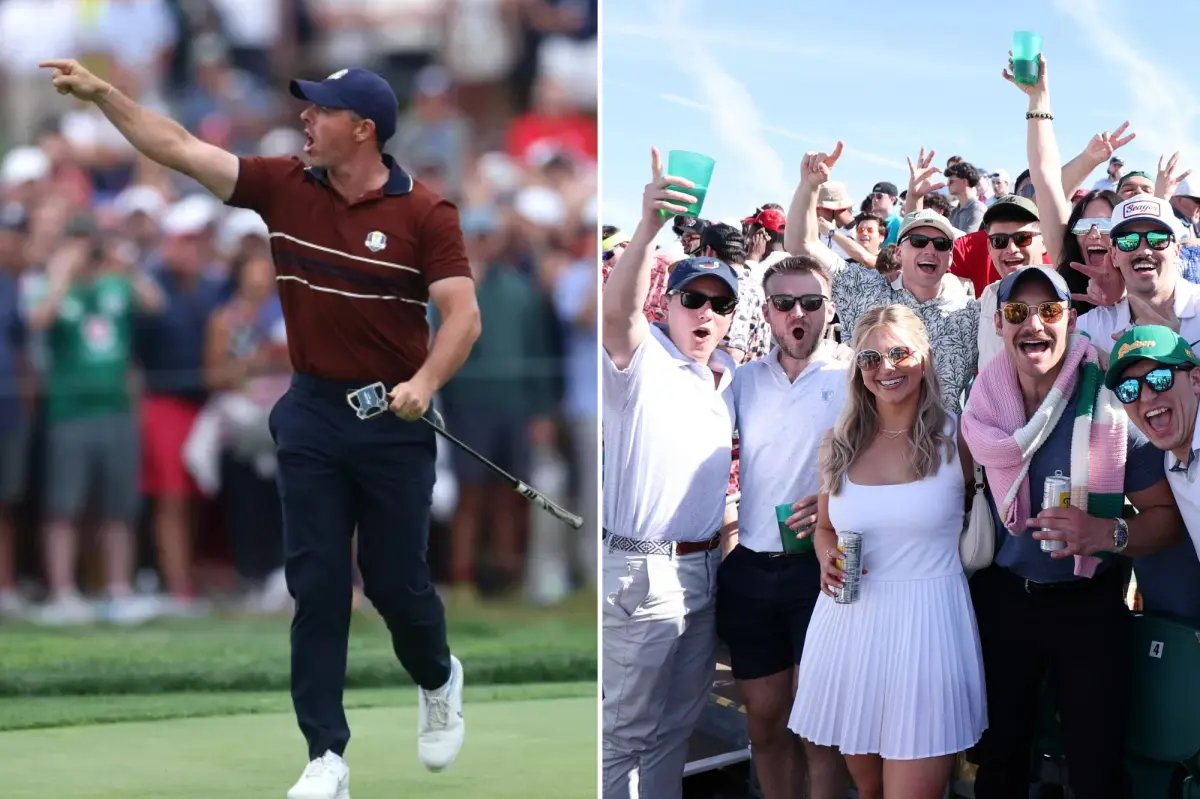

As Rory McIlroy stood on the tee at Bethpage Black last September, trying to focus on the biggest team event in golf, thousands of fans packed around him.
Some cheered. Many more jeered.
Earlier, the first tee MC, Heather McMahan, had led a chant of ‘F—k Off, Rory’ on the public address system.
Later, a cup of beer was hurled in the direction of McIlroy’s wife, Erica.
By the end of the Ryder Cup, the world number two ranked golfer was being escorted around the course by a small army of security guards and police officers, teammate Shane Lowry had confronted a spectator who mocked his weight and Europe’s victory had been overshadowed by a question nobody in golf could ignore: when did the fans become part of the problem?
This week, as the US Open returns to Shinnecock Hills in Southampton, the spotlight will once again shine on the world’s best golfers. But just as intriguing as the battle for the trophy and first prize of $4.5 million is what happens beyond the ropes, where golf is grappling with a growing epidemic of heckling, abuse and alcohol-fueled disorder that threatens to drag the once genteel sport in a direction it has never wanted to go.
Golf has alwayshad the occasional idiot trying to make a name for themselves but usually it’s been little more than a poorly-timed ‘Get in the hole!’ heckle or — in the unusual case of Tiger Woods at the 2011 Frys.com Open in San Martin, Calif., someone running on to the green and throwing a hot dog at him.
But things have taken a turn for the worse in recent years.
Now, instead of polite applause and respect for the game, there’s an increasingly toxic atmosphere at some pro golf tournaments and those lame heckles aimed at players have become deeply personal and hugely offensive.
Jonathan Yarwood is one of the world’s top golf coaches and worked with both 2005 US Open champion Michael Campbell and Nelly Korda, the most dominant player in the women’s game. He believes there has been a discernible shift in the way crowds behave and what it’s doing to the players. “It really can affect players, but it depends on everything from how they are playing, how close the fan is and, obviously, what is said,” he explained.
“Most players will try and ignore it or laugh it off, but it’s crossing a line too often now and the players are human, just like me and you, and trying to do a very difficult job in the public glare.”
That line was certainly crossed at the last Ryder Cup, where the biggest talking point wasn’t Europe’s thrilling victory over the United States but the conduct of the home fans and the controversy they left in their wake.
And now, nine months later, golf’s spotlight returns to New York – and nobody quite knows what to expect. Ask anyone in golf where the most raucous fans are and they will probably say New York.
It is here where most tournaments cease to be the staid and polite events you might typically witness elsewhere. Instead, the beers start flowing, the noise becomes amplified and etiquette all too often goes out of the window.
One veteran Tour caddie, who has worked on the PGA Tour, the European Tour, LIV Golf and the Ryder Cup says the atmosphere at some events has changed beyond recognition, especially since COVID-19. “There seems to a younger generation since 2020,” he tells The Post.
“At big events, especially on the old European Tour, it used to be full of 40-70 year olds, but now there are way more 20-30 year olds turning up and that, in itself, brings new problems.”
Specifically, problems with drinking.
A day at the golf can mean up to 12 hours walking around the golf course and if you’re drinking alcohol all day, it’s going to take effect.
Outside of New York, there’s the Waste Management Phoenix Open in Scottsdale AZ, a PGA Tour where rowdiness isn’t seen as just acceptable, but positively encouraged.
Nicknamed ‘The People’s Open’, it’s known as the most raucous of all pro golf events. Most of the boozy action takes place at the short 16th hole where thousands of fans surround the green, shouting and heckling and where, in the event of a hole in one, they all throw their beers on to the putting surface.
In 2024 tournament organizers had to temporarily halt the sale of alcohol just to try and keep a lid on matters. “I coached a player at the Waste Management a couple years ago and simply could not believe what people did and said there — and it was all alcohol-fueled,” confirmed Yarwood.
“It was a total s—tshow but I guess the only answer is to serve less alcohol, have more gallery police and a genuine zero tolerance policy to anyone who steps out of line.”
But it’s not the only new problem.
Today, social media and the ceaseless clamor for content, allied to drinking, has seen a dangerous new trend emerge. “You know, everyone suddenly thinks it’s great idea to video themselves shouting abuse and filming it on their phones to show to their pals later,” says the Tour caddie.
“Look at The Ryder Cup at Bethpage — that was a disgrace. You have to think that mobile phones should be banned like at the Masters.
“That way, there would be way less bull—t.”
Yarwood agrees, adding: “Modern fan behavior is indicative of society to some extent. Everyone has a voice and wants to be heard, but mainly on social media. But then there’s some people who take that literally and into the real world.
“[But] Contrary to social media, when the person expresses something in real life there are often real-life consequences, like being kicked out, which must come as a shock to certain generations used to hiding behind keyboards.”
At the 2025 Ryder Cup a man was arrested for allegedly stealing a golf cart. A year earlier, a fan dressed as William Wallace from movie “Braveheart” was escorted off the green by police after he ran onto the 11th hole.
Nick Price, former world number one and three-time major winner, thinks there’s also something else at play – the explosion of sports gambling. “I wonder who puts these people up to it and what is really at stake?” He asks.
“Who’s to say the fans who heckled Rory and his wife at the Ryder Cup last year were paid by some person to go and disrupt and distract him on the course?”
The Masters, held at Augusta National each April, remains the benchmark of how to keep spectators in check.
As a private event held on private land, it rules its competition with a rod of iron where even the slightest infringement of its myriad rules can mean instant expulsion and a lifetime ban from ever returning.
It helps, of course, that crowd numbers are strictly limited and demand for tickets always exceeds supply, meaning those lucky few in attendance are always likely to be on their best behavior, but it still offers the rest of golf a chance to see how it could be done.
Price says other tournaments should follow suit. “There is an easy solution to all of this behavior,” he tells The Post. “Those fans who are unruly and being just downright rude should have their tickets pulled immediately and escorted off the property.
“It what they do at Augusta – and it works.”
Having a ‘Fan Code of Conduct’ is one thing. Enforcing it, however, is another entirely.
After all, last year’s Ryder Cup had one too, demanding spectators “avoid heckling or taunting” with “no abusive, obscene, discriminatory, or disruptive behavior” and encouraging “responsible alcohol use,” and look how that turned out.
For generations, golf fans knew the deal; remain silent during the swings, respect the players and remember they were there to watch the show, not become part of it.
Yet somewhere along the way, that contract has frayed.
The USGA insists this week’s championship will be played in front of passionate but respectful crowds, and Shinnecock’s long history suggests it should be.
And as the game’s elite touch down on Long Island once more, the hope is that Shinnecock delivers what it does best — the sternest test in pro golf and a truly deserving winner.
But if the defining sound of the week ends up being abuse from the galleries instead of roars for great golf shots, the championship won’t just be remembered for who lifted the trophy — but for a game still struggling to keep control of its own crowd.