
An inspired Harry Kane wrote himself into history books and the hearts of England fans forever with a pair of goals that denied what could have been one of the greatest World Cup upsets of all time.
His strikes, in the space of 11 minutes, consigned the Democratic Republic of the Congo, leading the game for 69 minutes, to pure despair. As England wheeled away in celebration, Congo’s brave men – who defied a footballing powerhouse for most of the game – broke down inconsolably.
But the World Cup wouldn’t forget their courage. It took one of the most lethal strikers in the world, a man inspired in the second half, a loveable man who has suffered heartbreaks in three major tournaments (World Cup and Euros), to deny them a slice of history.
Those were goals that Kane scored with his will, the technique and vision just the complimenting tools. The winner could become an iconic moment in English football.
Catching his breath after the match, unable to recollect the events, Kane said; “We have hero moments, for me it was today.”
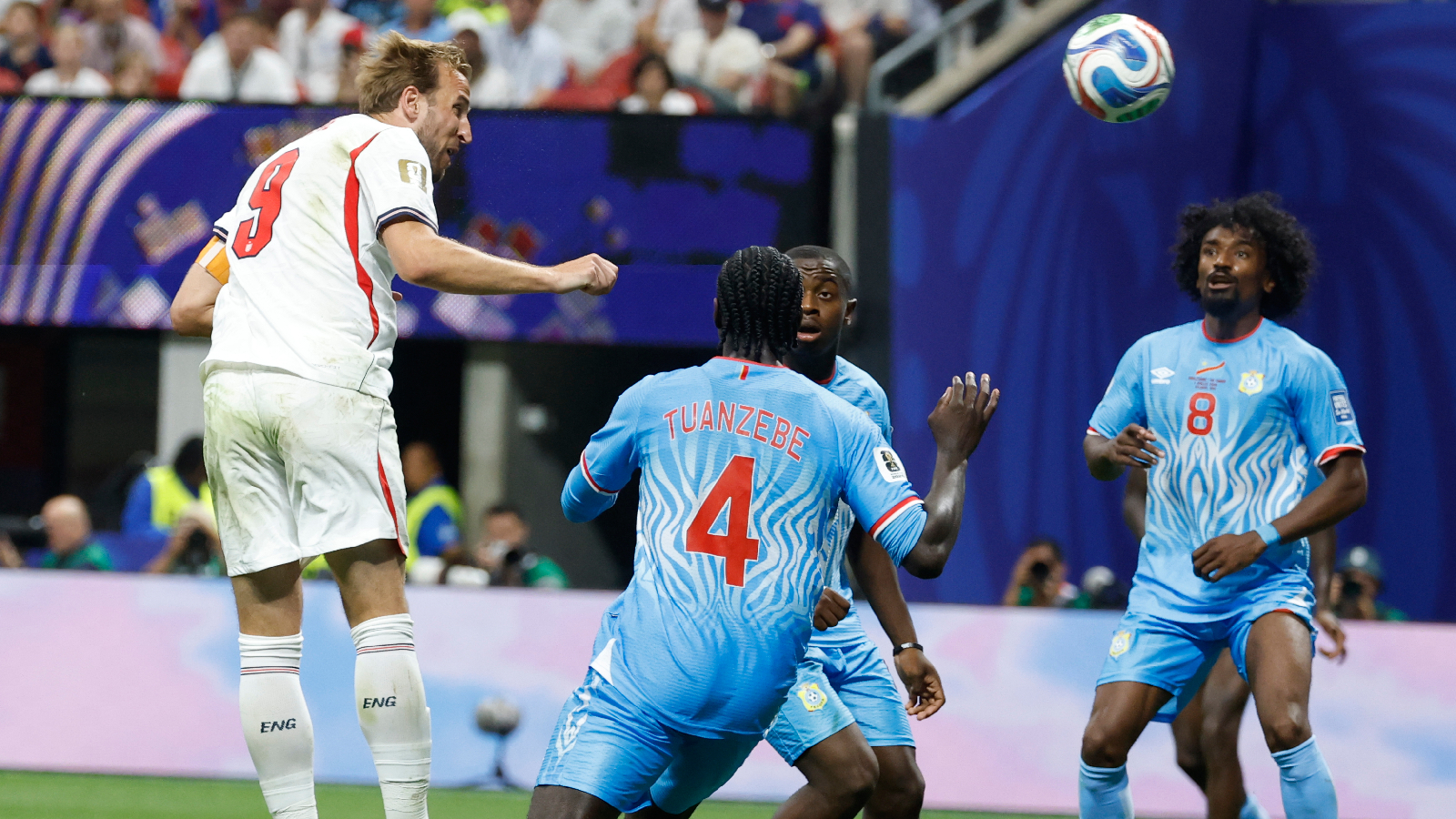 England’s Harry Kane (9) scores his side’s first goal against Congo during the World Cup round of 32 soccer match in Atlanta, Wednesday, July 1, 2026. (AP Photo/Erik S. Lesser)
When he picked the ball on the edge of Congo’s box, his back was facing the goalkeeper. Men in shimmering blue converged. He escaped them, turned languidly and paced to his left, before he swivelled and flashed a rising shot past Lionel Mpasi, the guardian of Congo who had kept them in the game with a string of reflex saves. It was a cruel end to Congo’s resistance, but Kane didn’t want a crueller end for himself.
He could have imagined the public fury back home, the media-scavenging, the end of careers and multiple sackings, the disillusionment and dismantling of the team. But England would croon thankfully: “It was Kane that saved the King.” When all his colleagues looked lost and lumbering, running on fumes, Kane alone showed up, lifting his troops in an individual performance that would elevate him to the pedestal of England’s greatest. England’s captains are associated with tragic flaws and combustibility in clutch moments. Kane was mocked for the lack of trophies in his shelf, for the supposedly poor choices when joining clubs. Not that England loved him less, but they would love him even more now.
Harry kane scored second goal for ENGLAND🏴
Harry Kane is back pic.twitter.com/AVEroJPxmu— GoalRush (@GRGoalRush) July 1, 2026
His first goal was not as aesthetic as the second, but as significant. Just 15 minutes were left in the game, when Kane sprung higher than the circle of blue men around him, and headed the ball past the leaping, the hitherto infallible Mpasi.
Story continues below this ad
The Congolese goalkeeper almost clawed it away, but the power and direction was irresistible. Congo’s 70 minutes of pure, glorious resistance ended cruelly.
Kane screeched and gestured to the audience, largely muted and bereft of hope, to bring the roof down. England’s fans pulsed, transforming the arena in Atlanta to Wembley or Old Trafford. Their hope was treading on thin ice, dripping away with every moment. Then came the captain’s moment, and then came another.
Escape to victory
But how awry it could have all gone. In fixating over breaking Congo’s defensive wall, England forgot their own chores. Just six minutes had passed when their worst nightmare unfolded. Poor Djed Spence – a fourth-choice right-back as Reece James, Tino Livramento and Jarell Quansah were all injured for the match – misjudged the trajectory, and sheepishly watched the ball float over him. Waiting for the lapse was Brian Cipenga, unmarked and lonely in the box. He took a touch to let the surprise gift sink in. The next second, he pulled the levers past a slightly bemused Jordan Pickford.
England’s players and supporters looked crestfallen, with their hands on heads and mouths agape. The ghosts of the past would have come rushing back.
Story continues below this ad
It was not Spence’s fault alone, the England backline was as disorganised as a bunch of kids unleashed in a park. The dynamism of Congo’s forwards surprised, and they were unequipped to deal with their directness, more than speed. It was not merely a test of character and skills, but belief.
Harry Kane equalizes for ENGLAND🏴
What an amazing goal pic.twitter.com/xzuKDcIoT0— GoalRush (@GRGoalRush) July 1, 2026
England turned off the hand-break, with Declan Rice putting up an inspired show. He stoked a killer pass for Jude Bellingham, but Mpasi pulled out a quicksilver save to deny him.
Shortly, Axel Tuanzebe produced a stout block to divert Kane’s shy. The rebound fell invitingly into Rashford’s path, only to watch his former Manchester United teammate Aaron Wan-Bissaka clear it off the goal-line.
Mpasi ambushed another save off a powerful, low header from Bellingham, by springing to his left. He made another save at the stroke of half-time, his sturdy legs rebounding Kane’s volley from six yards. He made a double save seven minutes into the second half as well.
The game thereafter was played entirely in Congo’s half. England had to breach three lines of rigorously pressing blue walls. A Congolese version of Catenaccio played out. And it took a super-willed man and an ice-cold forward to break it.