

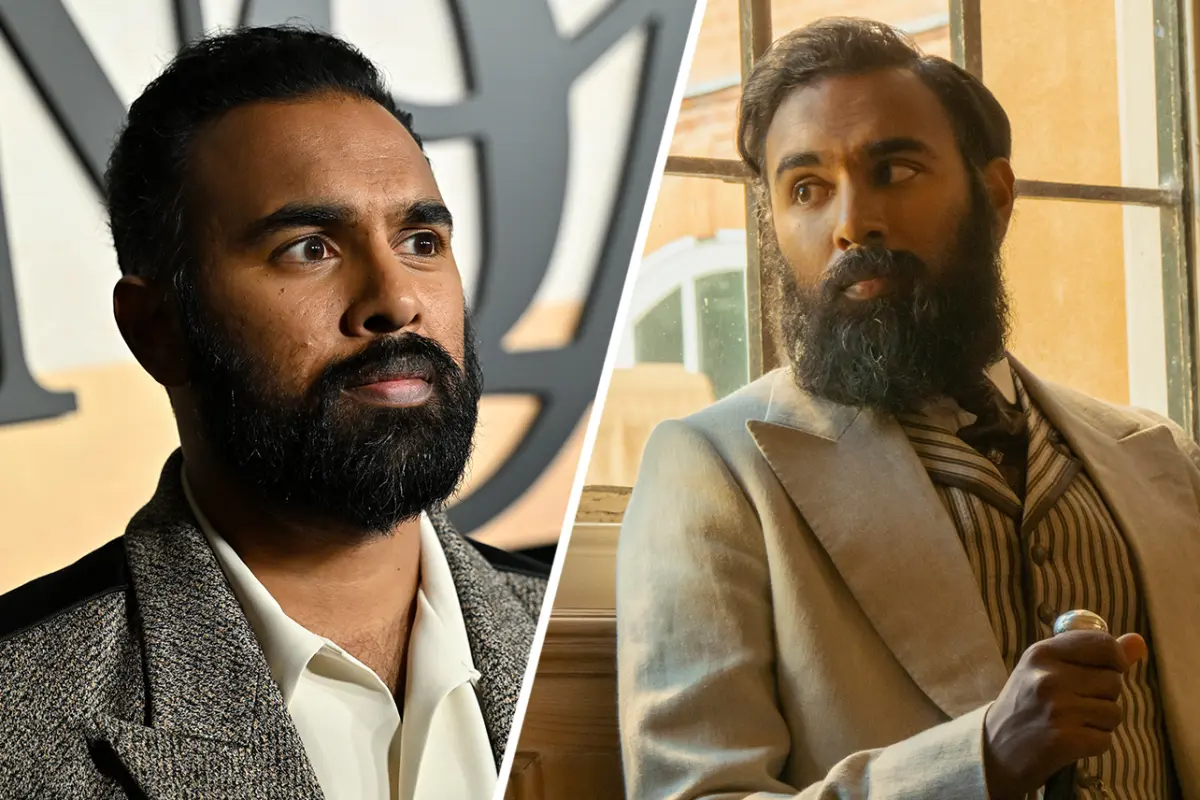
Five years ago, when Himesh Patel was cast for a cameo appearance as as one literature’s most iconic characters in Netflix’s Enola Holmes 2, he thought about what it meant to portray a British Indian version of Dr. John Watson.
“I was heartened by that when I first spoke to [screenwriter] Jack Thorne about it back in 2021, when I would have done that cameo. I was curious as to where we might go with,” Patel told Decider in a recent Zoom interview. “It’s a real point of difference to any other version of Watson that’s come before.”
Now, Patel is finally back in Watson’s shoes (and his walking cane, and his suit vest), and takes on a much larger role in Enola Holmes 3, which began streaming today as the third entry in the family-friendly franchise starring Millie Bobby Brown as Sherlock Holmes’s kid sister, based on the book series by Nancy Springer. This version of Watson doesn’t spend with much time Sherlock—the world famous detective, played by Henry Cavill, spends most of the film kidnapped—but he does play a key role helping Enola solve the mystery of her missing brother. And, in an emotional scene with young star Louis Partridge (who plays Enola’s love interest, Tewkesbury), he addresses his character’s role in the British rule of India.
“It’s a really special moment,” Patel told Decider. “It was the heart of what excited me about playing this version of Watson, really. From the moment that I came on board, all those years ago.”
Patel spoke to Decider about collaborating with director Philip Barantini and Thorne (who’s adapted all three Enola Holmes films) on that scene, the personal impact of colonialism, and his upcoming role in Christopher Nolan’s adaptation of The Odyssey.
I was so happy that Dr. Watson got a big role in this film. Tell me about crafting your version of Watson—did you look to other portrayals of him, or go back to the Conan Doyle stories?
I went back to the stories—read some, and listened to some audio book versions. I had time to do that over the years, between number two and number three. While I waited for news on whether we were going to do a number three, I just kept that running in the background, and so that was a lot of fun. I’ve watched a lot of the other interpretations, just through being a fan and watching versions of Sherlock [Holmes]. But I didn’t consciously turn to them for preparation. I just trusted that there’s something there in the background that’s given me a certain sense of what has been done, what could be done. But as with anything, you want to stay truthful to the story that’s in front of you.
You get this huge, exciting introduction in the movie, the chase scene on horseback. Do you have any horseback riding experience? What was filming that sequence like?
I do not have any horseback riding experience. So, there’s a lot of movie magic that allows me to look like I have copious horseback riding experience. [Laughs.] But yes, it was a reminder that maybe that’s a skill I should acquire because it does look great, doesn’t it?
I know you don’t have many scenes with Henry Cavill, we still get a sense of the Watson and Holmes dynamic, when Watson recalls the story about having tea with Holmes. I’m wondering, what’s your head cannon of this version of the Watson and Holmes relationship?
I really love that sequence for that story. It was one of those bits of writing that I was so excited to shoot. It really gave me a lot, just a little snapshot of a moment, as it does for the audience. It gave me a lot in terms of building the character, and as you say, “head canon.” Is that what you just said? That’s great. I’m going to use that.
Sorry, that’s my fandom roots.
That’s great! I think the years that have passed between when [Watson] first walked through the door, as we saw, at end of number two, and where you find them at number three—I think it, literally, has become home for Watson, but I think it’s also, emotionally, become home for Watson. As we learn in this story, this version of Watson has had to build a life for himself, devoid of many other contexts in which he previously existed.
Finding Sherlock, finding Enola—they’re a safe place for him, I think. He trusts them with his life. That isn’t to be taken lightly. No matter what’s going on, no matter what insane scrape they find themselves in, which is not the first time—though this is probably the highest stakes that he’s been in up til now, maybe—he would not be anywhere else. He would rather always be with them.
You have this really nice scene with Louis Partridge where Dr. Watson reflects on British imperialism in India, and his father. Can you tell me about how you approached that scene from when you first read it in the script, to filming on the day?
It was a process of evolution, actually. [Screenwriter] Jack [Thorne] had written this beautiful monologue, and I just thought that there was opportunity to add even more flavor to it. I’m so thankful that he—and [director] Philip [Barantini], and Millie [Bobby Brown], and our other producers—were so collaborative, so open to those ideas. They were all ears to my thoughts. We made a few edits, a few tweaks. I love how it sits in the movie—the way it cross cuts with Enola discovering the written truth of it all.
It’s a really special moment. I loved shooting it. I thought Louis did a beautiful job in that scene. It was the heart of what excited me about playing this version of Watson, really. From the moment that I came on board, all those years ago, because it’s a real point of difference to any other version of Watson that’s come before. It speaks to the overarching story that we’re trying to tell in this movie.
Can you say more about what specifically your ideas were, when you said that edits were made?
The details of it all sort of fade away into history. It’s been over a year now. But, I think it was a sense of the emotionality of a father and son relationship, against a wider context of forces beyond their control. How that can destroy your emotional relationships with those who you love, more than anything. That’s beyond so many of the other destructive forces of a movement such as imperialism and colonialism.
Obviously, they have destructive forces writ large, but the way they can twist people’s lives upside down is a more subtle thing that we don’t necessarily always see. I found it really spoke to those difficult conversations that we all have with our parents. We all have those Christmas dinners where someone brings something up and you go, “Why? Why am I having this conversation again?” [Laughs.] But this takes it to a whole another level, you know?
I hope you don’t mind me saying I really like the acknowledgment that this Watson is British Indian—that we get into that specificity of his identity rather than just ignorning it. How did you feel about highlighting that part of his character ?
I was very keen to highlight it in the right way. I was heartened by that when I first spoke to Jack Thorne about it back in 2021, when I would have done that cameo. I was curious as to where we might go with it. Those ideas were floating around then, and so it was really thrilling to finally get the script for number three and to see how that had unfolded. I thought [Thorne] crafted it all in beautifully, and sensitively. It’s an era of colonialism that we don’t necessarily explore in these contexts. I’m really excited that we’ve done that, and I really am happy with how it’s turned out, and I admire everyone for going there.
I have to ask if you’ve heard anything about Enola Holmes 4, and what you might want to see for Dr, Watson in future movies?
I haven’t heard anything. We are just here to enjoy number three coming out into the world. I would love to go again. I’d love to step into those shoes again. In terms of my hopes, I mean—a bit more time with Sherlock would be great. [Laughs.] Henry seems like a lovely guy. I’d love to spend a bit more time with him.
I’d love to see that, too. I also have to ask about The Odyssey—you play Odysseus’s second-in-command, Eurylochus. What can you tell me about that experience?
It was the privilege of a lifetime. I haven’t yet seen it. I’m going to see it soon. I can’t wait, because I’ve no doubt that it’s going to be really special. It was and always will be one of the most special experiences I’ve had in every way.
You’ve also just been cast in Ryan Coogler’s The X Files reboot. Congratulations. What can you tell me about your character in that? Is this a new version of Fox Mulder, or a new character?
Almost all I can tell you is that it’s a new character. [Laughs.]