

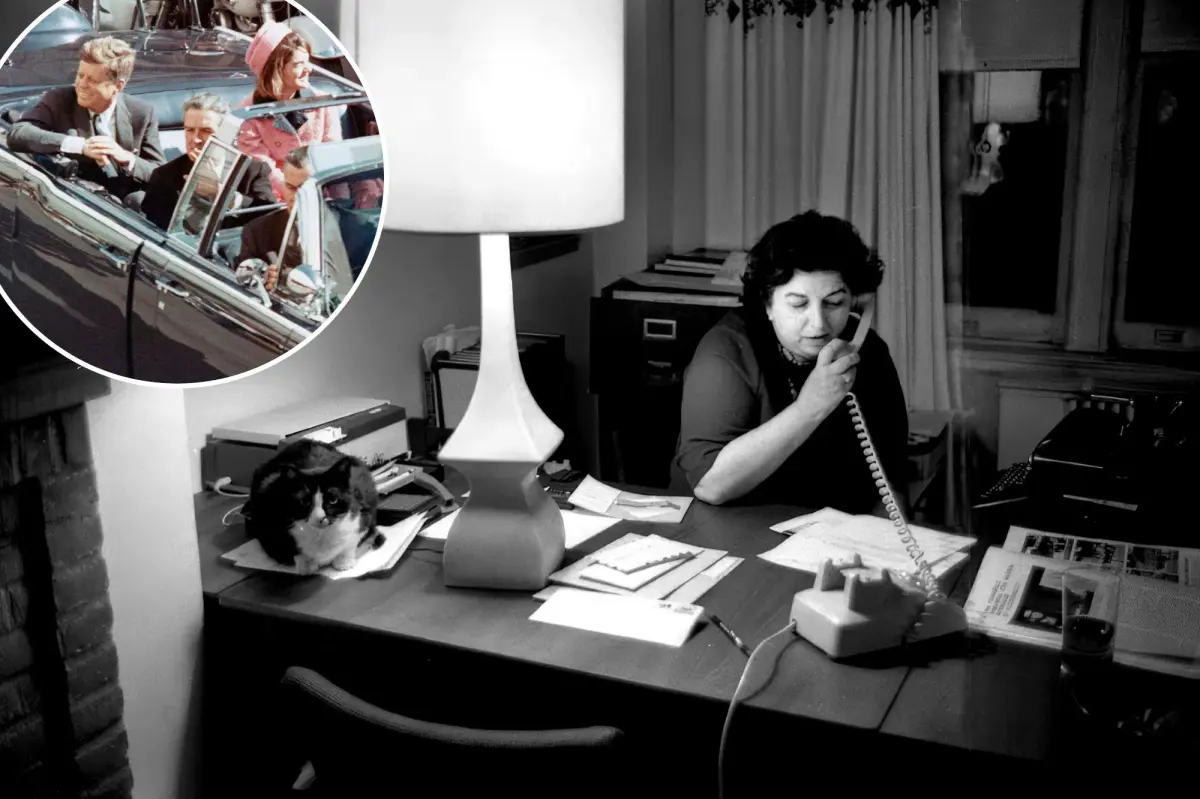

Sylvia Meagher’s life changed the day John F. Kennedy was assassinated.
Until then, the New Yorker had what she considered her dream job. An editor and researcher at the United Nations, working for the World Health Organization, Meagher spent her days immersed in world affairs, happily navigating the corridors of international power.
Intelligent, meticulous and fiercely political, Meagher, then 42, seemed destined for a long career in diplomacy and global policy. But, after the tragedy in Dallas on Nov. 22, 1963, she couldn’t return to her daily life and carry on.
The more she read about the assassination, the more questions she had.
And when the government finally released its findings, she became obsessed with finding the truth.
In “The Housewives Underground: The Untold Story of the Women Who Made the JFK Assassination Our Most Enduring Mystery” (Crown), author Kaitlyn Tiffany tells the remarkable story of Meagher and two other unlikely investigators — Oklahoma housewife Shirley Martin and Maggie Field, the wealthy wife of a Californian stockbroker — who devoted years of their lives to challenging the official account of what happened in Dallas.
Together, the trio became pioneers of a movement that would ultimately help transform JFK’s murder from a national tragedy into America’s longest-running mystery.
“They were disillusioned and bitter, yet they still believed in some possible future in which the country they lived in could be more like the one they’d been promised,” Tiffany writes. “Somehow they never questioned their obligation to participate in its creation.”
When the Warren Commission released its report in September 1964, the verdict seemed straightforward: Lee Harvey Oswald had acted alone.
But it wasn’t.
Buried beneath the report’s conclusions were 26 volumes of supporting evidence containing nearly 18,000 pages of testimony, exhibits and documents. The Government Printing Office made the mountain of material available to the public, but few Americans bothered to buy it.
Fewer actually read it.
But Sylvia Meagher not only read it — she practically memorized it.
Working from her one-bedroom apartment in Manhattan’s West Village, she transformed her home into a research center complete with filing cabinets and stacks of documents. Frustrated that the Warren Commission had failed to create a usable index, she started building one herself.
“When discussing her task with friends and acquaintances, she explained by asking what they would think if the Encyclopaedia Britannica were issued with all its contents untitled, unalphabetized, and in random order,” Tiffany writes.
The resulting index became an indispensable tool for assassination researchers.
Meagher also began writing letters to newspapers challenging their coverage of the case and publishing essays highlighting contradictions and unanswered questions within the Warren Report.
She soon discovered she wasn’t alone.
Across the country, other amateur investigators were arriving at similar conclusions.
One was Shirley Martin, whose relentless digging made her a headache for J. Edgar Hoover’s FBI.
Another was Maggie Field, a New Yorker living in California, who turned her home into an assassination command center, hosting screenings of the famous Zapruder film and recruiting friends and neighbors into the cause.
Together, the three women formed an unlikely alliance.
In a pre-internet era, they exchanged information through letters, phone calls and occasional meetings. Martin gathered witness testimony in Dallas. Field circulated documents and connected researchers. Meagher became the group’s analytical powerhouse, comparing claims against the official evidence and hosting gatherings of fellow “Warrenologists” in her apartment.
What united them was a growing belief that the government’s explanation simply didn’t add up.
Soon they were appearing on television and radio, debating journalists, politicians and defenders of the Warren Commission.
In 1967, Meagher published “Accessories After the Fact,” a devastating critique of the official investigation. The book raised questions not only about Oswald’s guilt but also about the methods and conclusions of the Warren Commission and the FBI.
“Their goal was to change the minds of the American public, which required being taken seriously by respected figures in the media and in the government,” Tiffany writes.
As the years passed, Meagher came to believe that Oswald had been unfairly portrayed and may have been innocent altogether.
“I have tended to identify with Oswald,” she once wrote to Martin. “At least with his rebelliousness, independence, non-conformity, reading tastes and love for animals and children.”
Ultimately the three women had become central figures in a growing movement of assassination critics. They had no institutional support, no major funding and no official authority, yet their work helped fuel a wave of public skepticism that continues more than 60 years later.
But as the assassination research community expanded, disagreements emerged over strategy, evidence and credibility.
The biggest flashpoint was Jim Garrison, the flamboyant New Orleans district attorney who launched his own investigation in 1967.
Garrison claimed Kennedy had been killed as part of a conspiracy involving individuals connected to New Orleans and brought businessman Clay Shaw to trial. Many critics of the Warren Commission embraced his efforts.
Meagher wasn’t convinced.
But Martin and Field proved more sympathetic to Garrison’s investigation, creating tensions that gradually drove the women apart.
The alliance that had once seemed unbreakable began to fracture.
“Sylvia and her friends were trying to set just one thing right,” Tiffany writes.
“They sometimes made bad guesses, trusted the wrong people, surrendered to pride or paranoia, clung to the past — to their first instincts — and they eventually fell apart … They started something they couldn’t quite finish.”
Meagher died of complications from the flu at St. Vincent’s Hospital in Manhattan in January 1989.
In researching the book and going through Meagher’s old papers, author Kaitlyn Tiffany came to learn that she wasn’t actually a fan of JFK.
“She hadn’t even voted for the man,” she writes. “Yet his death had turned into her life’s work.”