

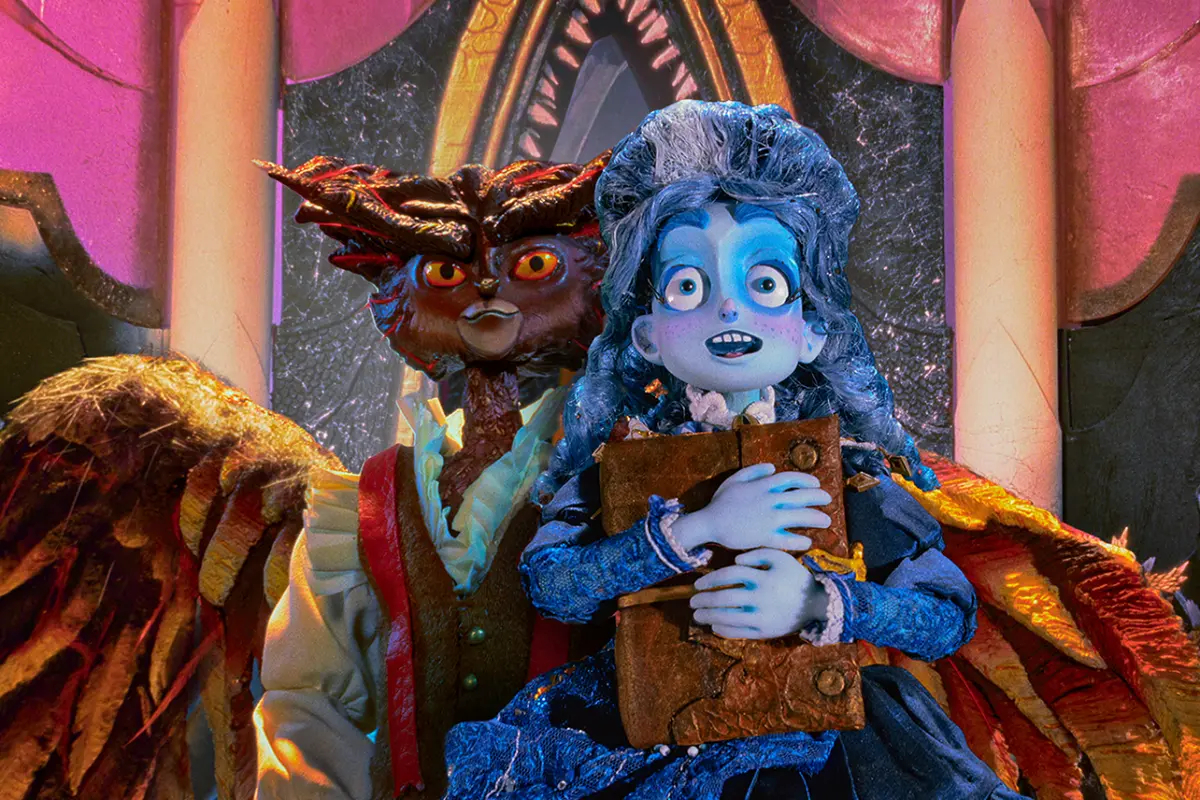
Mexican stop-motion animated film I Am Frankelda (now on Netflix) is as phantasmagorical as phantasmagorias get. As bizarre as it is beautiful, the movie is a product of the wild imaginations of Mexican sibling filmmakers Roy and Arturo Ambriz, who originally developed the idea — about a Mary Shelley-esque writer of scary stories named Frankelda — for a five-episode series, Frankelda’s Book of Spooks, that ran on Cartoon Network in Latin America, and can currently be streamed on HBO Max (note: the film stands on its own, so watching the series first isn’t necessary). Their story for a prequel special ballooned to feature length, and the film drew acclaim at a few festivals before Guillermo del Toro His Damn Self helped the Ambriz brothers with a tighter edit, which eventually was scooped up by Netflix for worldwide distribution. And one glance at the imagery tells us that the Ambrizes enjoyed some assistance from one of their biggest influences.
The Gist: REAL DEL MONTE, MEXICO, 1866. Devastated by her mother’s passing, rejected by her peers as being a weirdo, and under the thumb of her gargoylish grandmother, young Francisca Imelda (Mireya Mendoza) escapes her sad reality by writing scary stories. But as a narrator intones, “That which you imagine, imagines you.” Translation: Francisca’s stories come to life in another dimension. Where she dwells in the Realm of Existence, her characters populate the Realm of Terrors, which sups on the fears of humans. So while Francisca darns sock after sock after sock at the behest of her crappy grandma — a job the old bag deems the domain of women — she secretly stays up all night scribbling stories of princes and monsters and the politics of a world where nightmares are crafted to be dropped in human brains while they sleep. The more potent those nightmares are, the more prosperous the realm becomes.
But if those nightmares are bog-standard ditties about inexplicably pantsless people standing in front of crowds, the Realm of Terrors — a.k.a. Topus Terrenus — will crumble. Within this realm is an entire mountain range of lore delivered via copious exposition that means the plot spends roughly 30 minutes spinning its wheels, but at least the imagery therein is impressively bonkers. Topus Terrenus is under the leadership of a king and queen and their prince son, Herneval (Arturo Mercado Jr.), who resemble owl-human hybrids. The realm is withering because its chief writer, a righteously weird-looking spider person named Procustes (Luis Leonardo Suarez), sucks major butt at spinning nightmares, and exhibits the classic boastful ego of someone who’s deeply insecure about their crushing mediocrity. Hack city, man.
Now, this is the type of movie that forces one describing it to use the phrase, “what with one thing and another,” as a substitute for either an inordinate amount of detailed world-building or the handwaving of the hows and whys of some of that detail; this movie kinda wavers between both. So, what with one thing and another, Herneval figures out how to bridge the expanse to the human world, where he learns that Francisca can write circles around Procustes, since she essentially created him and the Realm of Terrors. And, I think, he created the Realm of Existence? Since, “that which you imagine, imagines you,” right? I think?
Anyway, Herneval wants to downsize Procustes and hire Francisca, now going by the nom de plume Frankelda, to replace his incompetent ass, which prompts the manipulative, duplicitous spider to provoke a rebellion against Herneval and the established hierarchy of the realm, which is composed of various clans and factions of fairies and wraiths and demons and miscellaneous indescribables. I’m a little confused about how all this works, and a little bulldozed by the discussions of “shaping human subconsciousness” and musical numbers with refrains including the words (translated from Spanish, mind you) “an inherent paradox,” but considering the delightful phantasmagoria of it all, I’m not sure total comprehension matters too much in this case.
What Movies Will It Remind You Of? Frankelda is deeply indebted to The Nightmare Before Christmas and the Tim Burton aesthetic, as well as del Toro’s Pinocchio, all of them essentially extensions of Ray Harryhausen’s work (see: The Beast from 20,000 Fathoms, etc.). And the handcrafted labor-of-love feel of the animation recalls similarly singular projects like Mad God and the mostly forgotten 9.
Performance Worth Watching: The work of the animators. You could watch Frankelda six times and not catch all the visual minutiae here.
Sex And Skin: None.
Our Take: I Am Frankelda is remarkably overstuffed, the density of the concept prompting us to debate the difference between “labored” and “tortured,” although that jells perfectly with the busy-busy-busy visuals, which sometimes challenge us to find a focal point among the plethora of motion and intricate set and character design. But at least the Ambrizes’ ambition is cohesive, and the onslaught of imagination on display — culled from other films as much as Mexican folklore and classical fine art — urges one to be an apologist and interpret “All This” as the product of Frankelda pouring everything she’s got into her creations. She’s an artist, she’s driven, she really has no other option but to create.
You’ll be compelled to forgive the film for its sprawling, dense narrative, which tends to pull focus on its core characters, Frankelda and Herneval — “All This” includes their tentative, underdeveloped romance — and get distracted by the introduction of piles of side players, all of whom wow us with their own distinctly detailed design. It’s ultimately the good kind of bewilderment we feel while watching this unfettered explosion of imagination, which is ultimately the vast thematic umbrella under which the filmmakers built their world. Dreams and nightmares are products of our imaginative minds; the stories we tell reflect ourselves, our communities and our histories; storytelling is the very heart of art itself; the mundanity of reality is balanced by the ebullient escapism of fantasy.
Whether such a conglomeration of ideas is coherent may be beside the point. Consider the inexplicable compulsion some artists experience as they sculpt or sing or write. Perhaps that’s how the Ambriz brothers felt as they painstakingly Frankenstein-ed their intricate puppets and sets and brought them to life through stop-motion, sometimes deviating into visual representations of oil paintings and paper-doll dioramas or the stuff of musical theater. They understand the importance of storytelling in human culture and quietly address the torment artists endure, whether it’s self-doubt (Frankelda is her own worst critic) or the struggle to be original (a thread involving Procustes can be summed up thusly: Don’t plagiarize, kids!). Frankelda may be maximalist nearly to a fault, but it ultimately underscores that stories concocted with passion, intent and purpose are transcendent, and maybe even immortal.
Our Call: The moments where I Am Frankelda made our eyes cross with its too-big-a-wad-of-bubble-gum concept are ultimately offset by its superabundance of visual wonder. STREAM IT.
John Serba is a freelance film critic from Grand Rapids, Michigan. Werner Herzog hugged him once.