

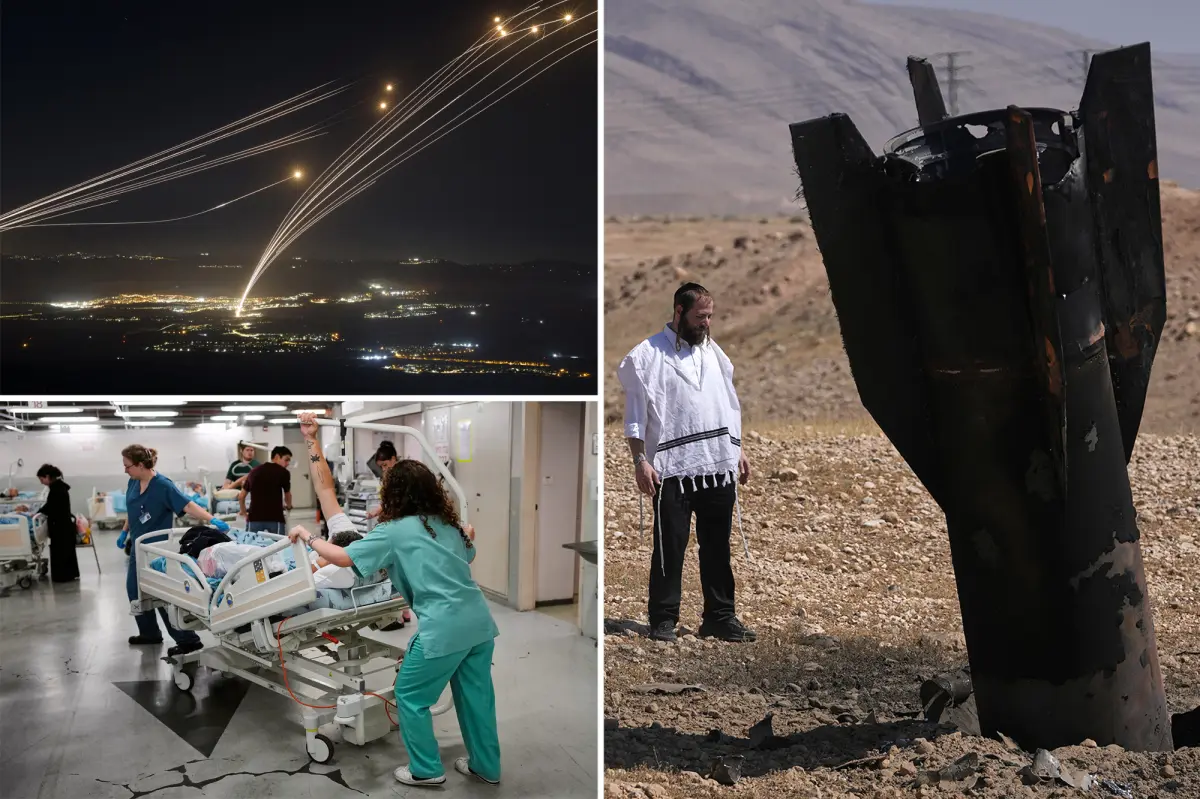

“Watch the sky tonight.”
The ominous words appeared on my phone somewhere over the eastern Mediterranean.
After 10 hours in the air from New York, I was scrolling for developments in the Middle East during the final stretch of a flight bound for Tel Aviv when I came across the breaking news warning from an Iranian official.
Hours earlier, Israel had struck Beirut’s Dahiyeh district, a Hezbollah stronghold in Lebanon’s southern suburbs. Tehran was promising retaliation.
“We will give a decisive and painful response to the Zionist regime’s attack on the suburbs. This rabid dog must be disciplined and put in its place. Watch the sky of the occupied territories tonight,” Ebrahim Rezaei, spokesman for Iran parliament’s foreign policy and national security committee, wrote on X.
Despite being in the targeted airspace at the time, the threat felt distant. Abstract.
Then the plane landed.
Passengers applauded as the wheels touched down at Ben-Gurion Airport. It was a familiar scene to anyone who has flown. Families reunited. Suitcases rolled through arrivals. Taxi drivers waited outside.
That normalcy is one of the first things that strikes an outsider arriving in Israel during wartime – even during a particularly volatile period.
Beyond the terminals, cars moved steadily along the highways. Tennis courts were occupied under floodlights. People queued outside pizza shops without an apparent care in the world. The Mediterranean stretched peacefully into the darkness.
And yet everywhere you look there were signs pointing toward protected areas, marked by the silhouette of a figure running toward a bomb shelter.
Life and war do not exist on opposite sides of the world here.
They exist side-by-side.
Before I’d even made it from the airport to a hotel, the illusion of distance quickly evaporated.
“Iran just launched an attack right now,” my panicked taxi driver told me after taking a call from his wife and switching on the radio.
His face dropped as he listened.
“We hope they are not close the airport again. No working. Everything is closed. No taxi. Who I take? No people in the streets. The airport is closed. No restaurant. No schools,” he explained.
“We don’t have war three months. Now again.”
As we drove toward Tel Aviv, dull booms echoed in the distance.
At first I wasn’t sure what I was hearing.
Then came another. And another.
Missile interceptions.
Somewhere overhead, Israel’s Iron Dome – a layered air defense system that uses radar to track incoming rockets and missiles before launching interceptors at those projected to hit populated areas — was already going to work.
The driver explained that missiles had struck northern Israel minutes earlier. News alerts which supported this quickly followed. Schools would close. Workplaces would shut. The country was preparing for another round of uncertainty.
Outside the car window, however, little seemed to change.
That juxtaposition — ordinary life unfolding beneath an active missile threat — would become the defining image of my first days in Israel.
‘A nation fighting for survival’
To much of the world, Israel appears as the region’s dominant military power: a technologically advanced state with one of the world’s most capable armed forces, sophisticated intelligence services and American backing.
But what is often overlooked is the reason they got there in the first place and why they haven’t fully backed down, according to many Israelis who spoke to news.com.au.
Israel is confronting threats on multiple fronts — Iran directly, Hezbollah in Lebanon, Hamas in Gaza, the Houthis in Yemen and Iranian-linked forces operating in Syria.
While critics argue its military campaigns risk perpetuating a wider regional war, supporters view them as necessary acts of self-defense.
After years of rocket fire, the October 7 attacks, security concerns and ongoing threats from Iran-backed terror groups, many Israelis see their country not as aggressors but as a nation fighting for its survival.
‘The only language they understand is missiles’
The resulting paradox sits at the heart of the current conflict: a tiny country capable of projecting enormous force that also genuinely believes it is facing existential threats.
Israeli officials argue that even offensive military action against Iran and its proxies is defensive because the objective is to protect their people from an onslaught of attacks and keep terror out – rather than conquer territory or achieve regime change.
“(The Iranian regime is) not willing to compromise,” Israeli depute foreign minister Sharren Haskel said at a press briefing attended by news.com.au in Jerusalem.
“We’ve tried negotiating for decades. The only language they understand is missiles.”
That argument surfaced repeatedly throughout my trip.
In bomb shelters. During military and press briefings. Inside health facilities. At Israel’s northern border.
And in conversations with ordinary people trying to navigate daily life under the threat of missiles and enemy attacks.
Whether one agrees with that assessment or not, understanding it is essential to understanding how many Israelis view the war.
‘A full week of continuous strikes’
In the short time it took to get from the airport to my hotel in Tel Aviv, Iran had launched a wave of missiles at Israel for the first time since the April ceasefire and declared this would be the beginning of “a full week of continuous strikes”.
As I approached the front desk at the hotel to check-in, the receptionist was fielding calls from guests asking where they should go if the attacks intensified.
She then turned to me and calmly explained the shelter procedures.
The tone was striking. She sounded less like someone preparing guests for incoming missiles and more like a concierge explaining how to access the swimming pool.
“You have a minute and a half to get to a shelter between the warning and it hitting,” the receptionist explained.
“It depends where the rockets are from as to how much time you have.
“Sometimes if it’s from Iran, you’ll get more of a warning beforehand – just start going.
“You will need to stay until we tell you to come back.”
The next morning, at 5.53am, I learnt just how important it had been to listen to those instructions.
A voice boomed over the hotel’s loudspeaker. There was “a rocket in our area”.
Moments later, air raid sirens wailed across Tel Aviv.
Half asleep, I rushed toward the closest shelter. By the time I arrived, the danger had already passed. The missile, launched by the Houthis in Yemen according to Israeli authorities, had been intercepted.
An hour later, another alert arrived. This time it was Iran firing rockets towards us.
By 9.40am, another one. Iran again.
Phones buzzed. Sirens sounded. People playing beach volleyball scrambled towards the boulevard. Hotel guests filed into reinforced rooms with practized efficiency. Hospitals moved patients underground.
One local told me he could distinguish incoming fire from outgoing interceptions by sound alone.
For visitors, the experience can be surreal. For Israelis, it has become routine.
“In New York they have snow days,” one Israeli observer joked later in the week, referring to the Empire State’s rules that sees schools and other infrastructure shut down when the weather is extreme.
“In Israel we have missile days.”
The deeper question, however, is why so many Israelis support military operations that much of the outside world increasingly views as aggressive and inhumane.
Since its creation in 1948, the State of Israel has been surrounded by those seeking its destruction.
However, locals who spoke to news.com.au said the answer leads back to October 7, 2023 when members of Hamas mounted a series of attacks and raids targeting Israeli citizens in the Gaza Envelope border area of Israel. Hundreds of Israelis and foreigners were kidnapped and more than 1200 people were killed, including children.
“Most of the people who were slaughtered by Hamas in Israel around Gaza were very left,” one Israeli local said.
“They believed in a two-state solution. They helped people in Gaza. They brought people from Gaza to medical treatment inside Israel.
“These people, they died first.”
Almost every conversation I had with locals eventually returned to this event.
The barbaric attacks fundamentally altered how many Israelis think about security, deterrence and risk. It proved to them that their fears about such attacks had been warranted all along.
Another Tel Aviv resident who spoke on the condition of anonymity argued that the country’s strategic mindset changed after the massacre.
“From 1948 until now, usually we just defend,” he said.
“Now, from October 7, we changed the script. We don’t wait to be only defensive anymore. We attack.”
That view exists alongside growing international criticism of Israel’s conduct in Gaza, where Palestinian deaths have mounted and human rights groups have accused Israel of disproportionate force, genocide and widespread destruction.
While the Israeli military insists that it gives ample evacuation notice to civilians in target zones, human rights organizations, the United Nations, and local residents report several severe systemic flaws that prevent them from safely escaping.
“It is not Israel who is wreaking havoc on its own people or posing a risk to the rest of the world,” Beni Sebti, an Iran specialist at the Institute for National Security Studies, said at a meeting attended by news.com.au in Tel Aviv.
“The Iranian regime’s mentality is different. Hamas and Hezbollah are terror organizations. “They are so radical. And you cannot talk to them.
“Israel is fighting back against these terror regimes – not against civilians. Its hands are tied.”
‘It’s them or us’
Gaza remains gripped with daily violence despite a formal ceasefire in place since October 2025, with both parties regularly accusing one another of violating the truce.
Israeli Prime Minister Benjamin Netanyahu has also come under fire for his country’s attacks on Lebanon but this week asserted that Israeli forces would remain there “for as long as necessary” regardless of any US-Iran agreement.
Lebanon was pulled into the war in early March when Iran-backed Hezbollah launched rockets at Israel after the killing of Iran’s supreme leader, prompting Israeli strikes and a ground invasion.
“We established deep security zones around the state of Israel,” Mr Netanyahu said, referring to the occupation area on the border where Israel has forcibly expelled more than one million Lebanese civilians and systematically demolished dozens of villages.
“I want to make it clear: We will remain in these security zones … to protect our country.”
US President Donald Trump this week stated he had “a great relationship with Bibi, but now Bibi has to be more responsible with respect to Lebanon”.
“You don’t need to knock down an apartment every time you’re looking for somebody,” he said on Tuesday.
“If Israel can’t do the job (of fighting Hezbollah) without killing everyone else, Syria should do the job.”
He added that the ongoing invasion “throws a negative light on the big deal, and that’s the deal with Iran”.
But Israel’s hands are ultimately tied, according to Mr Sebti.
“Israel has a huge problem that is a very small country. Iran is 80 times the size of Israel. Iran is with every missile that is shot towards Israel, Israel is fighting for the survival of its people and country as a whole,” he said.
‘Doing the dirty work’
The government’s logic is straightforward: if threats from Iran and the terror groups they support go unchecked — whether from Hezbollah in Lebanon, Hamas in Gaza, the Houthis in Yemen or Iran itself — the cost will be higher at their expense.
Critics argue that preventive military action can itself fuel escalation and perpetuate cycles of violence.
Supporters counter that waiting for attacks to occur first is precisely what failed on October 7.
“It’s them or us,” an Israeli whose daughter was killed by Hamas in the attacks told news.com.au at the Nova Festival massacre memorial site.
That debate now sits at the centre of Israel’s military strategy and security policy known as the “Octopus Doctrine” or the “Israeli Octopus”, according to a high-ranking IDF member who spoke to news.com.au on the condition of anonymity.
In this framework, Iran is viewed as the “head of the octopus” – the central force supporting a network of armed groups across the region with funding, advanced weaponry, training, and strategic direction – which must be addressed.
Whether that approach ultimately produces greater security remains deeply contested.
German Chancellor Friedrich Merz previously endorsed Israel’s air strikes on Iran during an interview on the sidelines of the G7 summit in Alberta, Canada last year.
He said Israel was “doing the dirty work for all of us” by fighting back against a regime and its proxies that have “brought death and destruction to the world.”
“Merz summed it up perfectly,” an Israeli restaurant worker told news.com.au after reciting his 2025 quote verbatim.
“We’re using force to take on terrorists because they surround us and we have no choice. But it’s not only Israel that benefits.”
For many Israelis living with regular missile alerts and the threat of attacks, Merz’s argument is one that resonates.
As the week progressed, evidence of that siege mentality appeared everywhere.
Roadside bomb shelters more ubiquitous than bus stops in many parts of Israel.
Reinforced safe rooms built into every modern apartment now required by law.
Children growing up knowing exactly how long they have to reach safety.
“You don’t count casualties in Israel because there are very few, right? But we are the casualties of this war in a different way,” Alma Research and Education Center founder Sarit Zehavi said.
“My daughter hardly went to school since October 8.
“That’s life here.”
‘We’re sitting ducks’
By the end of my first 12 hours in Israel, I had already heard missile interceptions overhead, sprinted to a bomb shelter before breakfast then twice soon after, and watched hotel staff discuss incoming rockets with the same composure most people reserve for weather forecasts.
For many Israelis, the gap between how the conflict is perceived abroad and how it is experienced by those living it is, in part, why a large portion reject the idea that their country is an aggressor in this war.
To them, the missiles are more than just a trigger for an alternate alarm clock or a regular inconvenience.
They are a constant reminder of the threat posed to their very existence by those who seek to destroy Israel.
“Nothing is 100 percent,” another Tel Aviv local told me while spruiking Israel’s “lifesaving” Iron Dome and advanced weaponry.
“But without it we’re sitting ducks so thanks God that we have these systems today.
“Hamas and Hezbollah and all of the others like them must be neutralized for the sake of the world.
“Israel is just the only country with the guts to do it but that’s also because we to.”
On Monday, Israel’s prime minister claimed that the joint US-Israeli military campaign against Iran had spared his country from what he described as the Islamic republic’s threat of “nuclear annihilation”.
Ben Azra Haim, an Israeli taxi driver who drove me to the airport at the end of my trip, agreed with that sentiment.
He also credited Israel with preventing hostile states from obtaining nuclear capabilities, citing Israeli operations against Iraqi and Syrian nuclear facilities in previous decades.
“My feeling is, as a Jewish guy, we saved the world three times already,” he said.