

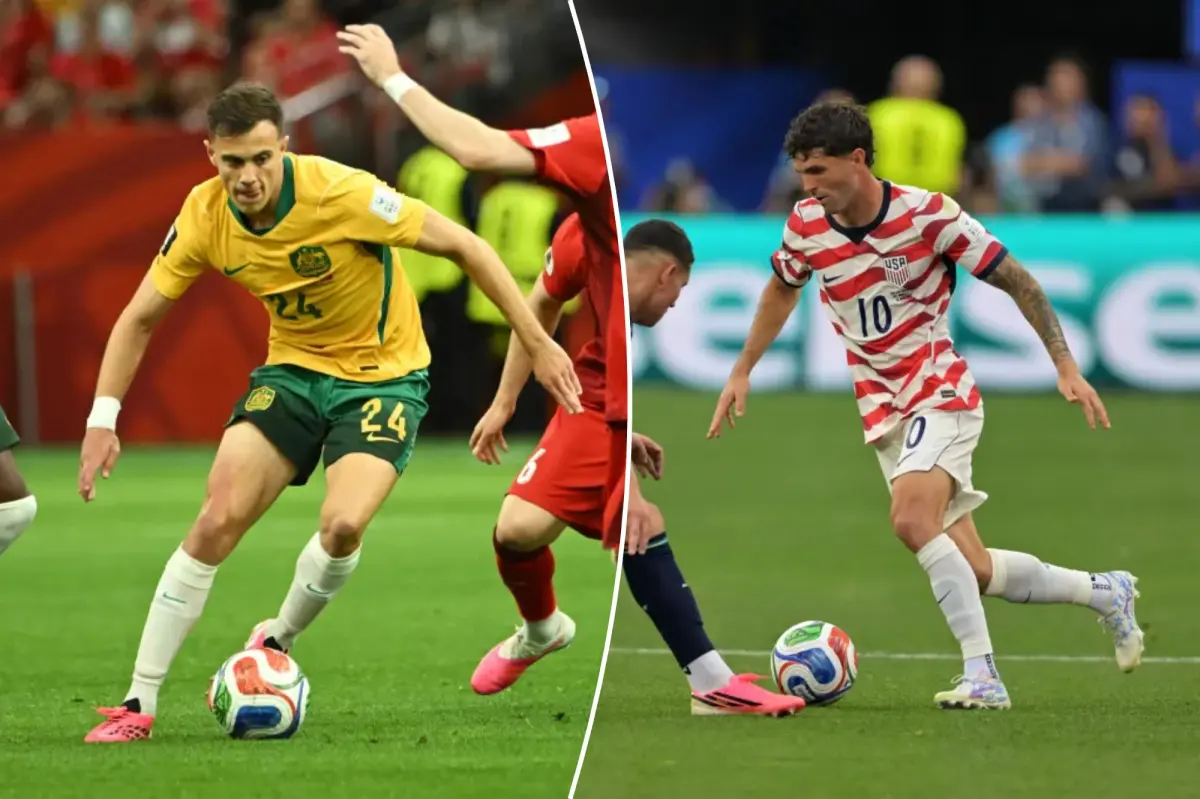

SEATTLE — There’s been a perception among the pundit class that Australia represents an easy opponent for the U.S. men’s national team.
That is far from the reality.
Australia, just like the USMNT, can clinch a spot atop Group D on Friday. The U.S. needs a win and a Paraguay win or tie against Turkey later in the evening; Australia needs a win and a Turkey win or tie.
With the U.S. riding a 4-1 win over Paraguay in its opener, and having beaten Australia in a friendly back in October, the Americans are certainly the favorites Friday, but the match will be far from simple.
The Post breaks down the matchup between the U.S. and Australia:
When the U.S. has the ball
The most revealing moment in the lead-up to this match came Thursday when Sergiño Dest was asked about the best USMNT players in one-on-one situations, aside from himself.
“I think Christian is a really good one-on-one player,” Dest said. “It depends. Let me stay with Christian.”
This is both true and particularly important against Australia, given the 5-4-1, low-block setup in which the Socceroos will operate out of possession. The most obvious way to beat that configuration is to get the ball out wide in 1-on-1 situations and have the skill to dribble past defenders — in other words, the thing that Pulisic, whose injury situation hangs over this game, excels at. Right now, though, it’s unclear whether the USMNT will have Pulisic, with manager Mauricio Pochettino saying at his press conference Thursday that he doesn’t yet know whether his best player can go.
With or without Pulisic, the USMNT will realistically have a lot of the ball in this game. The possession stats from Australia’s opener against Turkey were ridiculous — per FIFA’s data, the Turks had 63 percent possession, led the shot count 30-9, had 130 line breaks to 54 and kept Australia in a low block for 56 percent of the time it was out of possession. Australia won that game 2-0, though, in part because its keeper, Patrick Beach, who surprisingly started over Mathew Ryan, made a terrific eight saves and in part because the defense in front of him was excellent. All three of Australia’s center backs — Alessandro Circati, Harry Souttar and Cameron Burgess — are 6-foot-3 or taller, with Souttar at 6-6. Aerial duels, an area in which the USMNT already doesn’t excel up front, seem like a losing battle here.
Paraguay also let the USMNT play in possession but this will be different. Australia plays deeper, it figures to be more physical and it has leaned heavily into its underdog status. If Pulisic can’t go, or is hampered in some way, the U.S. figures to be far more reliant on Dest to make things happen along the right side, and on Malik Tillman — who played in Pulisic’s left attacking midfield spot once Pulisic came off against Paraguay.
When Australia has the ball
You figure there won’t be much extended buildup from the Socceroos in this game, but what’s scary is how fast they can get on the counterattack. Their first goal against Turkey, a long ball from Paul Okon-Engstler to Nestory Irankunda that the latter turned into a brilliant finish, is an excellent example of how quickly Australia can make something happen.
The secret is out about Irankunda after his brilliant performance against Turkey; the 20-year-old is immensely talented on the ball and can always make something happen. Striker Mohamed Touré isn’t far behind. Wingback Jordy Bos and midfielder Connor Metcalfe are worth watching out for, and the height Australia has at the back makes it a threat on set pieces.
The USMNT has set up aggressively when it has the ball, and the transition phase after turnovers will be absolutely crucial. Australia looks to play in behind and go forward fast. For Tim Ream, Chris Richards and Tyler Adams, that’ll likely mean a lot of responsibility, and Adams will have to navigate playing on a yellow card.
One thing we never saw in the Turkey game is how Australia responds when playing from behind. Obviously, that would demand a little more aggression as opposed to bunkering in like the Socceroos did in that game. If there’s more extended buildup, Australia’s midfield overload can be dangerous, creating space for its wingbacks, and its 5-4-1 can become more of a 3-4-3.
Intangibles
The expectation for the crowd in Seattle is no less than the loudest building in U.S. Soccer history. Given the city’s soccer culture, this ticket being the cheapest of any of the three group games, the game falling on a holiday and Lumen Field’s acoustics, it seems a reasonable proposition.
Australia does have some good us-against-the-world energy, using comments from American pundits such as Mike Grella, who called the game a “layup” for the USMNT, as fuel. It used the same thing to good effect against Turkey after Turkey’s captain, Hakan Çalhanoglu, dismissed Australia as a team with less talent and quality than the Turks. Unlike the U.S. with Adams, no Australians will come into the game with a yellow card.
Prediction: A 3-1 USMNT win that looks tighter than the score suggests.