
4 min readUpdated: Jul 1, 2026 02:46 AM IST
For over six weeks, “Did AI write this?” was the recurring query attached to the entries of three of five regional winners of the 2026 Commonwealth Short Story Prize. Now, Trinidadian writer Jamir Nazir, 61, who wrote ‘The Serpent in the Grove’, the first story accused of AI-plagiarism, which led to further outcry, has been named the 2026 overall winner of the £5,000 (₹6,23,500) award.
Nazir, whose LinkedIn bio says he works on “organizational effectiveness and business development” has denied the allegations on LinkedIn, according to trinidadexpress.com, though the post was no longer visible at the time of filing this report. He also told The Observer that he had an unconventional writing process because a chronic health condition makes “sustained desk-bound writing” difficult, so he writes almost entirely via speech-to-text on his Android phone, followed by light keyboard editing.

The controversy
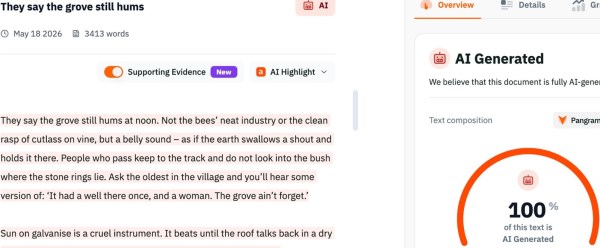 A screenshot of the Pangram AI detection result for Jamir Nazir’s ‘The Serpent in the Grove’ . (X@@EneaszWrites)
In keeping with a 14-year tradition, the British literary magazine Granta published the five 2026 regional winners, who were finalists for the overall prize, on May 12. The winners had been selected from among 7,806 entries, the second-highest in the prize’s history. The Serpent in the Grove was Nazir’s winning entry from the Caribbean region. Judge Sharma Taylor praised the story for its “polished and confident” prose, whose “melodic voice lingers long after the final line.”
Immediately after publication, there was an outcry as readers identified markers of AI-generated slop in his prose. Researcher Nabeel S Qureshi was among the first to publicly argue that the story’s sentence construction read as machine-generated, while Wharton professor Ethan Mollick after running the text through the AI-detection tool Pangram wrote on social media that a “100% AI generated story” had just won the Caribbean regional prize worth £2,500 (₹3,11,750). Once the post circulated, readers ran the other four regional winners through the same AI detection software. Pangram flagged John Edward DeMicoli’s “The Bastion’s Shadow” (Malta) as 100 percent AI-generated, and Sharon Aruparayil’s “Mehendi Nights” (India) as partially machine-generated, which she categorically denied in an email interview with indianexpress.com. A Pangram research scientist later said three of the five 2026 regional winners appeared at least partly machine-written, a first for the prize, since the company had found no such flags in winning entries from prior years. Some internet sleuths also ran Nazir and Aruparayil’s photographs through an AI detector and found them to be AI-generated as well, even judges’ remarks failed to pass muster.
The foundation’s response
Commonwealth Foundation director-general Razmi Farook initially defended the judging process, saying the foundation does not run submissions through AI checkers because doing so would raise “concerns surrounding consent and artistic ownership” for unpublished work. Granta’s publisher, Sigrid Rausing, however, asked claude.ai whether “The Serpent in the Grove” looked AI-written, and got a positive response, but the action was derided on ground of the LLM not being the right conduit to check AI plagiarism, raising concerns over AI literacy among publishers and editors. Granta subsequently announced it would no longer publish the prize’s regional winners going forward over concerts of editorial integrity.
June, following an internal review, the foundation cleared all finalists of AI accusations following an internal review, and backed their claim to the prestigious award. The Foundation said they had held detailed conversations with all five regional winners and reviewed their working drafts, time-stamped documents, and notes. Farook announced on June 22 that the foundation was “satisfied that AI was not used to write the winning stories” and would proceed with the regional winners as selected.
Pangram, the tool at the center of the flags, has separately published its own data on how often it wrongly accuses human writers. The company reports an overall false-positive rate of roughly 1 in 10,000, dropping to about 0.01 percent specifically for creative writing.
Story continues below this ad
The idea of a story written with the assistance of a not winning a literary prize has led to a reckoning over what is considered good post-colonial literature, and whether the Commonwealth Foundation is relevant anymore.