
Take a look at the essential events, concepts, terms, quotes, or phenomena every day and brush up your knowledge. Here’s your UPSC Current Affairs knowledge nugget for today on Strawberry Moon.
June’s full moon, popularly known as the Strawberry Moon, is set to light up the night sky. Despite its name, the moon does not appear pink or red. Instead, the name comes from the strawberry harvesting season observed by Native American tribes. In this context, let’s know about it and other astronomical events such as blue moon and Micro moon.
1. The main attraction of June’s Strawberry Moon is how low it appears in the sky when viewed from the Northern Hemisphere. It rises in the southeastern sky and is close to the horizon. Unlike a winter full moon that rises high overhead, the Strawberry Moon follows a low path across the southern sky, lingering close to the horizon throughout the night.
2. The name ‘Strawberry Moon’ comes from Native American Algonquian tribes, who associated June’s full moon with the brief season when wild strawberries ripen and are ready to be harvested, according to the Old Farmer’s Almanac.
3. While the Strawberry Moon does not actually appear larger than usual, it can seem bigger when it is close to the horizon because of the Moon illusion. This is essentially an optical illusion that makes the Moon look larger against buildings, trees, and other objects.
4. At the same time, its light passes through more of Earth’s atmosphere, scattering shorter blue wavelengths and giving the Moon a warm golden or orange glow.
5. This year’s Strawberry Moon is also the first full moon of summer in the Northern Hemisphere, adding to its seasonal significance.
Story continues below this ad
6. The June Strawberry Moon will reach peak illumination at 7:57 pm. EDT (11:57 pm GMT) on June 29. At that moment, the Moon will be directly opposite the Sun in Earth’s sky, making its Earth-facing side appear fully illuminated.
7. This year’s June full moon will also follow the lowest path across the sky of any full moon, as it occurs close to the Northern Hemisphere’s summer solstice. As a result, it will appear unusually low above the horizon, creating a striking sight for skywatchers.
Blue moon
1. Though the expression “once in a blue moon” implies a rare or unusual occurrence, a blue moon is not that rare an astronomical event.
2. There are a few definitions of a blue moon. One that is most commonly understood — and endorsed by NASA — describes a situation when a full moon is seen twice in a single month. Because the new moon to new moon cycle lasts 29.5 days, a time comes when the full moon occurs at the beginning of a month, and there are days left still for another full cycle to be completed.
Story continues below this ad
Full Moon Explainer: Strawberry Moon, Blue Moon & More
June Full Moon · Summer Solstice
Why the Strawberry Moon Hugs the Horizon
June’s full moon occurs near the summer solstice, when the Sun is at its highest point in the sky. Since the full moon always sits opposite the Sun, it follows the lowest arc of any full moon — rising in the southeast and lingering close to the horizon all night. This year it reaches peak illumination on June 29 at 7:57 pm EDT.
Jun 29
Peak illumination date (2026)
7:57 pm
EDT — Moon directly opposite the Sun
Lowest
Sky path of any full moon all year
🍓
Name origin: Algonquian tribes named June’s full moon after the brief wild strawberry harvest season — not the Moon’s colour. It does not appear pink or red.
Optical Phenomenon
The Moon Illusion: Bigger Near the Horizon?
The Strawberry Moon does not actually appear larger than usual — but it can seem so when near the horizon. This is the Moon illusion: the brain compares the Moon against nearby buildings and trees, judging it as bigger than when it hangs alone overhead with no reference objects.
◆
Reference object effect
Near the horizon, buildings and trees give the brain a size reference — making the Moon look larger by comparison. High in the sky, there are no nearby objects, so the brain perceives its true size.
★
Atmospheric colour shift
Moonlight near the horizon passes through more of Earth’s atmosphere. Blue wavelengths scatter away, leaving a warm golden or orange glow — adding to the dramatic visual effect.
●
Science check
The Moon’s distance from Earth does not change significantly during one night. The size difference is entirely perceptual — in the mind, not in the sky.
Lunar Calendar · NASA Definition
Blue Moon: Not So Rare — and Rarely Blue
A Blue Moon occurs when two full moons appear in a single calendar month. Because the lunar cycle is 29.5 days — shorter than most months — a full moon on the 1st or 2nd leaves enough days for a second one before month’s end. NASA says this happens every two to three years.
29.5
Days in a lunar cycle (new moon to new moon)
2–3 yrs
Between Blue Moons — next at end of 2028
●
Colour myth: Smoke or dust can scatter red wavelengths, making the Moon appear bluish in some places — but this has no connection to the term “Blue Moon.” The colour association remains unexplained.
Orbital Distance · Elliptical Path
Micromoon vs Supermoon: Distance Decides
The Moon’s orbit is elliptical, not circular. It completes one orbit every 27.3 days, but its distance from Earth changes — and that changes how large it appears in the sky. A full moon near the farthest point is a Micromoon; near the closest point, a Supermoon.
Micromoon · Apogee
4,03,945 km
Farthest orbital point — full moon appears smaller and dimmer than usual
Supermoon · Perigee
3,63,711 km
Closest orbital point — full moon appears larger and brighter than usual
⚠
Rare combo — Blue Micromoon: Two full moons in one month, with the second near apogee. The next one will not occur until 2053, per NASA.
Earth’s Shadow · Full Moon Phase
Three Types of Lunar Eclipses
Lunar eclipses occur only at full moon phase, when Earth sits precisely between the Moon and the Sun. The type of eclipse depends on how deeply the Moon enters Earth’s shadow — umbra (inner) or penumbra (outer).
●
Total Lunar Eclipse — “Blood Moon”
Moon moves fully into Earth’s umbra (inner shadow). Sunlight filtered through atmosphere reaches the Moon — blue-violet wavelengths scatter, leaving a red-orange glow.
◆
Partial Lunar Eclipse
Imperfect Sun-Earth-Moon alignment — the Moon passes through only part of the umbra. Shadow grows and recedes without ever fully covering the Moon.
★
Penumbral Eclipse — Barely Visible
Moon travels through Earth’s faint outer shadow (penumbra) only. The dimming is so slight it can be difficult to notice with the naked eye.
→
Solar Eclipse — Key Difference
Occurs at new moon phase (not full moon). The Moon positions itself between Earth and the Sun, blocking sunlight from reaching Earth.
At a Glance · Three Full Moon Phenomena
Strawberry Moon vs Blue Moon vs Micromoon
All three involve a full moon — but each has a completely different cause, visual effect, and frequency. Here’s how they differ.
🍓
Strawberry Moon — Every June
Cause: Seasonal — full moon near summer solstice. Effect: Lowest sky path, golden-orange glow near horizon. Name: Algonquian harvest calendar — not the Moon’s colour.
●
Blue Moon — Every 2–3 Years
Cause: Calendar — 29.5-day lunar cycle vs 30/31-day month. Effect: No visual difference from a regular full moon. Next: End of 2028.
◆
Micromoon — Several Per Decade
Cause: Orbital — full moon near apogee (~4,03,945 km). Effect: Appears slightly smaller and dimmer. Rare combo: Blue Micromoon next in 2053.
Sources: Old Farmer’s Almanac · NASA · Indian Express Knowledge Nugget (June 28, 2026)
3. Such a month, in which the full moon is seen on the 1st or 2nd, will have a second full moon on the 30th or 31st. According to NASA, this happens every two or three years.
4. Sometimes, smoke or dust in the air can scatter red wavelengths of light, as a result of which the moon may, in certain places, appear more blue than usual. But this has nothing to do with the name “blue” moon, and the association of the colour with the term is unclear.
Micro moon
1. The size of the moon, as perceived from earth, is dependent on its location within its orbit around the earth. The moon’s orbit is an elongated or stretched-out circle and it takes 27.3 days to orbit the earth.
2. According to NASA, the moon is about 363,711 km away at its closest to earth, known as perigee. At apogee, or the furthest point, the moon is about 403,945 km away.
Story continues below this ad
3. A smaller-than-usual moon is observable when the Moon’s fully illuminated phase occurs within a short time of apogee. On the other hand, a supermoon occurs when the moon is passing through or is close to its perigee.
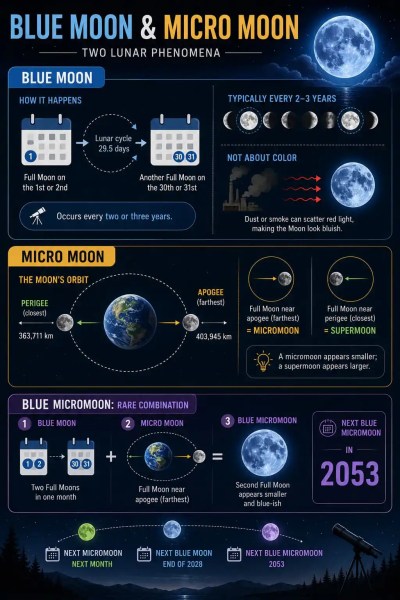
4. Notably, when seen in terms of both (Blue and micomoon) phenomena happening simultaneously, then it is a rare event. “Although the next micromoon occurs next month, and the next blue moon at the end of 2028, the next blue micromoon will not occur until 2053,” NASA stated.
BEYOND THE NUGGET: Lunar eclipse
1. There are two types of eclipses: lunar and solar. During a lunar eclipse, Earth’s shadow obscures the Moon. During a solar eclipse, the Moon blocks the Sun from view.
2. Lunar eclipses occur at the full moon phase. When Earth is positioned precisely between the Moon and the Sun. Solar eclipses occur only at the new moon phase, when the Moon is positioned between Earth and the Sun.
3. Types of Lunar Eclipses
Story continues below this ad
(i) Total lunar eclipses: The Moon moves into the inner part of Earth’s shadow, or the umbra. Some of the sunlight passing through Earth’s atmosphere reaches the Moon’s surface, lighting it dimly. Colors with shorter wavelengths ― the blues and violets ― scatter more easily than colors with longer wavelengths, like red and orange.
(ii) Partial lunar eclipse: An imperfect alignment of Sun, Earth and Moon results in the Moon passing through only part of Earth’s umbra. The shadow grows and then recedes without ever entirely covering the Moon.
(iii) Penumbral eclipse: The Moon travels through Earth’s penumbra, or the faint outer part of its shadow. The Moon dims so slightly that it can be difficult to notice.
Post Read Question
With reference to the lunar eclipse, consider the following statements:
Story continues below this ad
1. A lunar eclipse occurs when the Moon moves between the Sun and the Earth.
2. Lunar eclipses take place once a year around the world.
3. All the lunar eclipses are visible from India.
How many of the statements given above are correct?
(a) Only one
(b) Only two
(c) All three
(d) None
ANSWER KEY
(d)
(Sources: June Strawberry Moon 2026: What is it, when to watch it in India, UPSC Weekly Concepts Snapshot: A Moon, the New IIP Series and a Storm)
🚨 Click Here to read the UPSC Essentials magazine for June 2026. Share your views and suggestions in the comment box or at manas.srivastava@indianexpress.com🚨
Story continues below this ad
Subscribe to our UPSC newsletter. Stay updated with the latest UPSC articles by joining our Telegram channel – Indian Express UPSC Hub, and follow us on Instagram and X