

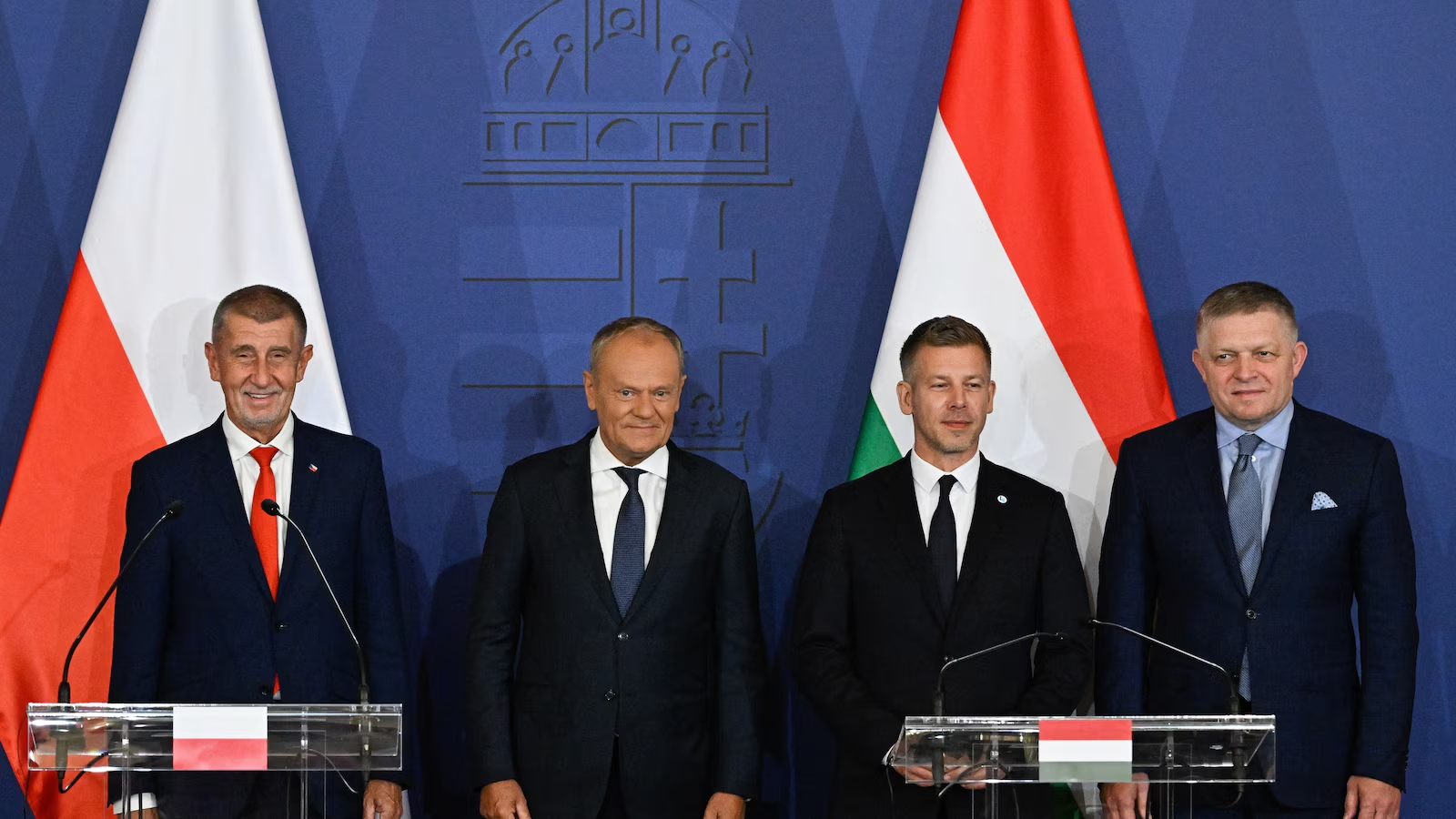
GODOLLO, Hungary — The leaders of four Central European countries signaled the revival of their regional alliance on Tuesday as they met in Hungary to repair relations that had fractured over the pro-Russian stance of former Hungarian leader Viktor Orbán.
The prime ministers of the Czech Republic, Hungary, Poland and Slovakia were meeting for the first summit of the Visegrád Four regional group in more than two years after Orbán’s approach to the war in Ukraine caused fault lines among the informal bloc’s other members, particularly Poland.
Hosting Tuesday’s summit at the Grassalkovich Castle in Gödöllő, a suburb of Budapest, was Hungarian Prime Minister Péter Magyar, who since succeeding Orbán in May has spoken repeatedly about the importance of breathing new life into the group.
Magyar said at a news conference following a one-hour meeting with his counterparts that he had proposed developing a high-speed rail line linking the four countries’ capitals, and that the prime ministers had also discussed finding common ground on energy security, agricultural policy and illegal immigration.
“The V4 is back,” Magyar said. “The heart of Europe is beating in Central Europe today.”
Magyar, whose center-right Tisza party gained a two-thirds majority in parliament in Hungary’s April 12 election, has pledged to bring an end to his predecessor’s obstructionist approach in the European Union, and to base his foreign policy on constructive mutual cooperation while defending Hungary’s interests.
On Tuesday, he emphasized that he’d like to expand V4 cooperation to include other countries, and to make “a Visegrád Four that is strong and which has a credible voice in European decision-making.”
Polish Prime Minister Donald Tusk echoed Magyar’s sentiment that the V4 countries should coordinate before meetings of the European Council to bring common positions to the table, saying the group can be a “beacon of hope” that forms a united front to help dictate policies at the EU level.
Magyar’s election marked a shift in Hungary’s Ukraine policy. Within weeks of taking office, his government had reached an agreement with Kyiv on restoring a raft of rights for a Hungarian ethnic minority in western Ukraine, and in turn lifted Hungary’s veto in the EU for starting the embattled country’s membership process.
The prime ministers of the Czech Republic and Slovakia, Andrej Babis and Robert Fico, are both Orbán allies and, following the former prime minister’s lead, have reduced or cut weapons and financial aid to Ukraine for its defense against Russia’s full-scale invasion.
Yet Babis on Tuesday took an optimistic tone toward renewed V4 cooperation, saying the group is “once again fully operational.”
“These four countries are the future of Europe,” Babis said.
Hungary currently holds the rotating presidency of the V4 but will hand over the role to Slovakia at the end of the month.