

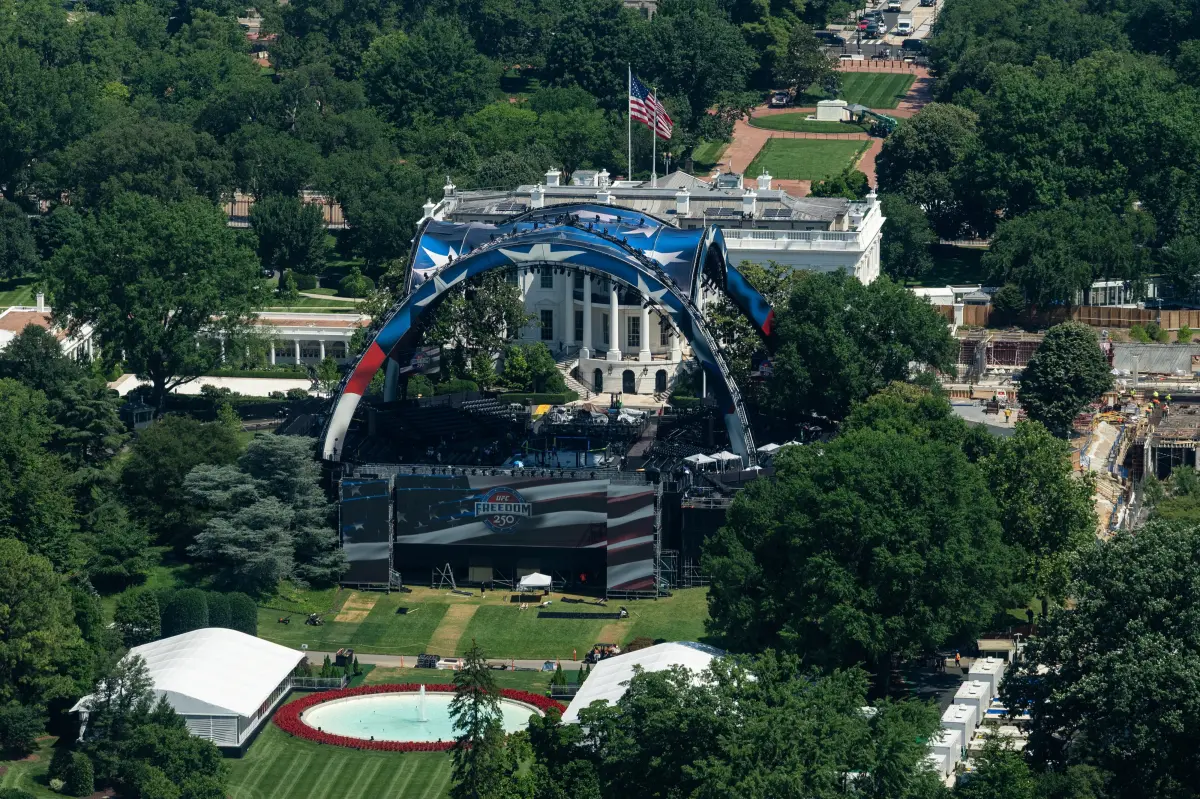

Last week, when I was honored to attend a dinner in the White House Rose Garden, White House Deputy Chief of Staff Dan Scavino gestured beyond the starry-eyed guests toward the massive arched dome that was rising above the South Lawn.
“UFC next week, that’s pretty awesome,” he joked about Sunday’s spectacle celebrating both the nation’s 250th birthday and President Donald Trump’s 80th.
“He’s thinking about keeping that. I’m sure no heads will explode on that one.”
Everyone laughed.
Outside the White House, though, plenty of hair was already on fire.
Hillary Clinton raged on X, “This is what Trump’s done to the People’s House: a third of it is rubble, another third is a cage match. What a metaphor.”
“What’s next? Cockfighting? Dogfighting?” spluttered Rep. Don Beyer (D-Va.). “It’s such a sacrilege to the White House and to our nation’s capital.”
A leftist nonprofit even filed a lawsuit to block the proceedings, characterizing them as “fundamentally” a “corrupt use of our most sacred national monuments.”
As I sat there that evening, surrounded by centuries of American history, I couldn’t help but contemplate the striking contrast.
The White House on one side; an octagon on the other.
To many in the political and cultural establishment, it apparently feels like an invasion.
To me, it felt uniquely American.
This controversy isn’t about mixed martial arts, but about who gets to decide what counts as American culture.
Notice that few critics are debating security, logistics or cost.
Their real objection is something else entirely — taste, and who gets to define it.
For decades, a relatively small group of gatekeepers decided what counted as respectable and acceptable in American culture.
They chose the celebrities and the entertainers.
They chose which athletes deserved admiration, and which should be dismissed as unworthy of serious attention.
And they determined whose tastes mattered: theirs.
For much of the 20th century, that system worked — enforced by three TV networks, a handful of newspapers and a smattering of Hollywood studios and record labels.
But now the audience has seized the remote control.
A podcaster today can command a larger audience than a network anchor.
A UFC champion can have greater cultural reach than a movie star.
We’re getting information, entertainment and inspiration from sources the traditional gatekeepers neither control nor fully understand.
President Trump recognized the shift long before most politicians did.
While others sought validation from Hollywood and established institutions, Trump built relationships with entrepreneurs, athletes, podcasters and personalities who speak directly to millions of Americans.
The result is that many Americans look at a UFC fight card on the White House lawn and think, “That sounds like fun.”
The cultural establishment looks at the same event and sees a crisis.
That disconnect tells us far more about the establishment than it does about the UFC.
After all, presidents have long blended politics with popular culture.
John F. Kennedy had Marilyn Monroe sing him a birthday song.
Ronald Reagan celebrated with Frank Sinatra.
Barack Obama’s White House invited performers from Aretha Franklin to Kendrick Lamar to the cast of “Hamilton” in to serenade him.
One of the most famous photographs in presidential history isn’t of a summit or a treaty signing: It’s Richard Nixon shaking hands with Elvis Presley in the Oval Office.
At the time, many considered the pairing unusual — yet no one suggested their meeting put the republic in danger.
The difference isn’t the spectacle, but the audience.
Those now objecting so vociferously were perfectly comfortable when America’s cultural institutions reflected their preferences and values.
What unsettles them is realizing that millions of Americans no longer take their edicts into account.
That’s why this event feels to them so threatening: Not because it’s unprecedented or inappropriate, but because it’s popular.
They’ve found themselves shut out of a culture they no longer understand, and all they can think to do is vainly demand that everyone else return to their rules.
For weeks, critics have treated the UFC’s arrival in Washington as though barbarians were gathering at the gates.
But perhaps they have it backward.
The fighters aren’t the invaders besieging the citadel.
Neither are the fans who follow them, or the millions of Americans who will tune in to enjoy the show.
It’s the elites who still believe they get to decide what counts as culture that are on the outside, looking in.
Alan Rechtschaffen is a trustee of the Wilson Center and author of “Capital Markets, Derivatives and the Law.”