

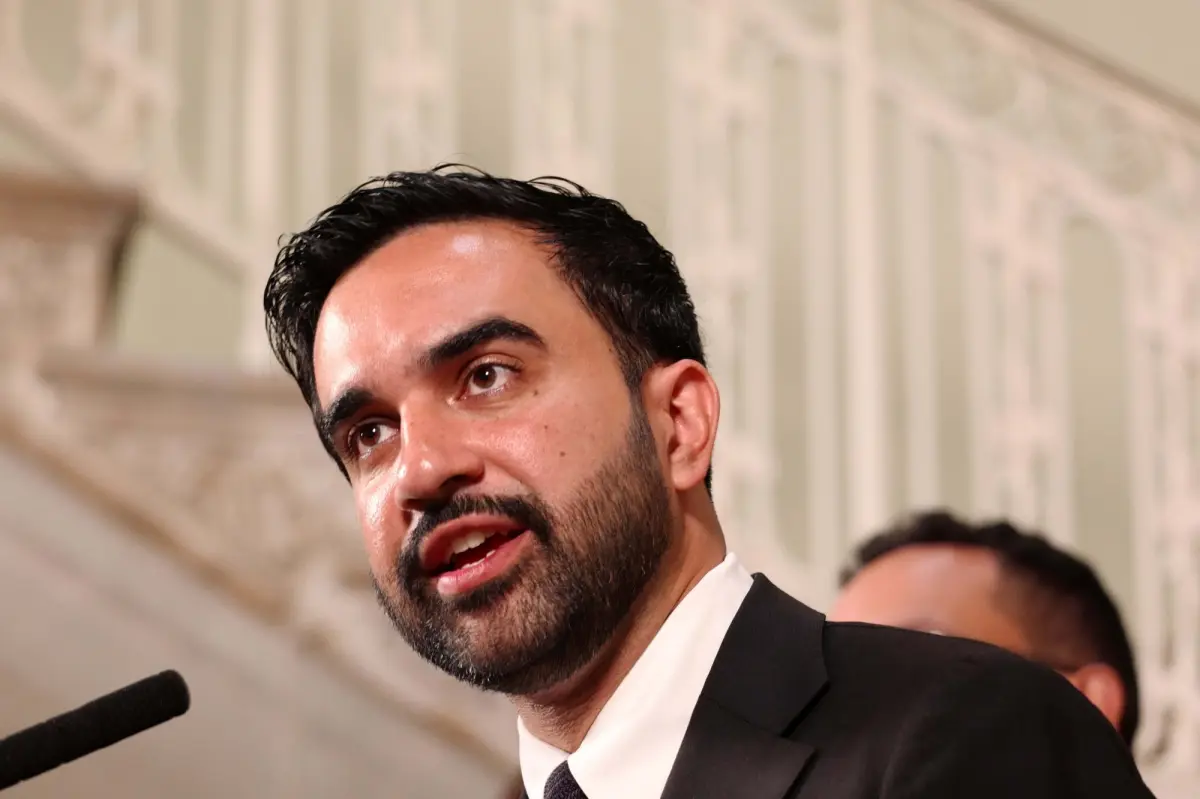

You know Gotham is careening toward fiscal crisis when the city council’s problem with the socialist mayor is that Zohran K. Mamdani . . . is not socialist enough.
In negotiating his first city budget with supposedly moderate council Speaker Julie Menin, Mamdani resisted socializing thousands of existing private apartments.
But Lenin — er, Menin — won.
Tuesday, in their $125.8 billion deal, Mamdani and Menin agreed to expand an eight-year-old de Blasio-era housing program called City Fighting Homelessness and Eviction Prevention Supplement.
Under FHEPS, the city gives vouchers to people who are in a homeless shelter or who are at risk of being evicted from their apartment.
With the voucher, a tenant can rent an apartment to get out of the shelter, or stay in her existing apartment, and limit her rent to 30% of her income.
City taxpayers cover the rest, based on “fair market rents” that exceed $3,500 a month in some neighborhoods.
As of last fall, 65,092 New York City households were using FHEPS vouchers, according to city comptroller Mark Levine — growth of nearly one-third over a year.
Taxpayers spent $1.2 billion on the program in 2025, four times the cost of the 2022 figure.
And that figure could have been higher.
Former Mayor Eric Adams had resisted an earlier expansion, which would have been so expensive that the council didn’t even try to estimate its costs.
The comptroller’s best guess was $1.1 billion to $4.5 billion per year.
Mamdani realized quickly that such costs exceeded his socialist budget, and he tried to limit the expansion, too.
But he and Menin agreed Tuesday: In lieu of the bigger program that Adams had resisted, they would launch a new expansion, adding at least $175 million for this new fiscal year, starting Wednesday, and $125 million annually after that.
How did City Hall cut the cost down?
Not through tightly restricting eligibility.
A family of three making up to $76,350, half the area’s median income, will be eligible, as long as they are in housing court with an eviction case on a rent-regulated apartment.
Runaway youth can apply, as can “justice-involved individuals” (people just out of prison).
Work requirement? “The department shall not consider whether a household is employed as a condition of eligibility,” says the council, removing a modest earlier mandate.
No, Mamdani and Menin are “controlling” costs by decree: When it’s out of its $175 million for this year, the city will stop handing out vouchers — no matter how many people have applied.
How quickly Mamdani and Menin grasp that socialism requires rationing!
The council’s new $175 million will cover only 8,000 or so new households — when, by definition, a quarter of the city earns below 50% of the city’s median income.
Even after subtracting people already in public housing, or who don’t have or can’t find rent-regulated apartments, or who don’t have legal immigration status, that’s still a lot of people.
And more people who don’t already have their own apartments will inevitably enter shelter just to obtain a voucher.
The shelter population already is close to 83,000, compared to below 60,000 pre-2020.
So it’s easy to see where this is going: Massive demand for vouchers will “prove” that the city needs to expand supply, the council will argue next year.
This demand will further distort the housing market, as people with vouchers will compete with everyone else for rent-stabilized apartments.
And after tenants obtain a voucher, good for five years and renewable after that, they’ll stay put, further decreasing supply.
Just like with NYCHA housing, this program discourages work — at least on-the-books work — as a tenant with higher income must pay more of that income in rent.
As Mamdani unveiled his budget Tuesday, he channeled free-market economist Friedrich Hayek.
The mayor reminded reporters that Hayek once said that “if socialists understood economics, that they wouldn’t be socialists.”
In a riposte to that century-old observation, Mamdani added, “if these past months have shown us anything, it is that socialists . . . understand economics just as well as the capitalists who came before.”
But Hayek knew that we don’t measure these things in six months.
In the meantime, we’re going to need a lot more capitalism — such as higher Wall Street bonuses next year — to pay for all this socialism.
Nicole Gelinas is a contributing editor at the Manhattan Institute’s City Journal.