

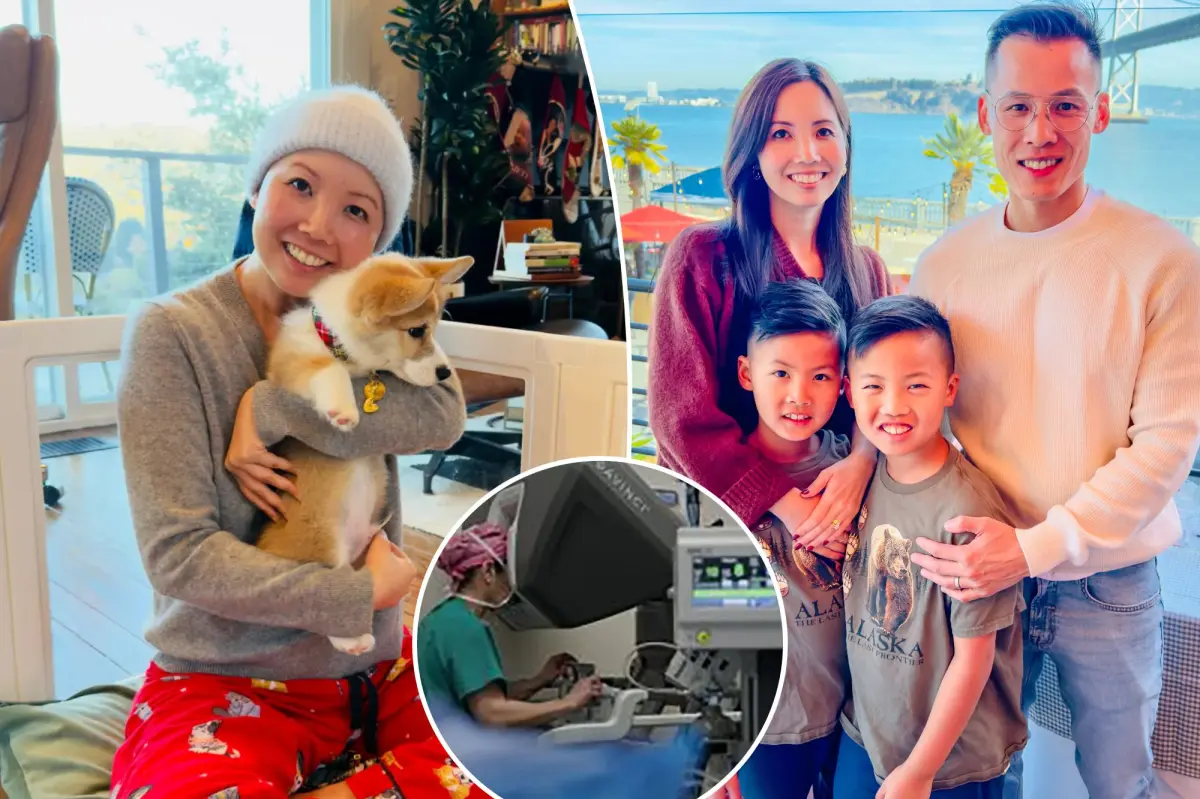

A California mom of two is back to her normal life after a robot helped removed her breast cancer in a historic surgery.
After noticing a bump during a self exam, Vicky Pan, 46, was diagnosed with triple negative breast cancer, an aggressive form that grows fast. She found the cancer had already spread to nearby lymph nodes.
She had “this deep seated fear,” she told The Post. “My whole family was very scared, including my kids, and devastated with the news.”
She underwent a robotic single-port mastectomy, the first of its kind in the US outside clinical trials, at Alta Bates Summit Medical Center in Oakland.
“I was both nervous and excited at the same time. Nervous since it was a big surgery, my first in my life. Yet I was also excited to get the tumor out of my body.”
With the help of the $2 million robot, the incision point is so small and surgery precise, it leaves the nipple and skin intact. This minimizes changes to appearance and recovery times.
In clinical trials, only a few centers offered the procedure, and there were strict limits on who could qualify to undergo the surgery — and strict limits on who could perform it, too. Now, things are changing as more hospitals can get ahold of the technology and more surgeons trained on how to use it.
How does the surgery work?
The only part without the robot is the first, small incision — the size of a paper clip, Dr. Rita Kwan-Feinberg, who performed the surgery, told The Post. All the necessary tools enter here, usually away from the breast, at the side of the chest.
Then, the doctor uses the robot to see beyond the limits of human perception. They call it “3D vision.”
“I can literally see small little vessels pulsating,” Kwan-Feinberg said. “I can see the blood flowing through those vessels because the magnification is so high and the detail is so great.”
That makes a big difference in making precise cuts, which is the name of the game in a mastectomy. They key is to remove cancerous tissue between the skin and breast tissue. If you take too much, it gets into the skin and it dies, she said.
The robot allows for this kind of accuracy.
“We’re going from traditional big surgical instruments that the surgeon is using directly with their hands on the tissue to be able to translate the surgeon’s movements into these small, tiny little instruments to dissect that tissue,” she said.
The robot is never operating on its own — the surgeon is in control the entire time.
The robot named Carol
In December, the FDA cleared the Da Vinci SP Surgical System for nipple-sparing mastectomy (NSM) procedures.
This is pretty new in the US but has been used around the world with great success for several years, Kwan-Feinberg said.
That’s allowed surgeons like her to learn from others with more experience, including doctors from Italy and Korea. Surgeons and staff are required to train with the robot before doing a surgery.
“It definitely requires rigorous training,” she said. “It’s not just the surgeon, it’s also the staff in the operating room. It’s, you know, how do we position the patient? How do we keep them safe with anesthesia? It also has to do with how do we keep the instruments sterile.”
The robot is expensive — $2 million — but it’s not a one-trick pony. The FDA has cleared it for use in a number of surgeries, including urology, colorectal and thoracic surgeries.
The robot even has a name: Carol. It’s named for the wife of the donor who made helped bring the robot to Alta Bates Summit Medical Center.
“His wife died from breast cancer and it was quite a bit of heartache. But through that heartache, he found a way to translate that grief into joy,” said Kwan-Feinberg.
Free the nipple
This new type of mastectomy could have better outcomes in terms of tissue loss, pain and recovery, but also keep the breast looking largely unchanged.
But Sparing the nipple isn’t just about aesthetics. It has physical and emotional benefits for the patient, Kwan-Feinberg said: Cancer can change a person’s entire life and minimizing additional changes to the body helps a person’s dignity and self-image, too.
Pan said her hair fell out and her body changed from chemotherapy. “Anything that can help minimize the loss, anything that can help me retain some form of identity, I think is like a type of mercy,” she told KTVU.
She told The Post that recovery went “very smoothly” and her pain was “quite minimal.” She even “was able to move around and go on a short beach getaway three weeks post surgery. The outcome was as good as I can hope for.”
She’s now in remission but continuing chemotherapy and immunotherapy to prevent recurrence. She will require reconstructive surgery, but she says, “I am on my path to healing.”
“I feel grateful for being a cancer survivor … All my priorities have shifted and I just appreciate everything more,” she said. “I don’t take tomorrow for granted, and I’m more present for my family.”