


It’s an exclusive club no one wants to be a member of.
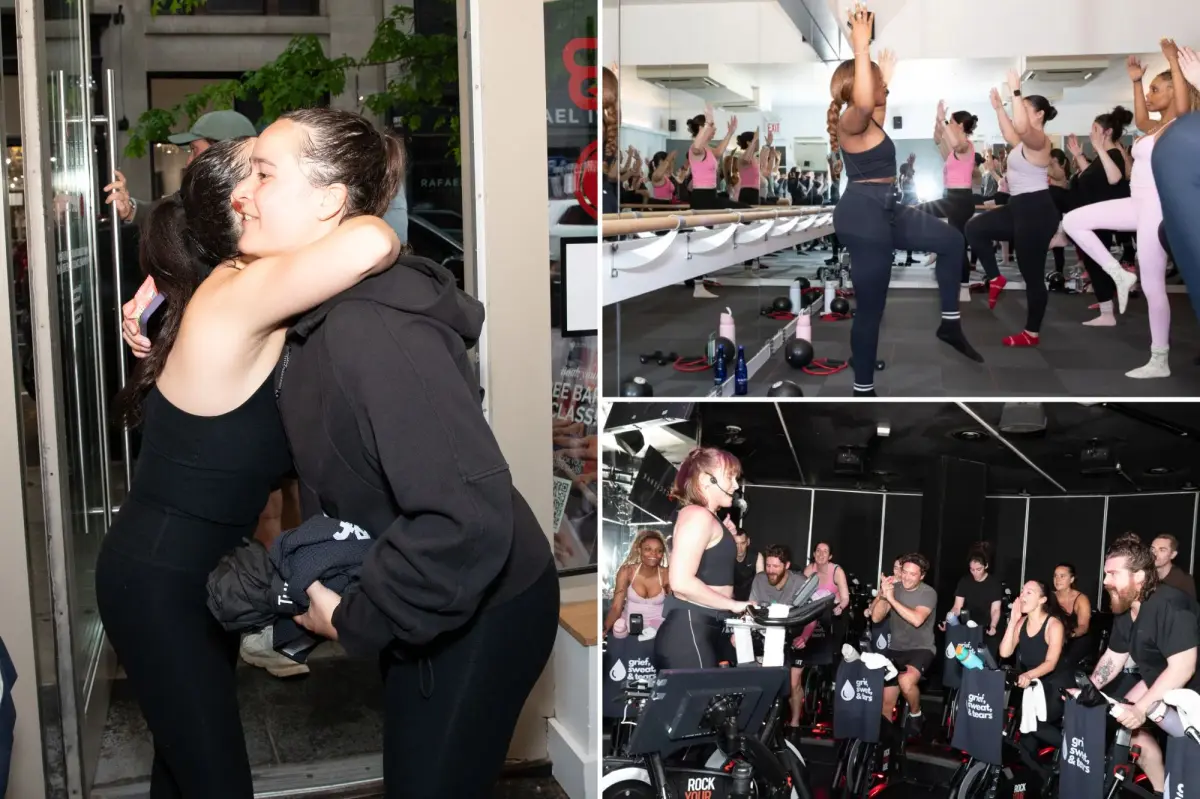
That’s how several people explained why they were at a “Grief, Sweat, & Tears” event this spring, at which about 25 men and women met up for a double-header barre and spin class.
When everyone gathered in the lobby to chat afterward, sweaty and smiling, conversation flowed as naturally as it would at a bar — but death and grief were the main topics, with people trading stories about lost loved ones.
“It’s obviously something that people are not naturally inclined to discuss,” Margot Lichtenthal, a past Grief, Sweat, & Tears attendee who lost her father to suicide, told The Post. “But when you’re talking about it with somebody who can genuinely understand what you’ve gone through, it’s a whole different story.”
After losing her dad in the middle of the COVID-19 pandemic, Lichtenthal found emotional relief through solo hot Pilates — but she was feeling isolated despite attending support groups.
Then, a cousin introduced her to Grief, Sweat, & Tears. Lichtenthal admitted that although a group fitness class centered on bereavement sounded unusual, she felt compelled to try it.
“Working out was such an outlet for me when everything happened that it just felt like the perfect combination of releasing endorphins and then releasing your emotions at the same time,” she said.
The events start with a workout to help alleviate the physical symptoms of grief, followed by social time for attendees to meet others going through similar experiences.
While she considers herself an open book, Lichtenthal was still surprised by how easy it was to share her story with strangers.
“When you go through loss, it’s really easy to feel alone in a crowded room,” she explained. “I felt such a sense of unspoken acceptance and understanding that we’ve all gone through.
“Being able to talk about your story without it being this whole dramatic event, but instead just get these feelings out in a casual way, was a lot more healing than I think people recognize.”
Fitness … and recovery
Grief, Sweat, & Tears is the brainchild of 29-year-old Betsy Kaplan, who lost her father, Joel, to suicide in 2018. Attending therapy left her with pent-up energy and tension — and an urge to blow it off through exercise.
“Talk therapy is amazing, and I swear by it,” Kaplan said, “but at the same time, movement, in conjunction with getting out your emotions, just takes the cake.”
There’s certainly some evidence that exercise can be an effective tool for managing emotions associated with grief — and many experts support it.
“Taking those pent-up feelings and incorporating them into their fitness routines can be cathartic,” New York clinical psychologist Dr. Ernesto Lira de la Rosa previously told The Post.
Kaplan, a p.r. manager, began cold-contacting fitness studios to set up classes and discovered the idea resonated with a lot of people.
“No one gets how hard this is. But [Grief, Sweat, & Tears] made me feel like I was seen, which I’ve never felt.”
Jenna DeNapoli
In fact, someone she worked with at SLT Tribeca, where the first event was held in mid-January, had lost their mom and thought the idea of sweating through grief was “amazing.”
“You put yourself out there, and the person on the back end either can relate or knows somebody very close to them that can relate,” Kaplan said. “Because grief is really all around us.”
To join, participants are asked to fill out a form on which they can share details about the person they lost.
The first class had 13 people. Now, Kaplan is managing waitlists and even has studios reaching out to her to set up Grief, Sweat, & Tears classes.
Initially, some workouts had a discounted admission fee, with a portion of proceeds donated to a grief-related charity. Others were completely free, usually at the behest of the instructor — who experienced a loss of their own.
Moving forward, classes will have a fee, although Kaplan will strive to ensure they’re affordable and accessible.
“To be able to go into these fitness studios and just sweat — and sometimes even cry after having such a good sweat release — was like, ‘Wow, this is going to become a part of my everyday,’” she said.
An exercise in healing
Grief can often be an isolating, lonely experience. That was true for Jenna DeNapoli, a nurse and content creator from Long Island, who lost her father to stomach cancer in 2018.
“I come from an Italian family,” the 29-year-old said. “You don’t talk about your feelings. You don’t go to therapy. Everyone loses people. You just figure it out.”
But after she started talking about her grief on social media, an old friend invited her to a Grief, Sweat, & Tears class at the Pilates studio Serotonin Club.
Despite her initial skepticism, she was hooked.
“There’s something so special about connecting with people who have gone through similar situations,” she said. “No one gets how hard this is. But [Grief, Sweat, & Tears] made me feel like I was seen, which I’ve never felt.”
Though it was emotional — and she “never wanted to be part of this club” — she wishes she had gone sooner.
Just cry (or sweat) it out
Grief, Sweat, & Tears was never meant to replace therapy or support groups. Kaplan simply wanted to create a space where people could talk openly about loss without the clinical feel of therapy or traditional grief groups.
And their social media capitalizes on this, striking a balance between empowerment and turning a tragedy into comedy with dark humor, often calling out the “dead dads club.”
“We’re not having prompts and sitting in a circle saying the name of our person and … what’s coming up for us,” she explained.
If an attendee has just experienced a death anniversary or a challenging calendar moment, such as the deceased’s birthday, Kaplan may ask if they’re comfortable sharing their story.
That’s how Anthony Martin, who lost his mom to breast cancer in 2011, ended up speaking at a class in mid-March that fell near the anniversary of his mother’s passing.
“There was definitely a little bit of anxiety there,” the 37-year-old told The Post. “But feeling that sense of understanding and community gave me relief.”
Building endurance
Everyone walks into a Grief, Sweat, & Tears event with similar emotions — but they often leave with a new perspective on grieving.
“That event helped me think about grief more intentionally,” Martin said. “And I think that’s given me more confidence to … be more of a help to [others] by listening and offering advice.”
For Lichtenthal, attending the event was also a reminder to be more mindful and present while dealing with her loss.
“We’re so busy trying to put a Band-Aid on everything when uncomfortable or difficult situations transpire,” she said. “But … this type of community is here to help you continue living through what you’ve experienced and grow from it.”
Interest in the community events has been increasing quickly, with people messaging Kaplan about starting chapters in cities including Chicago and Dallas.
For now, she’s focused on providing a unique space for those who are grieving and building community.
“I hope people start to build friendships and networks that they can now rely on,” Kaplan said. “It’s a beautiful thing to see people giving hugs after and exchanging phone numbers and just building their own sense of community through grief, sweat and tears.”