

The central government on Thursday issued a clarification asserting that an Indian passport has “never been treated as conclusive proof of citizenship”, stressing that the position is neither new nor recently adopted.This comes a day after the ministry of external affairs (MEA), during a media briefing, stated that a passport is primarily a “travel document” and should not be viewed as definitive proof of citizenship. The remarks drew criticism from sections of the Opposition.Defending the position, the government cited Section 20 of the Passports Act, 1967, which empowers the Centre to issue passports or travel documents to non-citizens in certain circumstances.
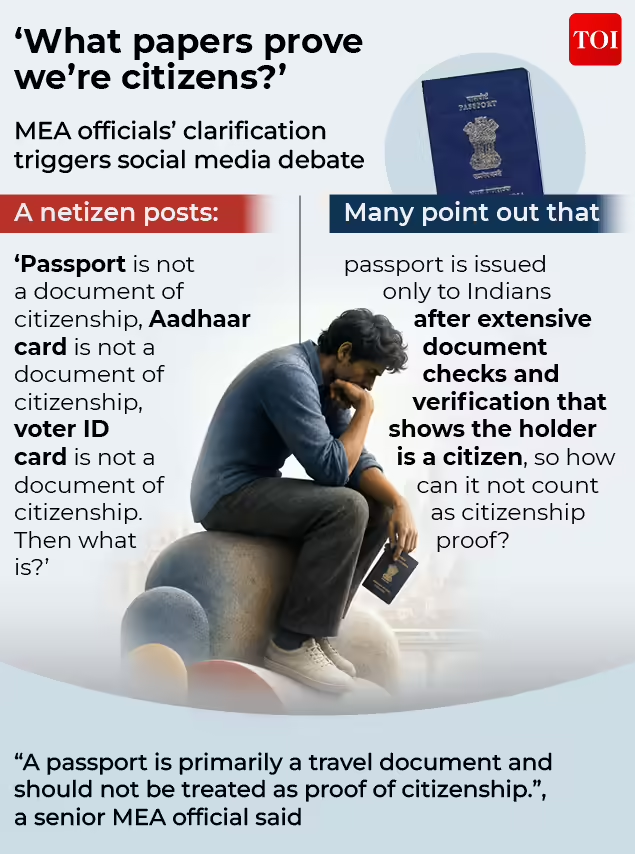
The provision states, “Notwithstanding anything contained in the foregoing provisions relating to issue of a passport or travel document, the Central Government may issue, or cause to be issued, a passport or travel document to a person who is not a citizen of India if that Government is of the opinion that it is necessary so to do in the public interest.”According to the government, the legal position has also been upheld by courts, including the Bombay high court, which ruled in 2013 that possession of a passport alone does not establish Indian citizenship, news agency ANI reported.The issue gained political traction after Rajya Sabha MP Kapil Sibal questioned the implications of the MEA’s remarks.In a post on X, Sibal wrote: “MEA June 24, 2026 : “A passport is a travel document, and not a document of citizenship.” Which document then is proof of citizenship? BLO can doubt my citizenship Deprive me of my vote Result BJP wins the election Over to Supreme Court !”Lyricist Javed Akhtar also called MEA’s statement “absurd” and questioned whether the ministry is issuing passports to non-Indian citizens as well.The BJP, however, accused critics of misrepresenting a long-settled legal position. Additionally, the comment started a debate online with questions over citizenship documentation.Responding on X, BJP IT department head Amit Malviya said: “For the “kagaz nahin dikhayenge” brigade outraging over the Ministry of External Affairs’ statement that a passport is not proof of citizenship, here is a reality check. The MEA has not announced a new policy. It has merely reiterated a settled legal position.”Malviya further cited court rulings and provisions under the Citizenship Act, arguing that citizenship is determined through eligibility and documentary evidence rather than any single document.“The Bombay High Court made this clear in 2013 and reaffirmed the principle subsequently: citizenship is determined under the Citizenship Act, 1955, based on eligibility and supporting evidence, not by the mere possession of a single document,” he wrote.He added that citizenship in India is established through a range of records, including birth certificates, electoral rolls, school records, government service records, residence documents and passports, among others.Also Read: Passport not proof of citizenship, says MEA: What documents establish Indian citizenship? 10 FAQs answeredReferring to the Passports Act, Malviya said: “Under the Passports Act, 1967, the Central Government has the power in specified circumstances to issue a passport or travel document even to a non-citizen. The law itself therefore recognises that possession of a passport cannot, by definition, be treated as conclusive proof of citizenship.”Calling the controversy misplaced, the BJP leader added, “A passport is an important identity and travel document. It is evidence that may support a claim of citizenship. But citizenship itself flows from the Constitution and the Citizenship Act, not from the possession of any single government-issued document.”The clarification coincided with the observance of the 14th Passport Seva Divas, which marks the enactment of the Passports Act on June 24, 1967. The Ministry of External Affairs also recently held its Annual Regional Passport Officers’ Conference in New Delhi as part of the commemorative events.