

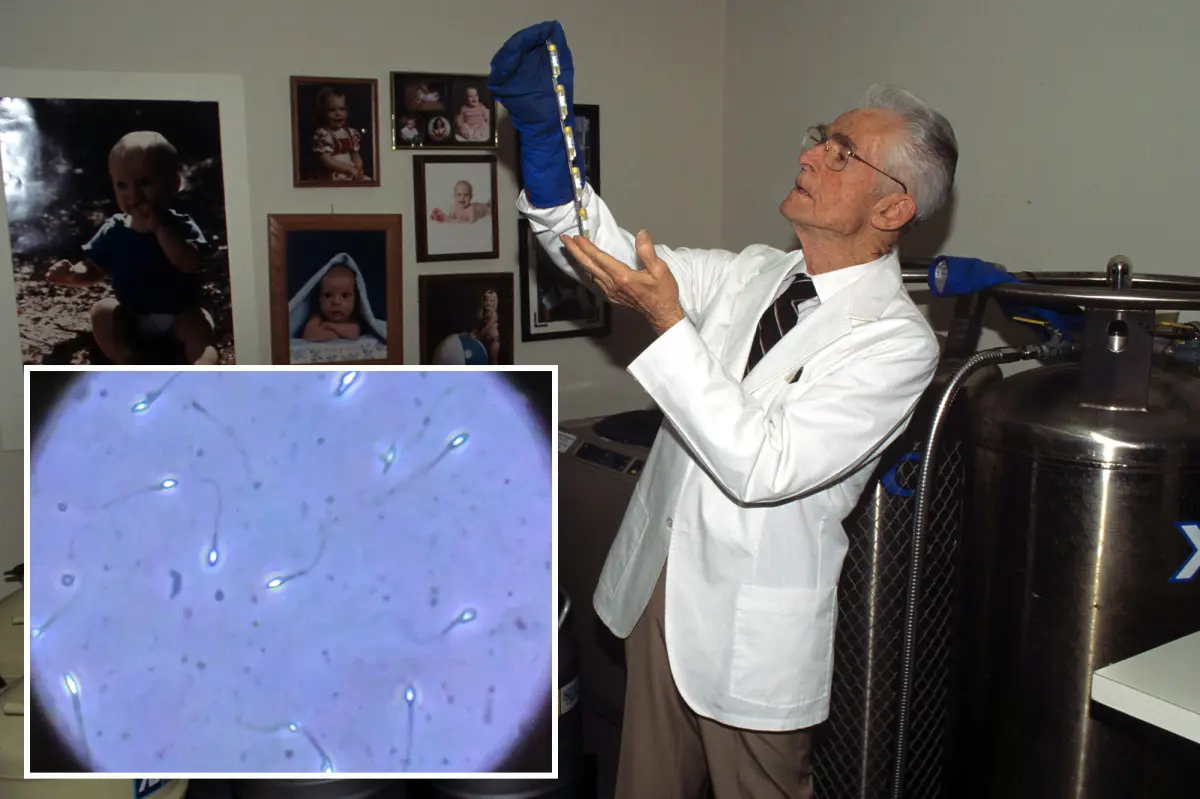

If I were to tell you there once existed a “genius sperm bank” which exclusively accepted the semen of Nobel Prize winners, you’d be forgiven for thinking it was a dystopian sci-fi plot.
Yet exist it did.
It was one of the most radical experiments in human breeding and genetic engineering the world has ever known.
It had a big yet inadvertent impact on shaping the fertility industry as we know it today – including in Australia.
What’s more, the so-called genius offspring – 217 of them – are coming of age today and could help settle an age-old question: are such traits down to nature or nurture?
One author of a newly released book, having studied such super kids, has a somewhat blunt answer.
Nobel laureate sperm only
Created in the 1970s, the infamous sperm bank was accepting donations for its controversial elitist experiment in the USA right up until 1999.
That means the youngest of its new breed of so-called geniuses will be turning 25 around now.
Conceived by American millionaire Robert K. Graham, who made his fortune by inventing scratchproof lenses for spectacles, the idea was to collect sperm from Nobel laureates in science and distribute it to “intelligent women.”
The ultimate goal? To breed an entire generation of geniuses. Its official name was “Graham’s Repository for Germinal Choice.”
Graham wanted to do this because he believed the American population was getting lazy and degenerate. He was alive at a time when American paranoia about communism being the very opposite of the American rugged individual dream was soaring.
In a welfare state, “retrograde humans,” as Graham called them, could flourish. He couldn’t have that – and his social engineering endeavour would counter it.
Ultimately, Graham recruited just three Nobel laureates to his cause.
In announcing the plan, he understandably became a pariah and was roundly ridiculed and condemned in the American media – from newspaper columns to “Saturday Night Live.”
What he was proposing was uncomfortably similar to the eugenics espoused by Adolf Hitler himself.
Yet he was surprised by the outrage and comparisons to Nazi ideology of creating a “master race.”
He played down accusations of racism and eugenics, claiming “a few more creative intelligent people might be born.” And indeed they were.
But things would get worse – and even crazier – than anyone could have imagined once the donors started coming forward, and supposedly super smart babies began being born.
The genius myth
The first pitfall happened quickly. Spooked by the bad press, two of the Nobelists – fearing their identities would be revealed and reputations ruined – backed out and never donated again. That left the Nobel sperm bank with just one Nobel laureate.
And he was among the worst Nobel laureates in history.
On paper, William Shockley looked like the perfect sperm donor to people who subscribed to such ideas. He’d won the Nobel prize for inventing the transistor, and opened the first ever company in Silicon Valley.
But the true contents of his character reveal what author Helen Lewin describes as The Genius Myth, in her new book by that title.
“The genius myth is the idea that there are a set of stories that we tell ourselves about high achievement, and they’re not always true,” Lewin tells news.com.au.
“The question is, how is ‘genius’ bestowed – with what criteria? It’s often what people in a particular culture value at that time – and that then changes over time.”
In the book, she questions the very idea of geniuses, showing how they often reveal our need for a hero and a narrative (often a greatly exaggerated ‘founder’s story’).
These raise the genius to a celebrity cult status, often overlooking the ‘villages’ (teams of people) and societal structures (class, gender, race) that enabled them to become thus elevated. She warns of the “dangerous allure” of “rebels, monsters and rule breakers.”
Shockley is the perfect personification of this. He consistently claimed that black people were less intelligent than white people – and was widely despised for such racism. He proposed sterilizing people with low IQs.
He even claimed, without any sense of irony, that his own children were disappointingly inferior in intelligence (not one of his three children attended his funeral).
He blamed his wife, whom he claimed they took after. Presumably he believed his genius sperm bank donation would suffer no such deterioration owing to pollution by less intelligent breeding recipients.
Yet he was very wrong there, too. Shockley was 70 when he donated in 1977. He traveled to a Travelodge, met Graham, produced his sample, and the two men parted ways.
For a self-made millionaire innovator and Nobel prize-winning scientist, what happened next simply added to the widespread lampoonery.
First, Graham attempted to sneak Shockley’s pensioner sperm onto a plane. He didn’t want to put it through an X-ray machine, because radiation can cause abnormalities.
But he was foiled by air stewards who saw liquid nitrogen curling out of the container – and was kicked off the flight. He somehow persuaded a pilot to let him fly with the semen sample in the cabin the next day.
Then there was the fact Shockley’s donation didn’t produce a single child. Scientist Shockley was shocked. He later told Playboy in an interview that he had no idea men’s sperm deteriorated in potency with age.
Graham, whose estate was picketed by demonstrators, even hired guards to protect his precious vats of frozen sperm. But given two Nobelists had dropped out, and Shockley’s aged semen was practically useless, the security were in effect guarding literal blanks more than a sperm bank.
As such, not one child of a Nobel Prize winner was ever born from the Nobel Prize sperm bank.
The closest it came was the unemployed son of a Nobel laureate who, upon donating, was quoted as saying: “I’m helping the human race because I have good genes. I have studied evolutionary biology and this is what evolution is all about. Winning is passing on your genes and losing is failing to do so.”
He had no kids with his own wife.
Roundly mocked, borderline fascist, no fecund laureates, ancient degraded semen that could barely breaststroke across a puddle and championed by narcissistic men half as intelligent as they claim, including a scientist with little understanding of basic science – the genius sperm bank looked doomed to fail.
Yet within a few years, it was receiving more requests for sperm than it could handle.
Criminals
In 1985, the genius sperm bank downgraded its entry requirements to sports stars and self-made millionaires. As such, it became the high achievers sperm bank, increasing both the donor pool, and demand.
Rough seas still plagued this rebranded version, though.
In the early 1980s, one couple who’d had a daughter via the sperm bank told journalists they planned to raise a “female Thomas Edison or Einstein.”
It later emerged that the couple had lied to get access to such elite sperm. They’d actually just been released from prison – they’d been using the identities of dead children to obtain loans, and the mother had lost custody of children from her first marriage after punishing them for poor academic performance.
What has happened to the genius children?
So what of the kids described as test tube superbabies?
In his 2005 book “The Genius Factory,” journalist David Plotz tracks down some of them and ponders what they can teach us about the nature versus nurture question of high achievement and intelligence.
Some are, undoubtedly, geniuses.
One – Doron Blake – was reading “Hamlet” at six, writing a book at 11 and scoring 180 on early IQ tests. He later studied at Harvard.
With the other children born from the sperm of high achievers, there are stories of straight A students, leads in school plays, musical instrument playing proficiency, mathematical wizardry and sporting prowess.
But, significantly, there are also other, less sensational stories. They aren’t all geniuses. They aren’t even all high achievers.
They’re “spread in a bell curve, slid a bit to the right of average,” Plotz writes.
“Some are brilliant. Most are very good students. And some are quite mediocre. Three of the 30 I know have severe health problems.”
When it comes to nature versus nurture, there’s actually little they can tell us – Plotz’s sample was small, and self-selecting. And the women who seek out a Nobel prize sperm bank, he writes, “become the over-involved mums who push their children into piano lessons at 3 and Ancient Greek at 5.”
As such, it’s “impossible to determine if their children’s talents are the result of nature or nurture, because they’re getting double helpings of both.”
What Doran can tell us
Doron Blake’s mother was one such eccentric character. She doted on him, breastfeeding him until he was six. She did past life regression with her psychology patients. She later charged reporters for interviews with her genius son.
And his story can perhaps tell us the most. He was bullied at school for being a donor baby.
For all his achievements, his first and foremost listed accomplishment on his Facebook page – above his Harvard attendance or teaching Buddhist philosophy, is “house dad”.
His Facebook picture features him, bespectacled, hugging his partner and two children.
“It was a screwed-up idea making genius people,” he told Plotz.
“It’s foolish to judge anyone by his intelligence. The fact I have a huge IQ doesn’t make me a person who is good or happy – I don’t think you can breed for good people.”
Impact on today’s fertility industry
Despite the setbacks, mockery and its ultimately failed mission, the controversial sperm bank had an inadvertent impact on today’s fertility industry.
Donors in Australia today are routinely asked their highest academic achievement, about their career, their full medical history and how often they exercise. Donors with university degrees get chosen before those without them.
Plotz says that Graham’s “unabashedly elitist” sperm bank “democratized fertility” by “upending the hierarchy, shifting the power away from the tyranny of “dictatorial” early fertility doctors and onto consumers, giving them choice.
It was an accidental impact of a doomed venture. Prior to his sperm bank experiment, donor insemination involved doctors inseminating women with unknown sperm and encouraging couples to lie and pretend the baby was theirs.
What Graham understood as a businessman was how to prioritize the needs of his customers. And his customers weren’t all as elitist or eccentric as it first seems.
His was one of the world’s first sperm banks to put their prospective donors through medical tests and provide the donors’ medical history. Many of the women – a sizeable cohort of whom worked in the health industry – sought sperm from it because they prized this health information over intellectual quotient.
But how far can the bar lift when it comes to consumer choice? In Iceland, almost all diagnosed Down syndrome pregnancies are aborted after prenatal testing. Other countries aren’t far behind.
“All sperm banks have become eugenic sperm banks,” Plotz rather chillingly says of the infamous sperm bank’s legacy.
Yet it’s the donor-conceived children we should be listening closest to – and not just regarding the measurable number of their IQ, but something no donor screening or prenatal screening can ever fully measure or test for.
And that’s something Harvard graduate, 180-IQ, precocious Shakespeare-reading, genius sperm bank baby Doron Blake best surmised when he was tracked down.
It speaks to the reason why he prioritises the accomplishment of being dad to the two clearly cherished children in his Facebook profile picture above all others.
“It’s what’s in your heart, not your brain, that matters,” he said.