

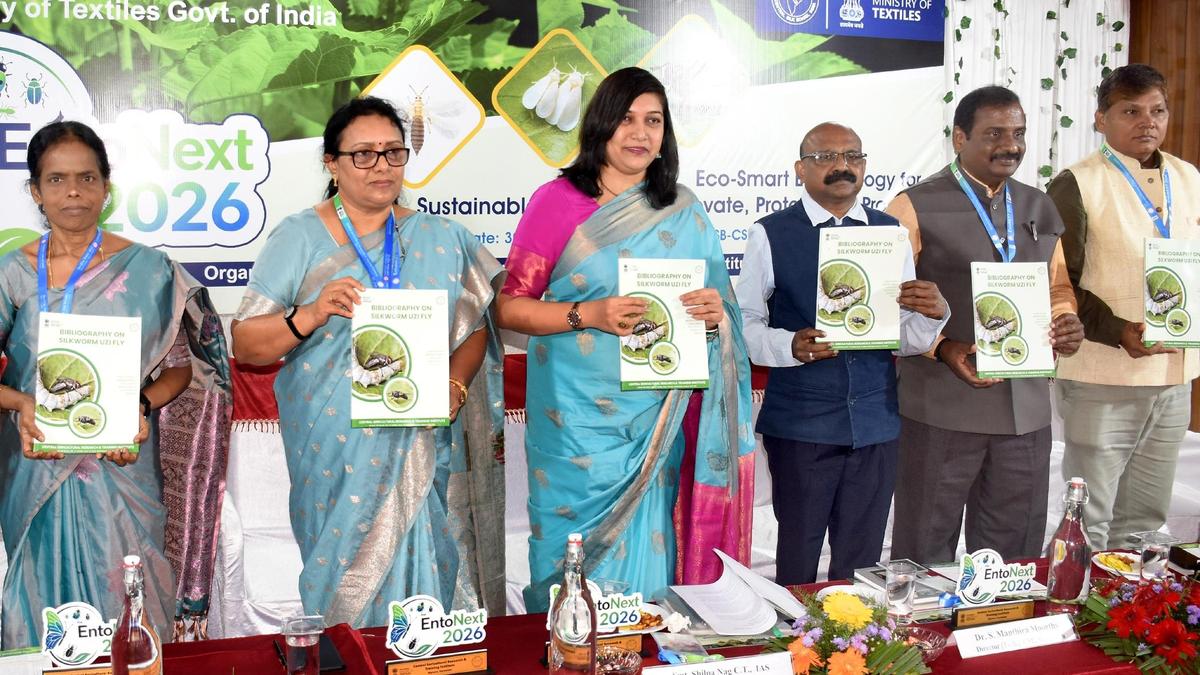

Commissioner of Sericulture Shilpa Nag (third from left) releasing the bibliography on Silkworm Uzifly at Central Sericultural Research and Training Institute, in Mysuru on Tuesday.
| Photo Credit: M. A. Sriram
Commissioner of Sericulture Shilpa Nag has emphasised the need for research in the field of sericulture to focus on growing stress on agricultural land.
Participating in a conference on “EntoNext 2026: Eco-Smart Entomology for Sustainable Sericulture: Innovate, Protect and Prosper” at Central Sericultural Research and Training Institute (CSRTI) in Mysuru on Tuesday, Ms. Nag pointed out that Karnataka had about 1.22 lakh hectares of mulberry cultivation and the landholding of each farmer is less than one hectare.
Even though researchers emphasise on spacing between mulberry crops, the increasing stress on land makes it difficult for the farmers to adopt the same.
Ms. Nag, who also serves as the Director of Karnataka State Sericulture Research and Development Institute (KSSRDI) cited a recent visit to a mulberry farm in Chikkaballapur, where the mulberry trees were grown close to each other, ignoring the spacing norms. She was informed by the officials that farmers are unable to adopt the spacing norms, however much they are instructed, as it impacts the yield in the available land area.
Similarly, adopting mechanisation in small areas by incurring the costs also poses challenges to the small farmers, she said. Hence, she called upon researchers and administrators to join hands to work towards research and programmes from the farmers’ perspective.
Ms. Nag also highlighted the need to focus on sustainable pest management using organic pesticides, advanced technologies for disease surveillance, economic sustainability and market support. She referred to the need to improve water-use efficiency by using the term “more crop per drop”.
Even though the government provides subsidies, Ms. Nag said subsidies provide only short-term financial support. Hence, efforts should aim for broader goals such as economic stability and export promotion.
She emphasised the need for by-product utilisation, including use of pupa waste for poultry and fish feed, pupa oil extraction, spun silk in fabric production, and compost from residual waste.
She noted that innovations developed in laboratories must reach the field. Several innovations in sericulture—such as heat-resistant races, disease-resistant silkworms, IoT applications, colour-sorting machines, and egg dispensers—need to be adopted.
The Department of Sericulture, Government of Karnataka, in collaboration with Central Silk Board (CSB), is planning Environmental Control sheds for silkworm rearing while also hoping to include Vanya silks like Eri, Muga and Tasar in weaving practices alongside mulberry silk.
Earlier, Director (Tech), CSB, Bengaluru, S. Manthira Moorthy, in his address, emphasised the importance of collaboration between scientists of CSB, Indian Council of Agricultural Research (ICAR) and Universities to address the pest problems affecting sericulture. He did not rule out the possibility of El Nino sparking a pest outbreak that would have an adverse impact on the sericulture industry.
Meanwhile, Director of CSRTI P. Deepa, in her welcome address, said the meet focuses on development and adaptation of sustainable and Green pest management technologies in sericulture.
The technologies should reduce use of pesticides through integration of biological, botanical and ecological approaches, she said.
The meet will also discuss the need to give special attention to silkworm and host plants while ensuring environment safety and preservation of beneficial microbes. Also, some key issues like non spinning and crop loss due to pesticide residues will also be discussed, she said.
Published – June 30, 2026 08:25 pm IST