

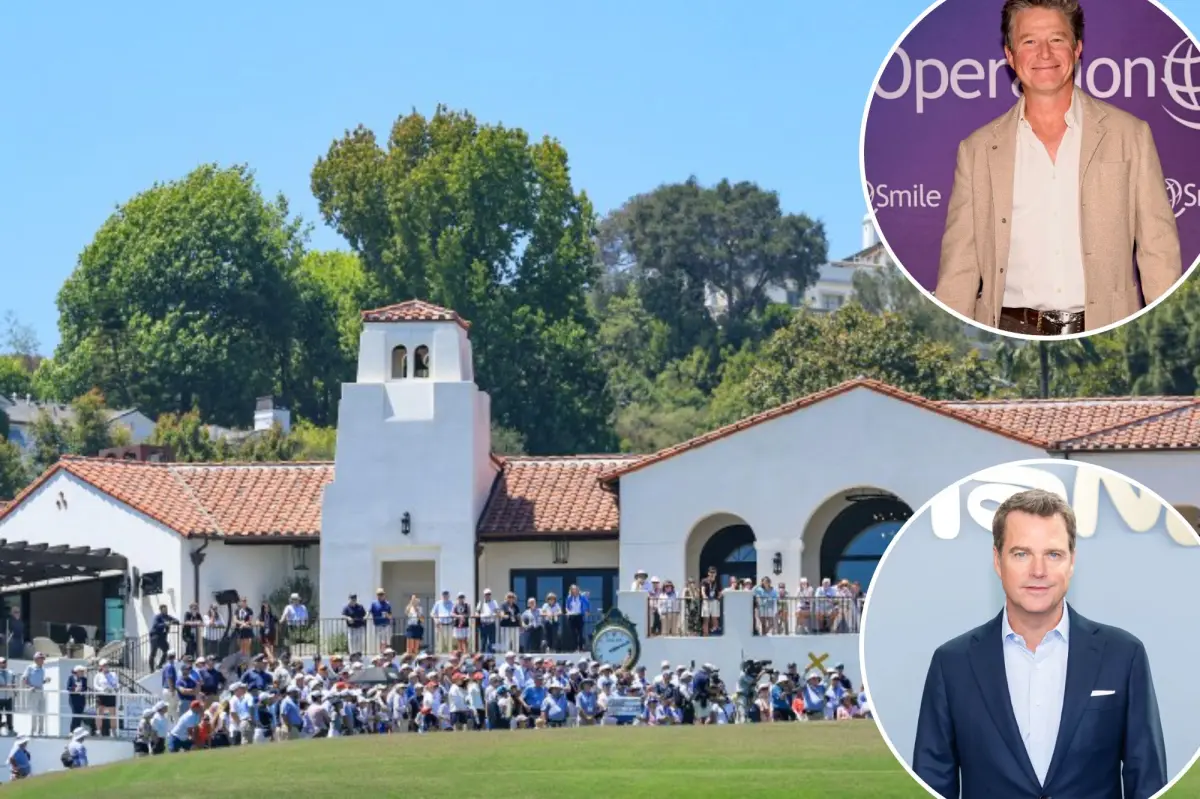

LA’s highest-end golf clubs are in the rough with a local politician who wants to drastically raise their taxes after learning that the private plots have a sweetheart deal dating back to the ’70s. But the new rates would be so high, they could mean extinction for the elite enclaves.
A consortium of the clubs agreed to negotiate with the pol before a decision is put to the public in the form of a November ballot measure. But there’s dissension in the ranks, scratch sources say, and one of the most prominent clubs has gone rogue as the city’s most privileged duffers gear up to fight for their right to tee off.
Last month, LA City Councilman Adrin Nazarian proposed a November ballot measure that aims to remedy a decades-old tax loophole allowing six private country clubs — Bel-Air, Brentwood, Hillcrest, Lakeside, LACC and Wilshire — to pay a fraction of what other landowners pay in property taxes.
Together the six clubs pay $811,000 a year in property taxes, although they occupy nearly 1,000 acres of land valued in excess of $15 billion, according to Nazarian.
The council member who represents much of the San Fernando Valley and proposes a $4 per-square-foot ‘parcel tax,’ got the idea to fix this situation which dates back to the 1970s after listening to a Malcolm Gladwell podcast.
In the episode, Gladwell estimated that the clubs should pay as much as $140M in taxes. If successful, the ballot measure could raise the targeted clubs’ tax rate by 160 times more than what they currently pay, which would more than likely put them all out of business, sources say.
Five of the six clubs quickly banded together to try to reach some sort of settlement with Nazarian and the city to stave off a ballot measure that seems likely to pass. (The current political climate isn’t exactly friendly to the gilded class and their golfing buddies.)
However, Page Six Hollywood has learned that the Bel-Air Country Club is breaking ranks and holding out.
Earlier this week Bel-Air Country Club president Brett Wyard sent out a memo, seen by P6H, in which he wrote: “On Friday, the Councilman who introduced the motion withdrew it after signing an agreement with six of the seven affected clubs to form a ‘working group’ that would continue to study his proposal. Bel-Air was the one club that did not join the agreement.”
The memo goes on to state: “At the end of the day, we decided that joining the other clubs in signing the agreement, and committing to the obligations it imposed, was not in our Club’s best interest.”
It’s somewhat unclear what the ramifications are of Bel Air Country Club breaking ranks. A source close to Nazarian told P6H that they were aware of the fissure, but felt that talks between the city and the other clubs could still move forward.
A longtime LACC member said the move was in keeping with the profile of Bel-Air Country Club members. “It’s less traditional over there. They are younger and cockier and my take is they’re just like — f–k it. Let’s fight it,” said this source.
Within the hierarchy of LA’s country club pecking order, most would put LACC at the top of the list, but Bel-Air is no slouch. Its grounds are considered an architectural marvel and include an 18-hole course, tennis courts, multiple dining spaces, a spa and wellness center.
Famous members of the club, founded in 1926, have included Clint Eastwood, Jason Bateman, Luke Wilson, Dennis Quaid, Pete Sampras and Chris O’Donnell. Jerry West was reportedly the club’s foremost greens reader, and when famed golf architect Tom Doak redid the course in 2016, he was allegedly urged to consult with the Lakers legend on his vision.
When former MPAA chief Chris Dodd was in LA for business, he often liked to squeeze in a round at Bel-Air. Initiation fees can range, but mostly run in the low six figures.
The clubs’ sweetheart deals date back to the state’s seminal 1978 Proposition 13 ballot measure, which capped property taxes at 1% of assessed value. The amount being paid was reportedly set at a 1975 rate, with annual increases limited to just 2%.
Nazarian said in a statement of his plan last month: “These private golf courses and country clubs are not paying their equitable share of taxes by exploiting a loophole — structuring their business as nonprofits to skate by on tax breaks they have no business receiving.” And, “Not only are the vast majority of Angelenos unable to afford membership at these elite clubs, they are being forced to carry someone else’s tax burden. This is fundamentally inequitable tax policy.”
Wyard, in his note to members, countered saying: “The Councilman’s motion asserted that Bel-Air and the other clubs did not contribute their ‘fair share’ to the City and ought to pay taxes reflective of the value of our property if we put it to more lucrative uses than a golf course. As we told the Councilman when we met with him two weeks ago, we vigorously dispute both points. California has many laws and constitutional provisions governing property taxation, and Bel-Air complies with all of them. We were reassessed recently following the completion of our new clubhouse and now have the highest property tax bill of all seven clubs, which of course we pay without objection.”
“Any complaint that the Club and its Members do not bear their ‘fair share’ also ignores the many contributions we make to our surrounding community and the City more generally. These contributions include but are hardly limited to hosting prestigious events like the Curtis Club and Women’s Amateur, something we do at considerable expense to all of us, and beyond that the generosity with which our Members support institutions throughout Los Angeles — hospitals, the arts, schools, our churches and synagogues — far above and beyond the tax bills each of us are assessed,” the memo adds.
Bel-Air Country Club did not return a message seeking comment.