

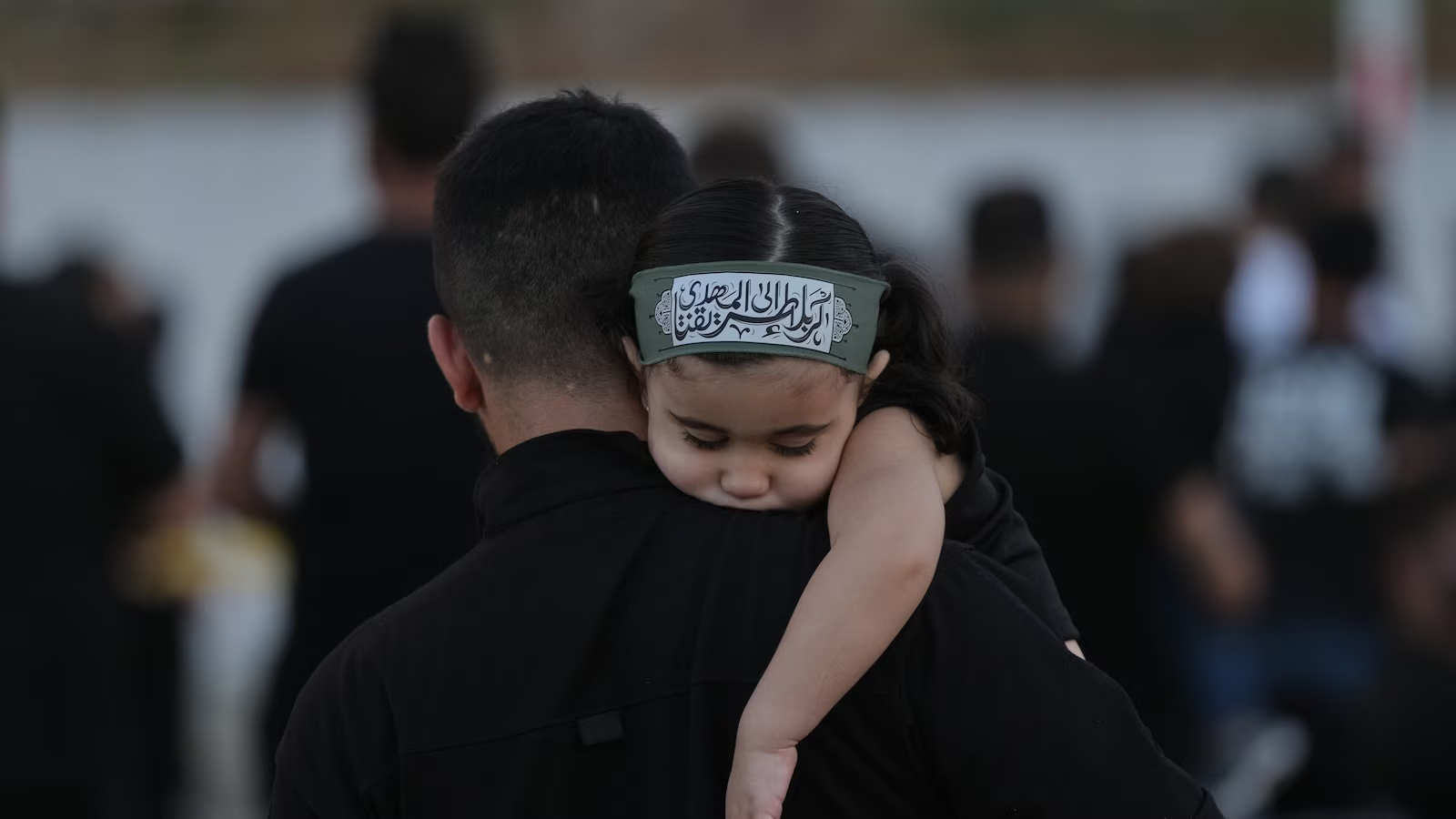
Shiite Muslims have been observing a solemn period of communal mourning leading to the day of Ashoura, which marks the seventh century killing of Hussein, a revered leader and a grandson of Prophet Muhammad.
Annual day of Ashoura commemorations are observed on the 10th day of the month of Muharram in the lunar-based Islamic calendar. In Shiite communities, Ashoura is viewed as a symbol of struggle against injustice and tyranny.
This year, Muharram and Ashoura follow the war in Iran, where the population is overwhelmingly Shiite, and an interim deal to end it. In Lebanon, many Shiites have been marking Muharram after the devastation inflicted during the war between Israel and the Lebanese militant group Hezbollah.
“The gathering every year and the reaffirming of collective memory and collective grief allows every year for the story and the message to adapt to its current context,” said Noor Zehra Zaidi, an assistant professor of history at the University of Maryland, Baltimore County who focuses on Shiite Islam.
Shiite Ashoura commemorations mark the death of Imam Hussein, who was killed in the Battle of Karbala, in present-day Iraq. He fought against the army of then Caliph Yazid, to whom Hussein had refused to pledge allegiance.
Hussein’s killing is seen as having cemented the schism between Sunnis and Shiites, which stems from the early days of Islam and arguments over Muhammad’s successors as caliph, or leader. The Shiites wanted the caliphate to descend through Ali, Muhammad’s cousin and son-in-law and Hussein’s father.
To Shiites, who make up the second-largest branch of Islam after the Sunni majority, the killing holds deep religious and historical resonance and plays a key role in shaping identity.
In the U.S., many Shiites of various racial and ethnic backgrounds gather for assemblies where they typically listen to recitations of the Quran, elegies, lamentations and lectures.
“In many communities, emotional lamentation and weeping are considered acts of devotion because they express solidarity with the suffering (of) the Prophet’s household,” Zaidi said.
U.S. communities embody a lot of the diversity of rituals seen across the Shiite world, she said.
“Our community comes to life. It pulsates with a beautiful group unity, where everybody comes together,” said Adam Almaleky in Michigan. “It’s a program of self-development, self-purification, gaining closeness to God through Hussein.”
In Texas, 23-year-old Sakina Ali attends the gatherings, which are also held in other parts of the world, with four generations of her family. “We learn and we mourn,” she said, adding the atmosphere gives her goose bumps.
Around the world, mourning rituals of Muharram and Ashoura can include rhythmic chest-thumping or beating in unison and public processions. Some Shiites self-flagellate and draw their own blood in public mourning practices that are controversial, fervently upheld by some while shunned or opposed by other Shiites.
In Iraq, pilgrims converge on the holy city of Karbala, site of the battle and home to a shrine to Hussein. Large volunteer service stations there feed pilgrims, Zaidi said, adding that distributing food and drink is one of the most universal practices.
“One of the remarkable enduring features of Ashoura commemorations is the way that rituals and communities reflect local cultures, traditions and languages while still remaining centered on Karbala,” she said.
As part of the Texas team of Who is Hussain, a London-based charity with teams in dozens of cities around the world, Ali has been helping organize a blood drive during this year’s Muharram commemorations.
“It’s to save lives. It’s to do good in the name of Hussein,” she said. “Since this is such an emotional time and the community is coming out from everywhere … the impact is much bigger.”
Hussein, she said, “sacrificed his life … for morality and for justice,” adding, “If he did all of that, I can do good in my community as well, following his example.”
These blood drives happen elsewhere in the U.S. and beyond. Mustafa Jafri’s mosque in New Jersey has been organizing them for many years.
“We do it really to honor Imam Hussein and his companions and his family,” said Jafri, a physician and a board director at Masjid-e-Ali. “He gave his blood to stand against injustice and so we resonate and want to give our blood to save lives.”
It’s a practical way, he said, to translate some of Hussein’s values into action and to give back. The drives, he said, often also attract some non-Muslims from the community to donate blood.
Zaidi said the blood drives are a more modern phenomenon in Shiite commemorations.
Jafri said it’s a time to reflect on how to better oneself and on “tackling injustices that are all throughout the world.”
Almaleky, team leader with Who is Hussain in Michigan, said that from Hussein, “I learn altruism. I learn principle. I learn dedication.”
Even following tragedy, he added, “we continue to draw energy as a community, and no matter how difficult this world becomes, it doesn’t compare in the difficulty that the family of Hussein ibn Ali faced and Hussein and his companions faced.”
___
Associated Press religion coverage receives support through the AP’s collaboration with The Conversation US, with funding from Lilly Endowment Inc. The AP is solely responsible for this content.