

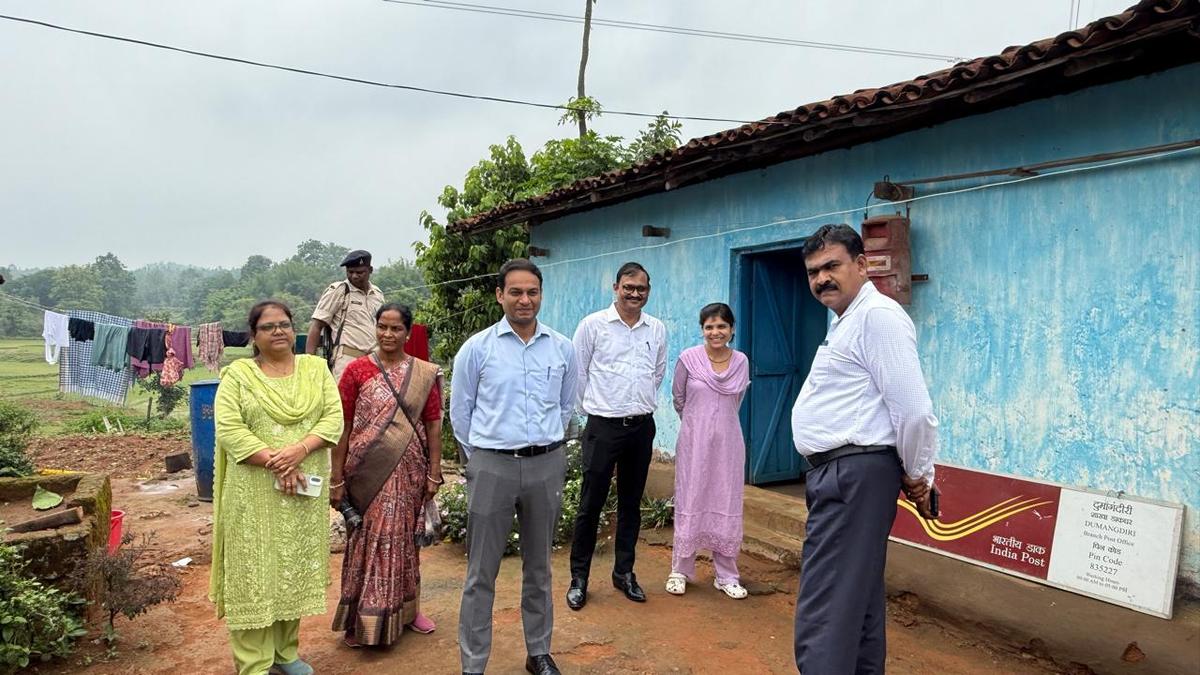

Jharkhand CEO K. Ravi Kumar (extreme right) overviews the preparation on the launch of the SIR on June 30, 2026. Photo: Special Arrangement
The Special Intensive Revision (SIR) of the electoral rolls formally started in Jharkhand on Tuesday (June 30, 2026) with Booth Level Officers (BLOs) visiting door-to-door across the State to distribute enumeration forms and verify voter details.
Chief Electoral Officer (CEO) K. Ravi Kumar said the SIR of the electoral roll was a participatory and transparent process. He added that it was audited at every stage, and provisions for appeals also existed. Mr. Kumar asserted that meetings involving BLOs and Booth Level Agents (BLAs) were held across the State on June 30, 2026 as part of the SIR process, and enumeration forms had been provided to BLOs for all polling stations.
Social media campaign
Addressing media at ‘Nirvachan Sadan’, Mr. Kumar said a social media campaign was organised to inform the public about the details of the enumeration phase.
“Under the SIR, BLOs will conduct door-to-door visits till July 29 to distribute partially filled enumeration forms. Voters are required to verify the details, fill in the necessary information regarding the SIR, and submit the forms back to their respective BLOs.”

He mentioned that the mapping of voters would be verified through a two-tier process, first by the BLO and second by Electoral Registration Officers (EROs) and Assistant Electoral Registration Officers (AEROs). Mr. Kumar added that the SIR was exclusively for eligible Indian citizens and non-Indians should not participate in this process.
The names of all eligible Indian citizens who would submit the enumeration form would be included in the draft publication of the electoral roll on August 5, 2026. Mr. Kumar clarified that voters would not be required to submit any documents while filling out the enumeration form.
“When BLOs visit homes, voters whose details have not yet been mapped against the electoral roll from the previous SIR (2003) should provide their details to the BLO to ensure mapping is completed. They should share details with their BLO based on date of birth,” the CEO said.
He pointed out that the names of voters falling into five categories — Absent, Permanently Shifted, Deceased, Duplicate, and Non-Indian — would not be included in the draft publication of the electoral roll.
Citing Article 326 of the Constitution of India, the Jharkhand CEO said all activities related to the SIR were being conducted to ensure that not a single eligible Indian citizen was left out of the electoral roll and no ineligible person was included.
Mr. Kumar added that the SIR process was transparent and participatory, with information regarding each phase made available to all recognised political parties and on the Chief Electoral Officer’s website. He asserted that the role of BLAs-2 (Booth Level Agents-2) from all recognised political parties was crucial, alongside that of BLOs.
Meetings between BLOs and BLAs-2 were also organised at all polling stations to mark the commencement of the enumeration phase.
The CEO asserted that when compiling lists of voters falling under the ‘Absent, Shifted, Dead, or Duplicate’ (ASDD) categories, BLOs must consult with the BLAs-2 designated by recognised political parties in their areas, furthermore, verification by the BLA-2 was mandatory for the final ASDD list.
Published – June 30, 2026 11:03 pm IST