

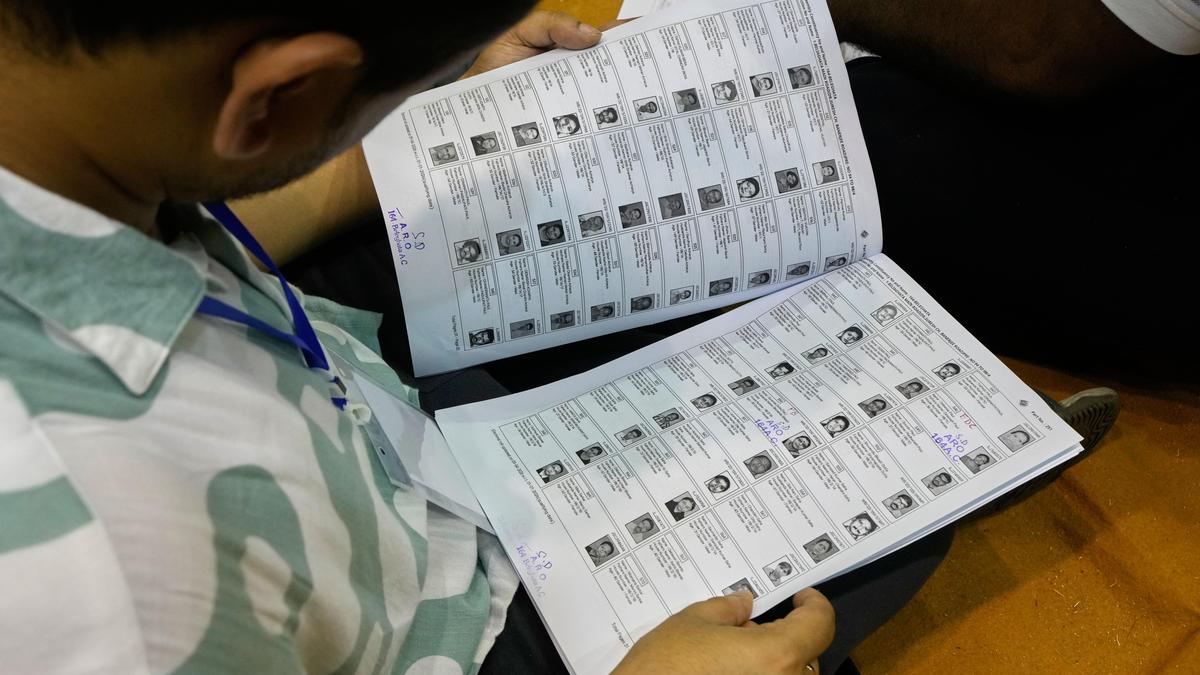
Amid mounting political opposition, legal challenges and growing public anxiety, the Special Intensive Revision (SIR) of electoral rolls is set to begin in Karnataka, with the door-to-door enumeration phase commencing on June 30.
Presented by the Election Commission of India (ECI) as an exercise to prepare a ‘pure’, ‘accurate’, and ‘inclusive’ electoral roll, SIR has become one of the most debated electoral exercises in recent years.
The Commission maintains that the exercise is intended to identify duplicate, deceased, shifted, and otherwise ineligible voters while ensuring that every eligible citizen finds a place on the electoral roll. Civil rights groups, constitutional experts and advocates, however, argue that the exercise introduces an unprecedented level of scrutiny for existing voters, and could directly affect migrants, women, Dalits, transgender persons, and other historically marginalised communities. The exercise, critics argue, is the preparation of a fresh electoral roll rather than a revision of an existing one.
The controversy, however, is not about whether electoral rolls should be cleaned. Few dispute that need. The debate is about how the process is being carried out. For the first time, existing electors across Karnataka are being asked to submit fresh enumeration forms, and undergo another round of verification.
If the objective is only to identify duplicate or otherwise ineligible voters, why are existing electors required to submit fresh enumeration forms? What exactly are the prescribed documents expected to establish, particularly when Indian law does not recognise any single document as conclusive proof of citizenship?
Even after submitting those documents, can a voter still be subjected to further scrutiny through what the Election Commission calls a ‘logical discrepancy’? And if the Karnataka government has assured that no genuine voter will be deleted, how much authority does the State actually have when the exercise is being conducted under the Election Commission’s constitutional mandate? These are some of the questions being raised by activists.
As the SIR door-to-door survey begins on June 30, here are the answers to some basic questions on the process:
What is SIR?
Electoral rolls are ordinarily updated through the routine Summary Revision process, where voters apply to enrol, correct details, change their address, or remove the names of deceased family members.
Along with the annual Summary Revision, the Election Commission has conducted Intensive Revisions, during which BLOs visit voters, verify the details furnished by them, and correct the electoral rolls. These exercises were generally conducted once every five or 10 years.
The ECI argues that the present exercise is also an SIR.
Critics, however, point out that in none of the 10 earlier Intensive Revisions, including the last ‘Intensive Revision of Special Nature’ held in 2002–03, were existing electors required to prove their citizenship, or submit fresh enumeration forms.
Mapped or not?
The dependence on the 2002 electoral roll also raises another question that remains unanswered. While the Election Commission’s Citizen Service Portal provides a ‘Search Your Name in Last SIR’ facility, it merely allows electors to retrieve details such as the Assembly constituency, Part Number and Serial Number from the 2002 roll for use in the enumeration form. It does not tell an elector whether the present record has actually been mapped with the earlier roll. Nor has the Commission publicly explained what an elector should do if the previous record cannot be located, cannot be linked with the present record, or if a BLO never visited the household in the first place for mapping, as reported by many citizens.
The Commission has also not explained how an elector can know, before the draft electoral roll is published, whether they have been classified as ‘unmapped’.
How is this SIR different?
SIR is different. Instead of relying primarily on applications from voters, now, Booth Level Officers (BLOs) conduct door-to-door verification, distribute enumeration forms, collect them back, and verify the information before preparing a fresh draft electoral roll.
For the present exercise, the 2025 electoral roll serves as the starting point. The 2002 electoral roll — the last time Karnataka underwent SIR — is used to compare older voter records with present ones. The exercise examine how a person’s electoral records have changed over time before preparing the revised electoral roll.
It is this reliance on the 2002 roll that has become one of the biggest sources of confusion.
What happens if a person moved to another district within Karnataka, but never voted after changing their address? What if they were below 18 years of age in 2002, and therefore had no electoral record?
In cases of intra-state migration, a person’s name may still continue in the electoral roll of their previous constituency even though they no longer live there. During SIR, such entries may be identified as ‘shifted’, requiring the voter to enrol in the constituency where they currently reside before their name can be included in the revised roll.
Another issue relates to what the Election Commission calls ‘progeny mapping’. Those who were below 18 years of age or were not yet born when Karnataka last underwent SIR in 2002 have no electoral record from that period. In such cases, officials seek to link present voter records with the electoral records of parents, or immediate family members to establish continuity.
Progeny mapping has added a layer of challenges. Many families cannot recall where they were enrolled in the 2002 electoral rolls, while others no longer have access to family records.
The challenge is also acute for transgender persons, many of whom are estranged from their families, or have changed their names and gender markers after the Supreme Court’s NALSA judgment, besides in cases where families have migrated, parents are no longer alive, names differ across documents, or older electoral records are unavailable.
Why are the documents becoming controversial?
The Election Commission has prescribed a list of 11 documents that voters may rely upon during the exercise while repeatedly clarifying that Aadhaar, despite being one of the country’s most widely held identity documents, is not sufficient on its own. Ration cards, too, are not accepted as standalone proof.
The list includes birth certificate, passport, matriculation or other educational certificates, permanent residence certificate (PRC), caste certificate, Forest Rights certificate, land or house allotment certificate, entries in the National Register of Citizens (where applicable), family registers maintained by government authorities, and identity cards or certificates issued by government departments, public sector undertakings, banks, post offices, or the Life Insurance Corporation before July 1, 1987.
It is to be noted that the Election Commission describes this as ‘indicative’, rather than exhaustive list of documents that may be relied upon during verification, rather than the only documents that can be considered. That leaves voters without a clear understanding of what alternatives may be available if they do not possess the listed records.
The prescribed documents are not sought from every elector at the time of submitting the enumeration form. They come into play only if an Electoral Registration Officer (ERO) issues a notice — for instance, where records cannot be linked with earlier electoral rolls, discrepancies emerge, or the officer has doubts about a person’s eligibility.
Even then, the documents required depend on the voter’s age. Those born before July 1, 1987 generally have to establish only their own eligibility. Those born between July 1, 1987 and December 2, 2004 may also have to establish the eligibility of one parent, while those born after December 2, 2004 may be required to produce documents relating to both parents.
However, since no voter knows in advance who may receive such a notice, or what level of documentary scrutiny they may ultimately face, the clarification has done little to ease public anxiety.
That has left voters asking — if Aadhaar and ration cards are not enough, what exactly is expected to satisfy the verification?
Citizenship question
Indian law itself does not recognise any single conclusive proof of citizenship. Citizenship is acquired under the Citizenship Act by birth, descent, registration or naturalisation — not through one particular document.
Each record relied upon during SIR establishes only one aspect of a person’s legal identity. A birth certificate records birth, Aadhaar establishes identity, previous electoral rolls show earlier enrolment as a voter, while other records establish different aspects of a person’s legal status. None of them, in isolation, conclusively establishes citizenship.
This points to a larger argument where voters are being asked to satisfy a documentary test even though the law itself does not identify a document that conclusively answers the question the exercise appears to raise.
Logical discrepancy
Even submitting the prescribed documents, however, does not necessarily end the verification process. Electoral records may still undergo additional scrutiny if the Election Commission identifies what it terms a ‘logical discrepancy’.
A category that came late
The controversy over ‘logical discrepancy’ first came to the fore during the SIR in West Bengal. After voters were mapped with the 2002 electoral roll, a second layer of scrutiny identified what the Commission described as logical discrepancies while the exercise was already underway there.
Notably, the category was not part of the original notification, which announced the SIR.
Logical discrepancy included implausible age gaps between parents and children – less than 15 years, more than six children to a single parent, inconsistencies in family relationships, and differences in names across records. Another recurring issue involved minor spelling and transliteration differences between Bengali and English, or variations that had crept into official records over decades, drawing even genuine voters into further scrutiny.
Changing parameters
What made the category particularly contentious was that it subjected even voters whose records had already been mapped to an additional round of adjudication. According to court records from the West Bengal proceedings, millions of electors fell into the logical discrepancy and unmapped categories, requiring them to respond to notices, and establish their eligibility before Electoral Registration Officers.
Concerns have grown further because the scope of ‘logical discrepancy’ has not remained unchanged. When the category first emerged during the West Bengal exercise, only four discrepancy checks were identified. In the framework now proposed for subsequent SIR exercises, including Karnataka, the number of discrepancy categories is expected to increase.
Since ‘logical discrepancy’ did not feature in the original SIR notification and evolved during the West Bengal exercise, voters cannot know at the time of submitting their enumeration forms what additional standards their records may eventually be tested against.
Karnataka’s Chief Electoral Officer V. Anbu Kumar has indicated that the application of logical discrepancy will become clearer only as the exercise progresses, and the draft electoral roll is prepared.
Which communities could face the biggest challenges?
While every voter is required to undergo the same verification process, its impact is unlikely to be uniform. Certain communities could face greater difficulties because of their social circumstances, migration patterns, or changes in personal records.
For women, changes in surname, address, or family details after marriage mean that older records no longer match newer ones. These changes could create difficulties during verification, particularly where present records have to be linked with older electoral rolls and family details.
Transgender persons face a different set of challenges. After the Supreme Court’s NALSA judgment, many changed their names and gender markers in official records. Older documents, however, continue to carry their birth names and assigned gender — either female or male. The earlier records do not match the current ones. Transgender identity certificates, which are routinely accepted by government authorities to establish their affirmed identity, are not included among the documents listed for SIR.
In Karnataka’s plantation belt, many Adivasi labourers have spent decades moving from one estate to another for work. As a result, many cannot trace where they were enrolled as voters in 2002, or link themselves to older electoral records. Without that historical linkage, the mapping exercise itself becomes difficult, raising concerns that many genuine voters may struggle to satisfy the verification process.
Even the elderly, rural residents, the poor and migrants may find it difficult to establish their citizenship through the prescribed documents relating to birth and descent, for a basic reason that they do not possess, or cannot produce them owing to their transient way of life, and the historical lack of government intervention that would have ensured such documentation.
Can Karnataka government prevent genuine voters from being deleted?
As concerns over SIR have grown, the Congress-led Karnataka government has repeatedly assured citizens that ‘no genuine voter will be deleted from the electoral rolls’. Chief Minister D.K. Shivakumar has maintained that genuine voters will be protected, while senior Congress leaders, including KPCC president B.K. Hariprasad, have said the exercise should be made more citizen-friendly and inclusive.
The pattern from SIR conducted in other States, barring the notable exception of Kerala, shows that around 10-12% of names were deleted from the electoral rolls. In Karnataka too, political parties and civil society groups have projected similar estimates, identifying Yadgir, Raichur and Chikkamagaluru districts as among those that could witness a higher number of deletions owing to migration, documentation gaps, and socio-economic vulnerabilities.
But how much authority does State gGovernment actually have once SIR is underway?
Under the existing constitutional and statutory framework, the preparation and revision of electoral rolls for Assembly elections remain under the superintendence, direction and control of the Election Commission of India. While the State government can facilitate documentation, provide administrative support and help citizens, it cannot alter the verification framework, prescribe alternative documents, or direct electoral officers on how eligibility is to be determined.
The Supreme Court has consistently upheld the Election Commission’s constitutional authority in such matters, further limiting the State government’s scope to intervene.
But what ways do voters have once the draft electoral roll is published?
Once the draft electoral roll is published, voters will get a chance to check whether their names have been retained, deleted or whether any details are incorrect.
Those who believe they have been wrongly left out, whose details need correction, or who wish to object to an entry, can approach election authorities during the claims and objections period. Depending on the nature of the request, election officials may require the prescribed statutory forms — Form 6 for inclusion, Form 7 for deletion or objection, and Form 8 for correction or updating of particulars, before the final electoral roll is published.
What happens if an officer doubts a person’s citizenship?
The Election Commission’s SIR handbook states that if an ERO or Assistant Electoral Registration Officer (AERO) is not satisfied because relevant documents have not been produced ‘or otherwise’, they may initiate a suo motu inquiry, and refer suspected foreign national cases to the ‘competent authority’.
The Supreme Court has made it clear that the Election Commission cannot itself decide whether a person is an Indian citizen. If citizenship is in doubt, the issue has to be determined by the competent authority under the Citizenship Act after following the procedure prescribed by law.
Yet, the handbook leaves several practical questions unanswered.
-
What does ‘or otherwise’ mean?
-
Apart from the non-submission of documents, what circumstances could lead an officer to question a person’s citizenship?
-
Who exactly is the ‘competent authority’, and through what legal process will it decide the matter?
-
Would such cases eventually go before a tribunal, or another statutory forum?
If an ERO or AERO refers a case to the competent authority, who that authority is may itself depend on the nature of the dispute. The Supreme Court judgment does not identify a single forum because citizenship disputes can arise under different legal frameworks.
The Supreme Court has directed that such references should, as far as possible, be decided before the next parliamentary, assembly or local body election, whichever is earlier.
For Karnataka, that could mean the upcoming Greater Bengaluru Authority elections, scheduled to be held before August 31. If citizenship-related references arise during SIR, the authorities would have to identify the appropriate forum, issue notices, hear affected persons, and reach a legal determination within a matter of weeks. How that process would work in practice remains unclear.
Concerns over the role of BLO
The concerns surrounding SIR are not limited to voters alone. Questions have been raised about the officials responsible for carrying out the exercise, particularly the additional responsibilities assigned to BLOs.
Anganwadi workers have opposed the additional responsibilities as BLOs, arguing that SIR falls outside their regular duties, and places an enormous workload on them.
The criticism, however, goes beyond workload. Booth Level ‘Officers’ act on behalf of the Election Commission during electoral verification. In Karnataka, many BLOs are anganwadi workers, who are honorary workers rather than ‘officers’ and ‘do not’ represent the State. They are essentially ‘volunteers’ engaged by the government, without any defined tenure, statutory status or formal training expected of public officers.
Whether individuals, who are not recognised as government officers, should be entrusted with responsibilities that could directly affect a person’s electoral rights also remains unclear.