

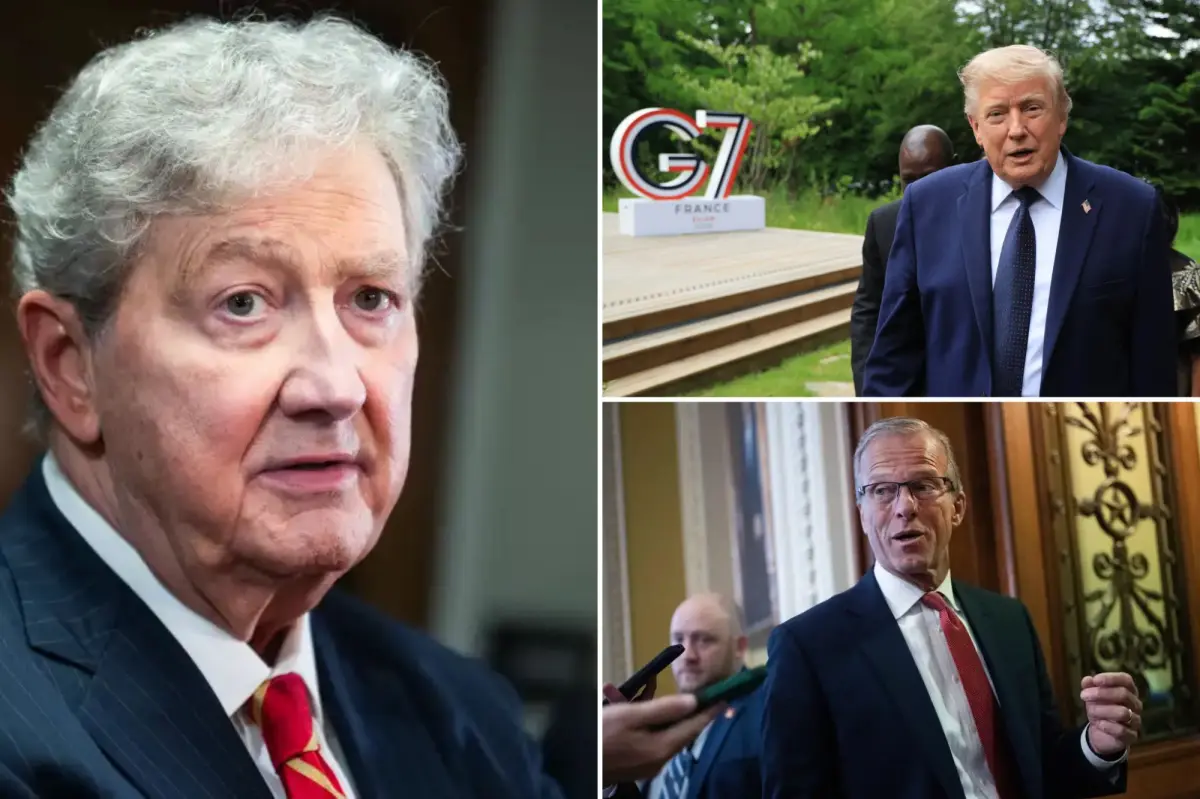

WASHINGTON — Skeptical congressional Republicans aren’t rushing to support President Trump’s still-secret Iran deal as they wait to read the document, which has not been shared with even the highest-ranking lawmakers.
“Unless you were homeschooled by a day drinker, no one’s confident that Iran is going to do anything,” Sen. John Kennedy (R-La.) told reporters, after saying, “I want to read it myself.”
Senate Majority Leader John Thune (R-SD) — a member of the so-called Gang of Eight, which is typically looped in on high-stakes national security matters — revealed Tuesday that he still hasn’t been briefed.
“There isn’t text out there yet,” Thune told reporters of the deal, which was signed privately on Sunday by Trump, Vice President JD Vance and Iranian parliament speaker Mohammad-Bagher Ghalibaf.
“We will get briefed when there’s text available,” said Thune, who may ultimately be called upon to push the deal through the Senate, which has a constitutional role in approving treaties.
Thune revealed he’s received no guidance from the White House on when the cloud of uncertainty may lift — as Trump and his senior aides give conflicting timetables for public disclosure of the terms.
“My assumption is that [the briefing will happen] as the week wears on and we get closer to whenever the public release of this is gonna happen,” he said.
The memorandum of understanding (MOU) is expected to reopen the Strait of Hormuz without tolls for 60 days, but details about the future of Tehran’s nuclear program and potentially billions of dollars in sanctions relief and funding to help reconstruct the Middle East country remain hazy.
The 60-day period will allow for final determinations on the status of deeply buried highly enriched uranium, which US officials hope to down-blend and leave in Iran, in conjunction with sanctions relied and the unfreezing of funds.
But the details of the preliminary deal have been withheld, allowing for competing narratives and generating concern about what exactly Trump got out of the costly nearly four-month war.
On Monday, Thune had noted “even the people who follow this stuff closely up here don’t know that much about it.”
Spokespeople for House Speaker Mike Johnson (R-La.) didn’t immediately respond to a request for comment on whether he has read the deal.
Sen. Mark Warner (D-Va.), the vice chairman of the Senate intelligence committee and another member of the Gang of Eight, also hadn’t been briefed, a spokesperson for his office said.
The deal will test Trump’s ability to maintain a diverse domestic coalition — after running for president three times trashing both “warmongers” and diplomatic efforts he deemed ineffectual, including former President Barack Obama’s 2015 nuclear deal, which Trump said did too little to constrain Tehran.
Trump lamented in 2017 that “Iran was on its last legs and ready to collapse until the U.S. came along and gave it a life-line in the form of the Iran Deal: $150 billion.”
The White House has said the text of the agreement is about 1.5 pages, but absent the document, lawmakers are getting squimish.
“The sooner it is released, the better,” arch hawk Sen. Lindsey Graham (R-SC) wrote in an X post Monday night. “I look forward to reviewing the actual document rather than relying on Iranian propaganda reports.”
Graham has withheld outright criticism of the deal while calling for it to be submitted to the Senate for approval. He said the yet-to-be-seen document could be “transformative for the region and a major achievement.”
Trump told reporters Tuesday that “I will send it to Congress” when asked about Graham’s remarks.
Sen. Rick Scott (R-Fla.), meanwhile, told reporters Tuesday that he has had talks with administration officials and that other Republicans are “all hopeful that what ends up with this is no nuclear weapons, no ballistic missiles, no money for the Houthis, Hezbollah, Hamas.”
Administration officials have briefed reporters that any sanctions relief or unfreezing of funds would be tied to concrete steps by Iran to dismantle its nuclear program and cease support for regional armed groups — while also teasing “small antes” of money as a goodwill gesture.
“We’d all like to see the terms of the memorandum and hopefully end up with a real deal,” Scott added.
“I don’t think there’s anybody in Congress that’s ever going to support giving money to them,” Scott said. “If we have any other money, they ought to pay for what costs us to do this to try to bring them to their senses to stop killing us.”
The Florida Republican said he would be “surprised” if the reconstruction plans for Iran involved handing over $300 billion as part of the MOU.
Administration officials have confirmed the $300 billion plan, but said that it won’t be funded by the US and would instead be a Gulf Arab initiative to invest in Iranian projects, with an American veto if progress ceases.
“What I want to do is I want to get reimbursed for the money that we’ve had to spend, to bring them to their senses. I mean, they got plenty of oil,” Scott said. “They can rebuild their own country.”
“I can’t imagine that would ever be a deal,” he added, suggesting that it would be akin to Obama’s Joint Comprehensive Plan of Action nuclear deal with Iran that gave the mullahs access to more than $50 billion in frozen funds, including pallets of cash flown from the US.
“That’s not going to happen. They’re not going to have … our planes full of dollar bills sent over there. That’s never going to happen again, you know, the, and if they don’t comply, we’re, you know, we’re going to have to go back and destroy them again because they’re not going to get a nuclear weapon.”
As elected Republicans await the text, a top outright critic is Trump’s former vice president Mike Pence.
“It’s my view that we would be better off allowing the armed forces of the United States to finish the job… [to] give the people of Iran a real shot at freedom,” he said Tuesday at the National Press Club.