

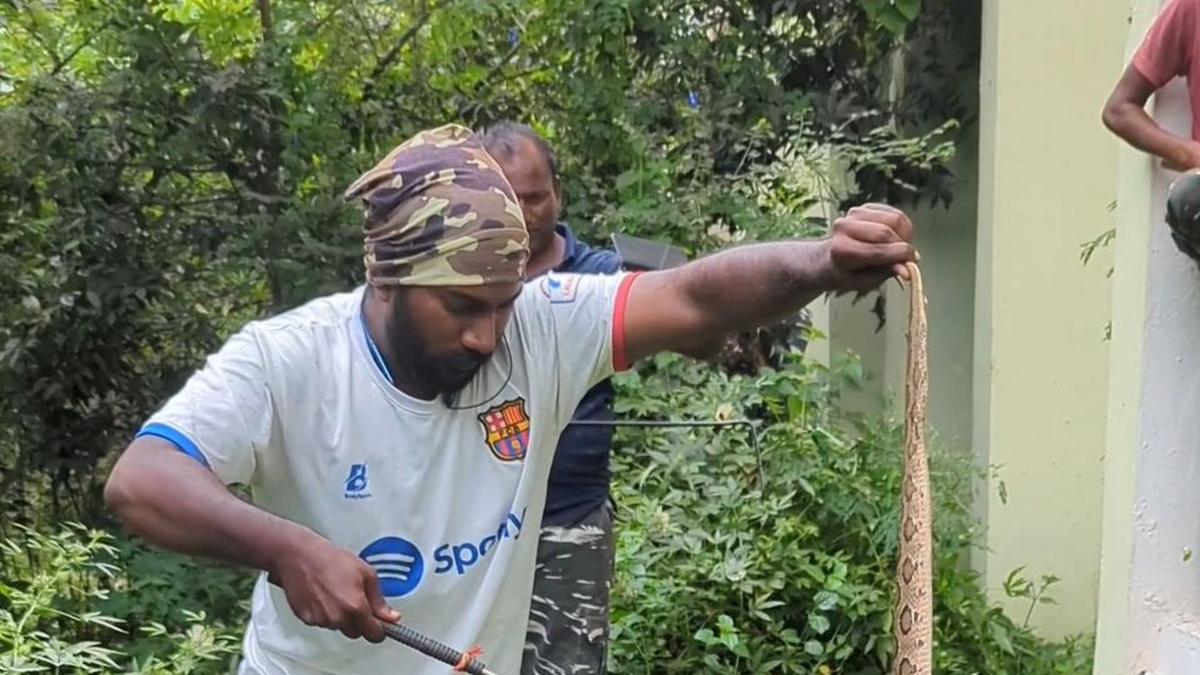

Friends of Snakes rescued around 1,300 snakes between June 1 and June 25, compared to about 1,200 snakes were rescued during the whole of June last year.
| Photo Credit: BY ARRANGEMENT
Snake rescue operations in Hyderabad have seen a rise in the first 25 days of June this year, with rescuers recording more calls than during the entire month last year. The trend, they say, may be linked to a delayed and weak onset of the southwest monsoon that kept snakes active for longer before sustained rainfall set in.
1,300 rescues in 25 days against 1,200 in 30 days
Friends of Snakes, a Hyderabad-based rescue organisation, said it rescued around 1,300 snakes between June 1 and June 25, including over 500 cobras and around 300 rat snakes. In comparison, about 1,200 snakes were rescued during the whole of June last year.
“June is usually our peak period because hatchlings begin to emerge with the onset of the monsoon,” said Avinash V, general secretary, Friends of Snakes Society.
Impact of monsoon humidity on snakes
According to rescuers, weather conditions play a key role in snake movement. While early monsoon humidity encourages activity and emergence of hatchlings, continuous rainfall typically reduces sightings.
“When it rains continuously, temperatures drop and snakes prefer to stay hidden in burrows or crevices. Because of the rain, visibility decreases, so people are less likely to spot snakes,” Mr. Avinash said.
This year, however, the monsoon’s weak and delayed onset meant Hyderabad experienced intermittent rainfall and fewer overcast days through most of June. Rescuers believe these conditions likely prolonged snake activity and increased human-snake encounters.

Not one factor
Rescuers also cautioned against attributing the rise in calls to a single factor such as El Niño, noting that multiple environmental and human-driven factors influence encounters.
“Urbanisation and construction are pushing into earlier forest edges, so encounters are naturally increasing in some areas,” Mr. Avinash said.
He added that awareness campaigns have also changed public behaviour, with more people choosing to call rescue teams instead of killing snakes. “Earlier, many snakes were killed on sight. Now people are more aware and call us instead,” he said.
June also sees a seasonal spike due to the emergence of hatchlings of several species, including cobras, which increases sightings in residential areas.
Once rescued, snakes are not kept locally but are released into suitable natural habitats. “All rescued snakes are safely relocated to forest areas with the help of the Forest Department,” Mr. Avinash said.
If the monsoon strengthens and widespread rainfall continues through July, rescuers expect a different pattern, with reduced snake activity above ground despite the season coinciding with hatchling emergence.
Published – June 29, 2026 03:55 pm IST