
A new study has warned that India’s digital policy is shifting to a more restrictive regulatory regime which could hamper the growth of the country’s startup ecosystem.
Over 88 per cent of Indian startups reported that current digital regulations in India pose operational constraints, with data governance rules identified as the primary area of concern by around 44 per cent of respondents, according to a new survey report titled ‘Digital Regulations and the Startup Ecosystem in India’ jointly published by Oxford Economics and Digital Prosperity Asia on Monday, June 29.
Regulations related to AI (23 per cent), cybersecurity (20 per cent), and platform rules (13 per cent) were also highlighted as areas of concern. An estimated 72 per cent of surveyed startups and venture capital (VC) firms said that resources are being diverted away from research and innovation to ensure compliance with burdening digital regulations.
Additionally, 68 per cent of startups reported increased uncertainty around future returns as a result of digital regulations in India, as per the report. However, 42 per cent of startups reported increased customer trust in their products and services owing to digital regulations.
The study was prepared in January 2026 by surveying 550 participants including 350 startups, 100 venture capital firms, and 100 incubators. The findings of the report relied on expert interviews and Oxford Economics’ quantitative economic modelling to assess the impact of digital regulations on India’s startup ecosystem.
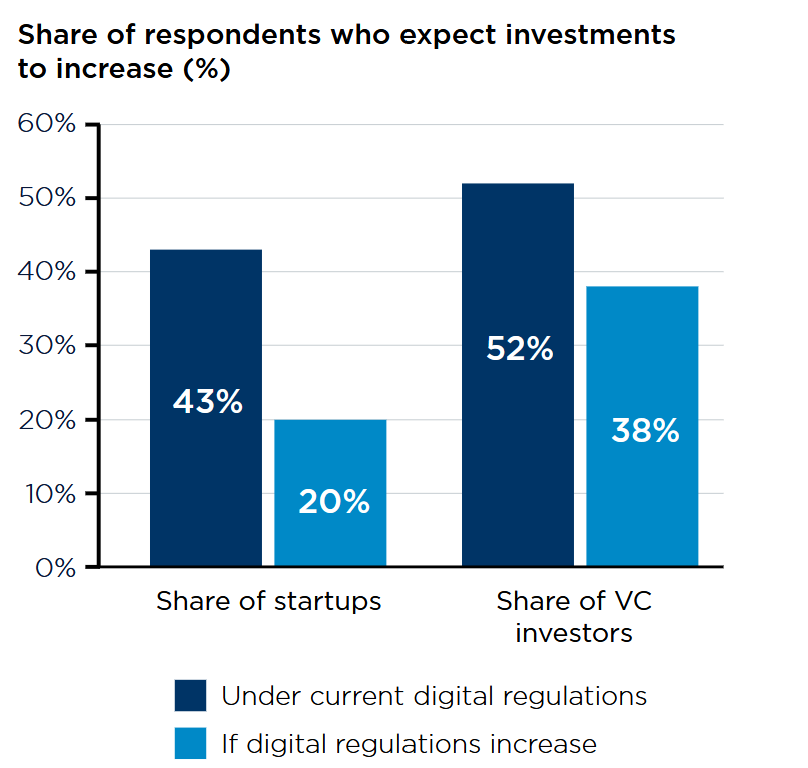 Share of respondents who expect investments to increase (%) (Screenshot: Oxford Economics report)
It comes amid massive outflow of foreign portfolio investors (FPIs) who have pulled out around Rs 2.6 lakh in the first five months of this year, already exceeding the total outflow for all of 2025. The design and implementation of regulatory frameworks have significant implications for innovation, investment, and job creation in India, according to the study.
“In an emerging market like India, maintaining proportionate, principles-based regulatory frameworks can support startup scaling, attract investment, accelerate technology diffusion, and strengthen the country’s innovation ecosystem,” Bali Kaur Sodhi, lead economist at Oxford Economics said.
Story continues below this ad
“By continuing to foster enabling digital infrastructure and adopting a balanced regulatory approach, India could unlock significant economic gains, including an estimated 80,000 additional startup jobs and ₹30,400 crore in annual venture capital investment over the next decade,” she added.
Key projections
A quantitative analysis undertaken by Oxford Economics, based on an index of digital regulatory restrictiveness that spans the data governance, cybersecurity, and AI governance pillars, found that “moving from a less restrictive to a more restrictive regulatory environment is associated with lower rates of firm creation and weaker VC investment.”
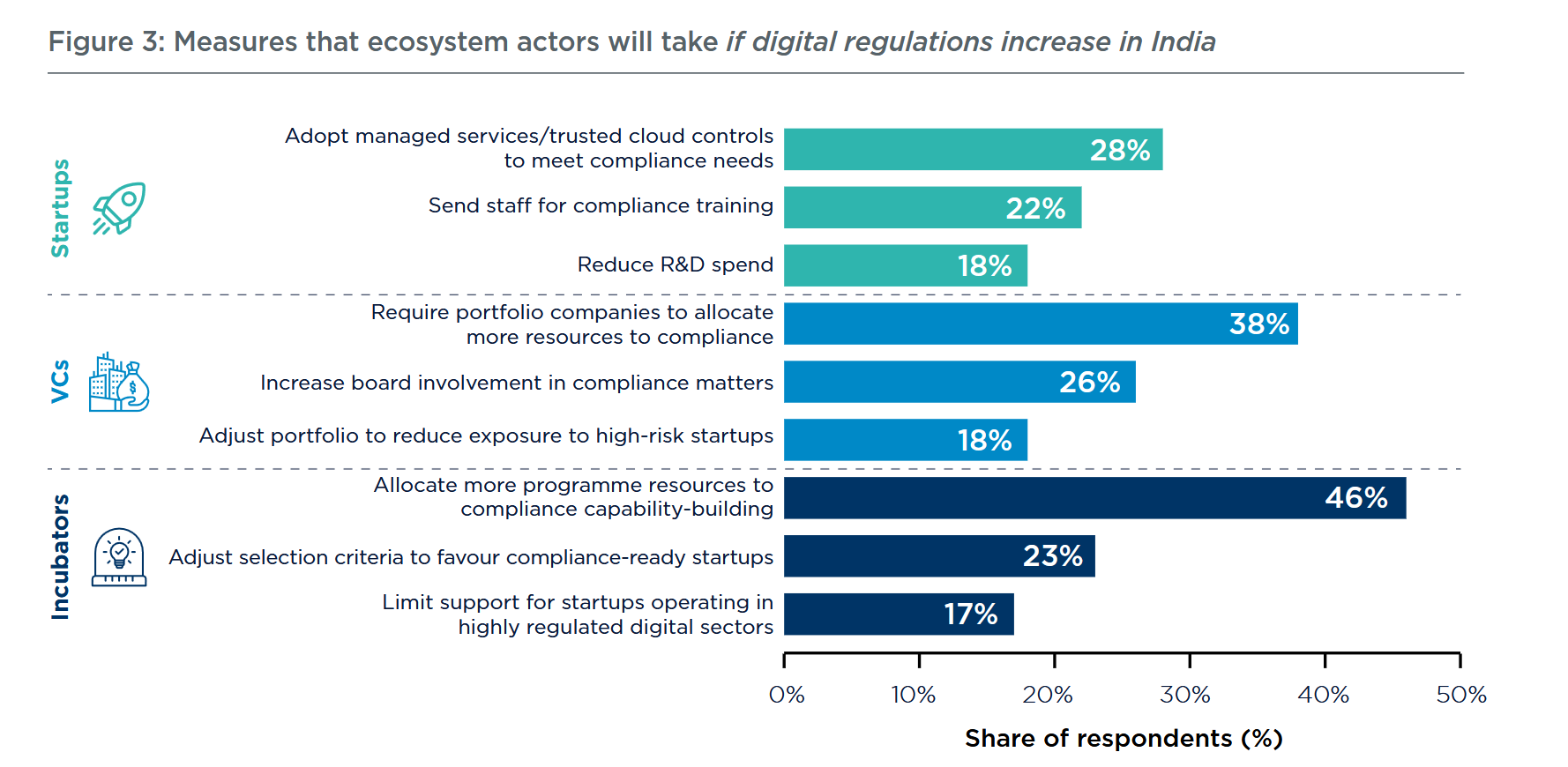 Sample: n = 218 (All startups expecting regulations to increase), 100 (All VCs), 100 (All incubators). (Screenshot: Oxford Economics report)
The report’s economic modelling suggests that a shift towards a more restrictive digital regulatory environment could lead to the equivalent of 2,130 fewer startups being created annually with a 25 per cent reduction in annual VC investment, representing a loss of approximately Rs 91,500 crore each year, and 2,45,000 fewer startup jobs supported in India in 2035.
On the other hand, a more enabling regulatory approach could boost startup formation by 7 per cent, increase venture capital investment by 9 per cent, and support an additional 80,000 startup jobs in India by 2035.
Story continues below this ad
As part of its recommendations, the report said that the Indian government should adopt three key principles to help strengthen the country’s startup ecosystem:
-Risk-based and proportionate regulation, particularly in emerging areas such as artificial intelligence.
-Greater coherence and alignment across regulatory frameworks to reduce duplication and compliance burdens.
-Consultative and iterative policymaking that incorporates feedback from startups, investors, and ecosystem stakeholders.