

Kerala and Tamil Nadu are among the most socially and economically advanced States in India. Yet, the finances of both governments, like those of most other States, are under stress. The White Papers recently released by the two governments described their outstanding debt as alarming. State government debt is often vilified as the result of fiscal mismanagement. But it may, in fact, reflect a mismatch between development aspirations and the limited fiscal capacity of State governments.
The fiscal dilemma
Debts build up over the years with deficits, which arise when the government’s expenditure overshoots its tax and other receipts. In India, while the power to raise taxes rests largely with the Union government, a larger share of overall government spending is borne by the State governments. A majority of the State government expenditure is on social sectors, such as health and education, and economic sectors, such as agriculture and irrigation, all of which have a direct impact on people’s lives and livelihoods. In Kerala, the high levels of State government spending on social sectors since the 1960s have been a central constituent of the public action driving social progress. Compared with the corresponding average for all Indian States, per capita State government social expenditure was higher in Kerala and Tamil Nadu (by 30% and 20%, respectively). In contrast, it was markedly lower in Bihar and Uttar Pradesh (by 35% and 40%) (for the period 2020-23, according to an analysis based on State Finances: A Study of Budgets, Reserve Bank of India).
White Paper addresses adverse impact of ‘revenue collapse’ on people of Tamil Nadu
States meet their expenditures partly through their own revenues — which mainly include State Goods and Services Tax (SGST) and sales tax — and through fiscal transfers, grants, and loans from the Union government. Kerala has a sufficiently good record of mobilising own-tax revenues, which, on a per capita basis, are 1.5 times the average for all Indian States and Union Territories. However, its share in the Union government’s tax devolution to States was 1.92%, lower than its 2.6% share of India’s population in 2023–24.
Of the limited financial resources at its disposal, Kerala has been able to direct only 10% towards capital expenditure to enhance future production capabilities.
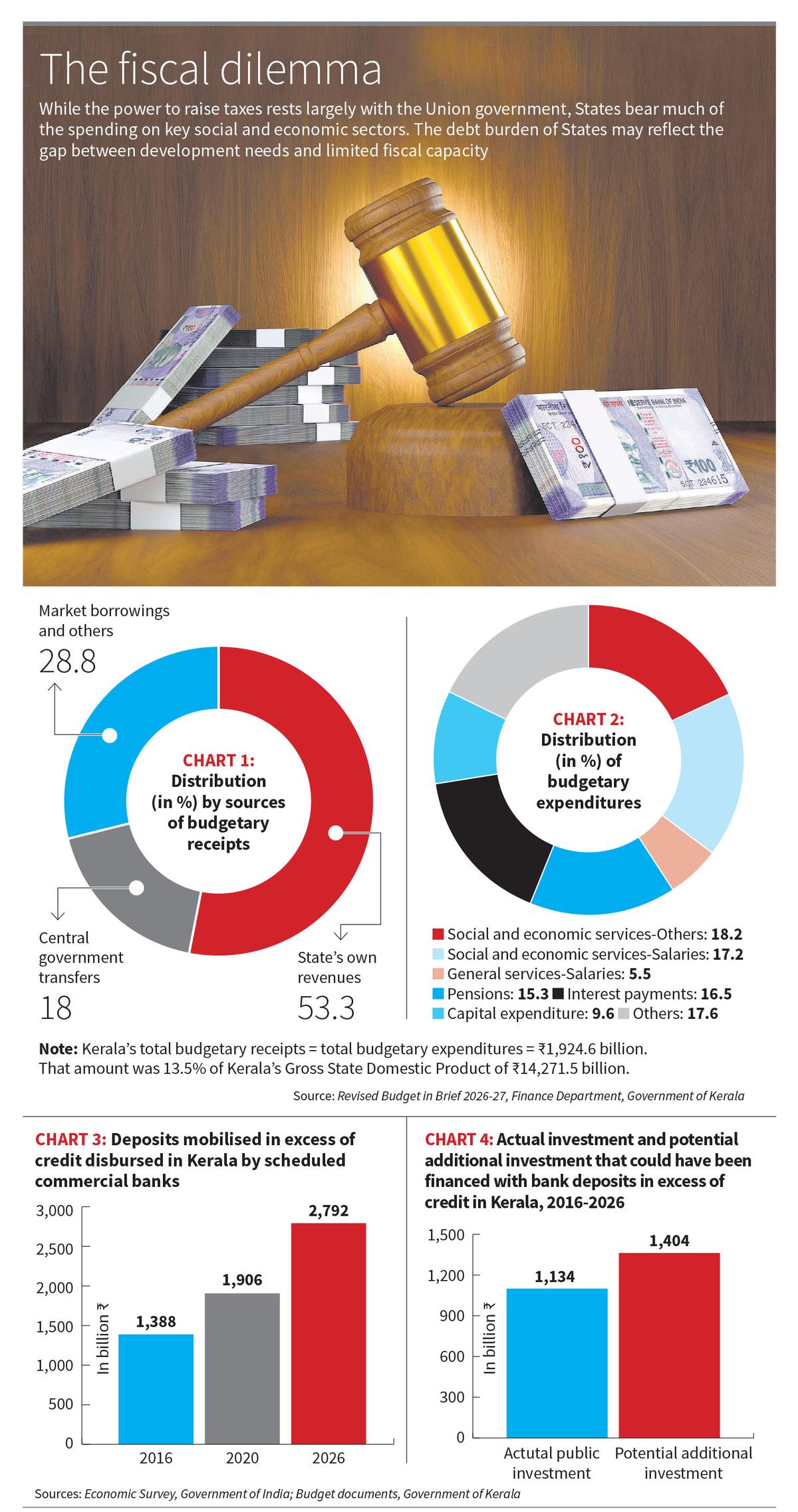
The excess of expenditures over receipts has been met through market borrowings by the States, on which the States pay interest (Charts 1 and 2).
Of the limited financial resources at its disposal, Kerala has been able to direct only 10% towards capital expenditure to enhance future production capabilities. The rest was spent on revenue, or day-to-day expenditure. Approximately a fifth of the State’s budget expenditure was on the salaries of government employees, mainly teachers, nurses, doctors, and police personnel. Pensions accounted for 15.3%, while interest on market borrowings accounted for 16.5% of the total budget expenditure (Chart 2).
The investment challenge faced by Kerala
Kerala is thus caught in a fiscal dilemma. If it tries to create more fiscal space by reducing revenue expenditures — cutting pensions, retrenching employees — it risks eroding its strengths in the social sector. At the same time, Kerala urgently requires large-scale, State-directed investments in infrastructure, higher education and research, and public transport, if it is to realise its potential in modern, knowledge-intensive economic sectors. Educated young people are leaving Kerala in large numbers because the State is unable to create educational and employment opportunities that meet their aspirations.
In Kerala, the government’s weak fiscal capacity contrasts with unmistakable signs of private affluence (lavishly built houses, expensive cars, and a high density of gold shops), threatening to exacerbate inequalities.
The ratio of credit to deposits of scheduled commercial banks in Kerala is only around 66%, compared with the national average of 76% and ratios exceeding 100% in Maharashtra and Tamil Nadu (2023). The excess of bank deposits over bank credit is one indicator of the volume of unutilised savings in Kerala. Between 2016 and 2026, the State government’s capital expenditure could have been at least doubled if Kerala had been able to channel at least part of its surplus savings into investment (Charts 3 and 4).
The borrowing opportunity for China’s local governments
In China, the bigger chunk of the massive investments that have boosted economic growth has been undertaken by provinces and lower-level local governments. Local governments borrow heavily to finance these investments, drawing on the large pool of domestic savings held by Chinese banks, while their efforts are coordinated through central government planning. China’s local governments raise resources through the sale of local government bonds (LGBs), land sales, and off-budget borrowing via local government financing vehicles (LGFVs), supplementing fiscal transfers by the central government.
In India, not only have there been limits on borrowing by State governments, but the cost of their debt has also been markedly high. State governments pay interest of 6.5% to 7.5% on the securities they issue, known as State Development Loans (SDLs), to borrow from the market. This is 0.25 to 0.75 percentage points higher than the rate at which the Union government borrows and significantly more expensive than the cost of borrowing by Chinese local governments from their banking system (around 2%).
The high interest burden further tightens the debt noose around State governments.
The State and Union government bonds issued in India are largely purchased by domestic financial institutions, including commercial banks and insurance companies, which deploy the savings they mobilise from the public to support government finances. In effect, the debt the government owes is a debt to its own people. A government that borrows to fund projects that expand welfare and opportunities is serving a far greater cause than a tight-fisted government.
A family would prefer that its savings, rather than being wiped out to send their child to study in a distant land, be used to establish a public university in their district.
We need fiscal structures that enable State governments to access domestic savings more easily and at a lower cost to fund meticulously planned development projects.
(Jayan Jose Thomas is a Professor of Economics at the Indian Institute of Technology (IIT) Delhi and a visiting researcher at the South Asia Institute of the Heidelberg University.)
Published – July 01, 2026 07:30 am IST