

There are summer movies, and there are summer movies. The term has become conflated with big-ticket blockbusters released in movie theaters between May and early September, and, in some cases, endlessly rewatched at home afterward. But there are also movies that feel like summer, because of their setting, subject matter, or, more often than not, their depiction of pure sun-fried heat.
These movies aren’t necessarily calculated to sell toys, nail four-quadrant appeal, or send audiences into a state of rollercoaster elation (though some of them did some or all of those things). These are movies to match the mood of the season. Cinematic depictions of summer ranging from comedies to dramas to thrillers (but, OK, a lot of them are comedies), with plenty of camp time, European getaways, and sweltering city streets.
So instead of beating the heat, maybe just lead into it with these fifteen seasonal classics from throughout cinema history, presented here in chronological order.
Honestly, as far as Marilyn Monroe comedies from the 1950s go, this one isn’t top-tier. How to Marry a Millionaire and Gentlemen Prefer Blondes are both a lot funnier, despite this one’s Billy Wilder pedigree. (He outdid this one, too, directing Monroe in Some Like It Hot.) That said, this is the rare depiction of that old summer standby. The family gets away from the heat while someone stays behind to work in the hot, hot city. That’s what leads to the most lasting and iconic moment in the film: Monroe’s character, the weirdly credulous and unnamed neighbor of conflicted husband and father Richard (Tom Ewell), getting her dress blown up by a New York City sidewalk vent. Ewell has to shoulder too much of the shtick, but the movie gets the antsy horniness of a NYC summer just right.
Summertime (1955)
In between big-canvas epics, director David Lean made something more intimate (and, given its shorter runtime, easier to rewatch): Summertime, a romantic drama about a middle-aged single woman (Katharine Hepburn) finding unexpected love in Italy. Yes, this is a classic precursor to what has become a go-to rom-com formula. While location shooting is obligatory of movies like Under the Tuscan Sun, it was less common in 1955, which lends the movie’s Italian locations extra summer-travel points. Also, who wouldn’t want to spend the summer with Katharine Hepburn?!
Now, Rear Window also takes place during a heatwave, but it’s weirdly outshined (in the summer-media department, that is) by the Simpsons episode “Bart of Darkness,” which riffs on the basic idea with an even more summery framework of the family getting a new pool. To Catch a Thief may be the most purely summer-y Hitchcock in the sense of depicting a lush getaway on the French Riviera. (And it does take place during the summer, if less sweatily than Rear Window.) Cary Grant plays an ex-thief attempting to clear his name with the help of one of his alleged victims (Grace Kelly!). It’s Hitchcock in light-caper mode, and there’s a summery fireworks display to boot! And, yes, this is the third 1955 release in a row. It may have been the best-ever year for summer-themed movies.
The Swimmer (1968)
A man emerges in his friends’ suburban backyard and takes a dip in their pool. He realizes with a far-off look that there’s enough of a chain of backyard pools from there to his own house that he can traverse the county and “swim home” (with some hikes in between, of course). To the bafflement of his friends, he takes off to do just that. This is the premise of a John Cheever short story, adapted into a strange and beguiling film starring Burt Lancaster as the seemingly cheerful suburbanite whose summer adventure takes him through the lives of his various neighbors, and masks, with decreasing effectiveness, his own despairs and failures. The movie tunes into how the idyll of summer can both hide and amplify feelings of suburban ennui (or worse). It’s equal parts eerily beautiful and genuinely unnerving.
Before he turned Star Wars into his life’s work, George Lucas served up a classic last-night-of-summer movie that would become a model for so many other stories of yearning, wayward, and/or confused teenagers to come. Set in 1962, the movie captures a transition from 1950s touchstones into 1960s culture (and tumult), with equal measures of youthful antics and coming-of-age soul-searching. There’s a particular vibe to summer after the sun goes down, less reliant on heat and more on ephemeral qualities, that Lucas summons here, all the more valuable because it doesn’t really figure into his later work at all.
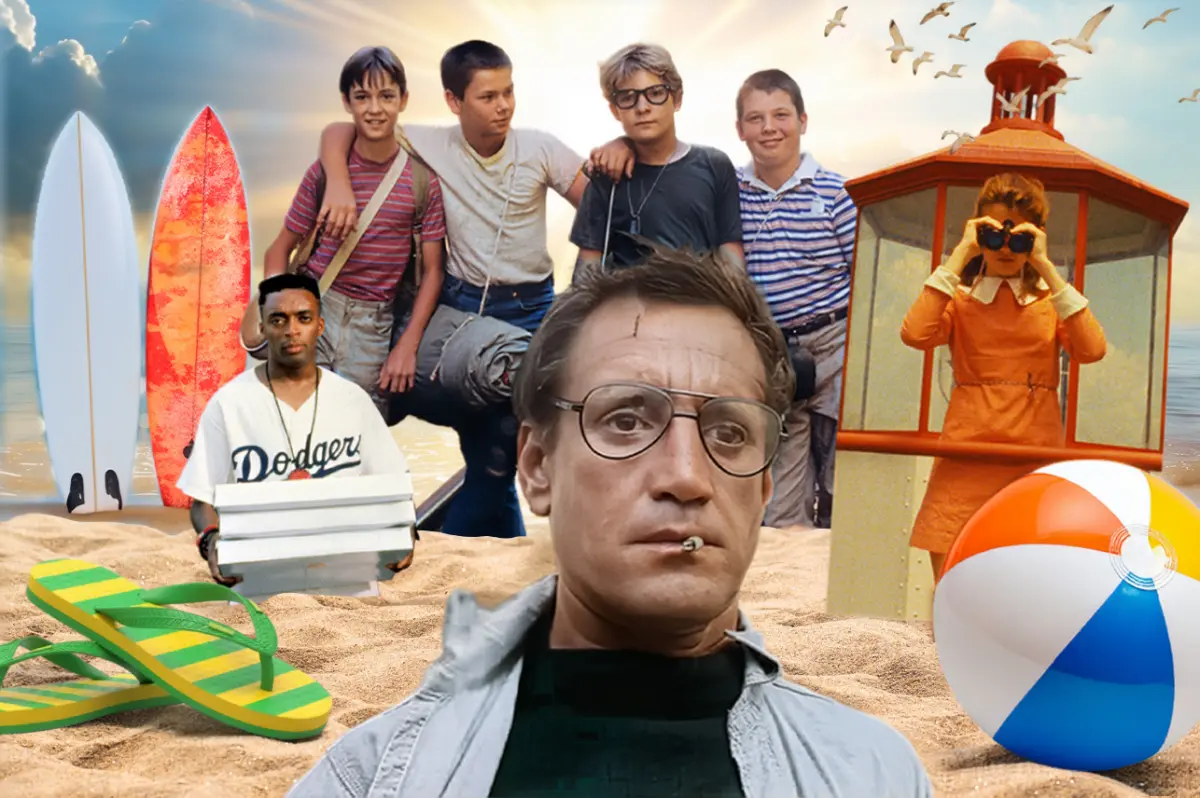
Meanwhile, similarly early in his career, Lucas’s pal Steven Spielberg made the definitive beach thriller out of a definitive beach read: Peter Benchley’s Jaws. Most people seem to agree that the book was elevated by Spielberg’s prodigious filmmaking, often working around a malfunctioning mechanical shark. The combination of beach-set terror and seafaring adventure, centered on a mayor’s refusal to close down a tourist attraction over the Fourth of July, makes this maybe the best American summer movie ever. It’s both a great thrill ride that practically invented the summer blockbuster as we know it and a pointed critique of capitalist carelessness that helped contribute to the blockbuster era.
The late Rob Reiner was in the middle of a crazy run of crowdpleasers when he made Stand By Me, adapting a Stephen King novella about four young teenagers who venture out on a summertime quest to see a rumored dead body in the woods. On paper, it sounds a bit more mordant and thorny than the likes of This Is Spinal Tap or The Princess Bride. Yet four decades later, this compact classic — it runs under 90 minutes! — remains one of Reiner’s best, and was reportedly the director’s favorite of his own films. (Stephen King is fond of it, too.) Its depiction of a free-range summer, with kids facing some genuine unsupervised danger, albeit not always more than they might find at home, is both nostalgic and, appropriate to King’s edge, a little scary, with a bittersweet postscript.
34 years after The Seven-Year Itch, Spike Lee took a less fanciful (but still quite lively and often funny!) look at New York City in the summer, here centered on tensions coming to a boil within a block in Brooklyn. Though he’s made plenty of great movies since, some arguably equal to this one, Do the Right Thing remains Lee’s signature achievement. It stands out in part because of how clearly it evokes the sticky, sweaty joys and frustrations of city life, while acknowledging the massive gulfs that still prevent racial harmony in our American emphasis-on-melting pot. For further Spike in Summer watching, check out Summer of Sam.
Dazed and Confused is a perfect companion to American Graffiti, and obviously very much inspired by it. Rather than a ’70s movie reaching back to the early ’60s for an ensemble story set on the effective last day of summer, this is a ’90s movie reaching back to the late ’70s for an ensemble story set on the effective first day of summer: the last day of school in 1976. Writer-director Richard Linklater has made a number of ace hangout movies, but this one may be his funniest and most memorable, thanks in part to a stunning cast of then-up-and-comers that we now recognize as major stars and beloved character actors. Matthew McConaughey, Ben Affleck, Parker Posey, Joey Lauren Adams, Milla Jovovich, and the late, great Nicky Katt all made hot first impressions here.
In horror circles, summer feels like slasher season almost just as much as Halloween, thanks to the proliferation of camp-set Friday the 13th movies and their attendant knockoffs. The problem is, few of those are all that great. While I Know What You Did Last Summer provides more of a murder-mystery framework and high gloss endemic to the late ’90s slasher revival — it’s not exactly In a Violent Nature — it also features major tourist-townie vibes in its character details, setting, and overall craft that looks a lot more substantial nearly 30 years later. It’s perfect summertime sleepover fodder.
(2001)
DIRECTOR: David Wain
STARS: Janeane Garofalo, David Hyde Pierce, Paul Rudd
PLOT: Watch the cult camp comedy before the series adaptation hits Netflix this summer. [Stream Wet Hot American Summer on HBO Go] Photo: Everett Collection
Some might choose Meatballs or another genuine summer-camp comedy for a list like this. But it’s nearly impossible to look at those movies the same way after David Wain’s now-seminal micro-targeted spoof Wet Hot American Summer, an absurdist takedown of a particular type of late ’70s/early ’80s teen comedy, made with the joke density (and inventiveness) of a classic Zucker-Abrahams-Zucker comedies. Mostly ignored during its scant 2001 theatrical release only to become a beloved classic on home video, it’s very much the broad-comedy equivalent to something like Dazed and Confused, in that it featured folks like Amy Poehler, Elizabeth Banks, Paul Rudd, and Bradley Cooper before they became bigger deals later in their careers. Seeing them in retrospect gives the movie a youthful glow even when it’s very obviously (and hilariously) casting adults as teenagers.
The rare comedy that can pull off “wistful” and “hilarious” near simultaneously, Greg Mottola’s Adventureland follows a recent college grad (Jesse Eisenberg) grappling with disappointment and also falling in love with a hometown girl (Kristen Stewart) while working at a dead-end amusement-park job. Eisenberg and Stewart have real chemistry, Martin Starr is alternately hilarious and heartbreaking, Bill Hader and Kristen Wiig provide broad comic relief, and Ryan Reynolds turns the smarm dial way down (though not all the way off; he needs a little of it) to quietly give one of his best performances.
OK, one more single-day ensemble movie in the tradition of American Graffiti, this one similarly set during the last 24 hours or so of summer vacation. The characters in David Robert Mitchell’s first feature skew a bit younger than the senior-aged Lucas ensemble, still fumbling their way through adolescence, which gives this movie a gentler, more poetic rhythm. Mitchell also uses his trademark wateriness about time periods to subvert the kind of easy nostalgia often attached to these narratives. American Sleepover generally feels like the past — like a vivid memory with hazy spots — without committing to any firm generational signifiers. It’s a beautiful and underseen gem.
IMDb Rating: 7.8
A quirky story of young love from the mind of Wes Anderson, Moonrise Kingdom depicts two pre-teens who decide to run away together from their New England hometown. The disapproving adults who will do whatever they can to stop our two young lovers from being together, but they won’t give up. Rife with innocence, humor, and wit, Moonrise Kingdom is the offbeat youth romance you’re bound to fall in love with.
[Stream Moonrise Kingdom] Everett Collection
As Wet Hot American Summer proved, there are enough summer-camp comedies to inspire an entire loving parody. But the flat-out best of the bunch came well after the subgenre’s ’80s heyday, with a story set well before, in 1965. Wes Anderson’s Moonrise Kingdom, about a 12-year-old camper who runs away with a local girl on a remote New England island, largely exists out of time, and it doesn’t feel as directly connected to the here-and-now as some of his other period pieces. Instead, it’s as timeless as the kind of middle-grate fiction its heroes read, and the movie clearly wants to evoke, alongside the beauty and the provincial inconveniences of living on a quaint island slightly removed from society at large. Oh, and it’s also much, much funnier than Meatballs.
Several Pixar projects were released straight to streaming during the height of the pandemic and Luca may be the most slept-on of the bunch. It’s a smaller-scale animated fantasy about two young sea creatures who can pass as human boys spending a summer striking out on their own in a small coastal Italian town. The movie’s aesthetic beauty has a cartoony bounce in addition that further enlivens the usual Pixar polish; you can practically feel the sea breeze and taste the gelato. Studios don’t really make live-action summer-themed movies for kids too often anymore; Luca continues that lineage in a different medium.