
5 min readUpdated: Jun 30, 2026 10:24 PM IST
VK Cherian was a science student in Thiruvananthapuram Kerala, in the late 1970s when he first started watching films at Chitralekha, the cooperative film society founded by Malayalam screenwriter-director Adoor Gopalakrishnan.
He didn’t become a filmmaker. Neither did Cherian pursue MBBS that his family wanted him to. Instead he went to the Indian Institute of Mass Communication, New Delhi, and became a journalist. But those early years of watching world cinema in small theaters, interacting with Adoor and G Aravindan – giants of Malayalam parallel cinema – stayed with him. Long enough to eventually become a book.

Noon Films and the Magical Renaissance of Malayalam Cinema (Atlantic Publishers and Distributors, 2024) is VK Cherian’s attempt to document the two decades, between 1970 and 1990, tracing how a group of filmmakers trained from Film and Television Institute of India (FTII), Pune, including directors Adoor, Aravindan and John Abraham – whom he collectively calls the “A-Team” changed what Malayalam cinema looked and felt like.
“That period really changed people’s taste as well as the filmmakers and technicians’ outlook towards the films,” he says.
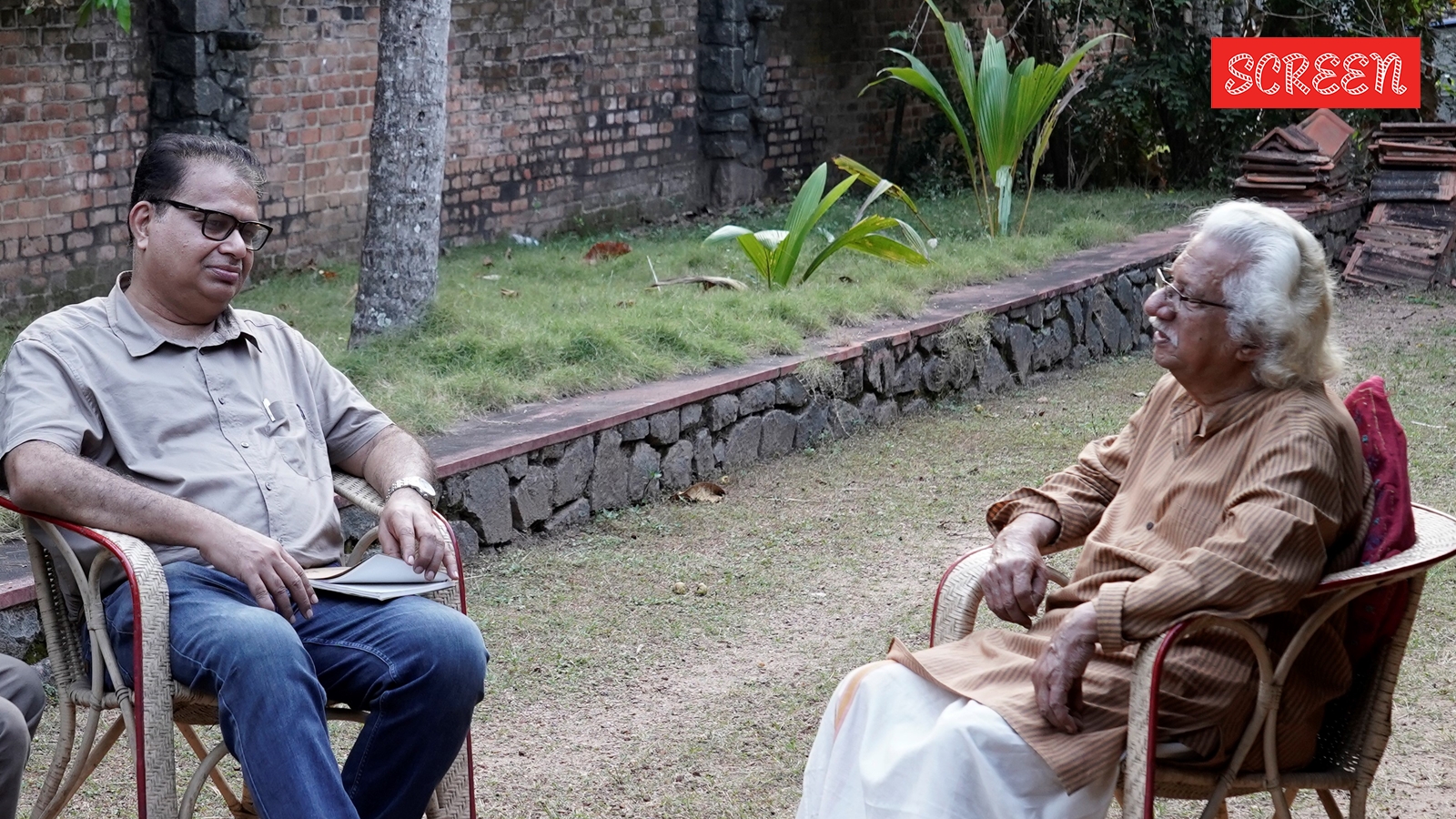 V K Cherian with Adoor Gopalakrishnan at his Thiruvananthapuram home. (Photo: VK Cherian)
Cherian, who is also a former film society activist and writer, believes that a lot has been spoken about the movies and filmmakers of the ’70s and ’80s , not to just frame it as a film movement. He said, “People write about films of those times but they don’t put it in the cultural and political context of the time. My effort is to do that.” The Emergency period, the literary ferment happening simultaneously in poetry and fiction, the rise of film societies across Kerala – all of it, he argues, created the conditions for a new kind of cinema.
Before the 1970s, cinema halls in Kerala ran three shows, typically at 3 pm, 6 pm, and 9 pm. When Adoor’s Swayamvaram (1972) presented social drama and documentary-style commentary, he heralded the New Wave in Malayalam cinema. The film swept the National Awards and put Malayalam cinema on a map. The film follows a young, unmarried couple who elope and defy societal norms, only to have their romantic ideals shattered by unrelenting poverty, unemployment and tragedy in an unforgiving urban world.
These New Wave films were still seen as risky commercial bets, and were given a noon slot that didn’t exist before, thus getting the name ‘noon films.’ “People were curious about what they (the directors) were doing, they were gaining national and state attention by winning the awards. So the distributors decided to give them a chance,” Cherian recalls. A slot born out of curiosity became the entry point for a generation of viewers.
Story continues below this ad
And those viewers came. Adoor’s Kodiyettam (1977) starring Bharat Gopy and KPAC Lalitha, ran for nearly 145 days in theaters. The thematic core of Kodiyettam lies in an interrogation of what it means to be a ‘man’ in a society, organised around duty, expectation and patriarchal inheritance.
These films also heavily influenced commercial cinema during the time. Directors such as P Padmarajan, KG George, IV Sasi and cinematographers who had come up through the film society world, began bringing a new visual seriousness to mainstream productions. Scripts got sharper, performers more restrained, technicians more considered. By the 1980s, the line between art film and commercial film in Malayalam had blurred.
The ripple effects were significant – a new generation of actors, editors and cinematographers trained in this aesthetic took over mainstream Malayalam cinema through the 1980s. The themes that were shown in the movies became more grounded and realistic, drawing more and more from real life issues.
Cherian’s own memories of that period are vivid and affectionate. He remembers Adoor walking into Chitralekha screenings with his wife and young daughter in their Ambassador car. “My standing in college was different, as I was part of the ‘big leagues,’” he adds, laughing.
Story continues below this ad
This is the continuation of his earlier work, India’s Film Society Movement: The Journey and its Impact (Sage Publications India Pvt Ltd, 2016), which traced the film society ecosystem from Bengal to Kerala. That research made him realise Kerala’s story was singular. Cherian is less happy about what followed. The 1990s saw Malayalam cinema veer heavily into mass commercial territory. He attributes part of this to the simple absence of the pioneers and filmmakers who were willing to take a risk and challenge the audience’s intellect. He added that filmmakers of the ’70s fought for every inch – forming cooperatives, scraping budgets, “evangelising” cinema at cultural gatherings. But Cherian feels that, later even when the money and the technicians and the technology existed, the hunger to create something different ceased to exist.