

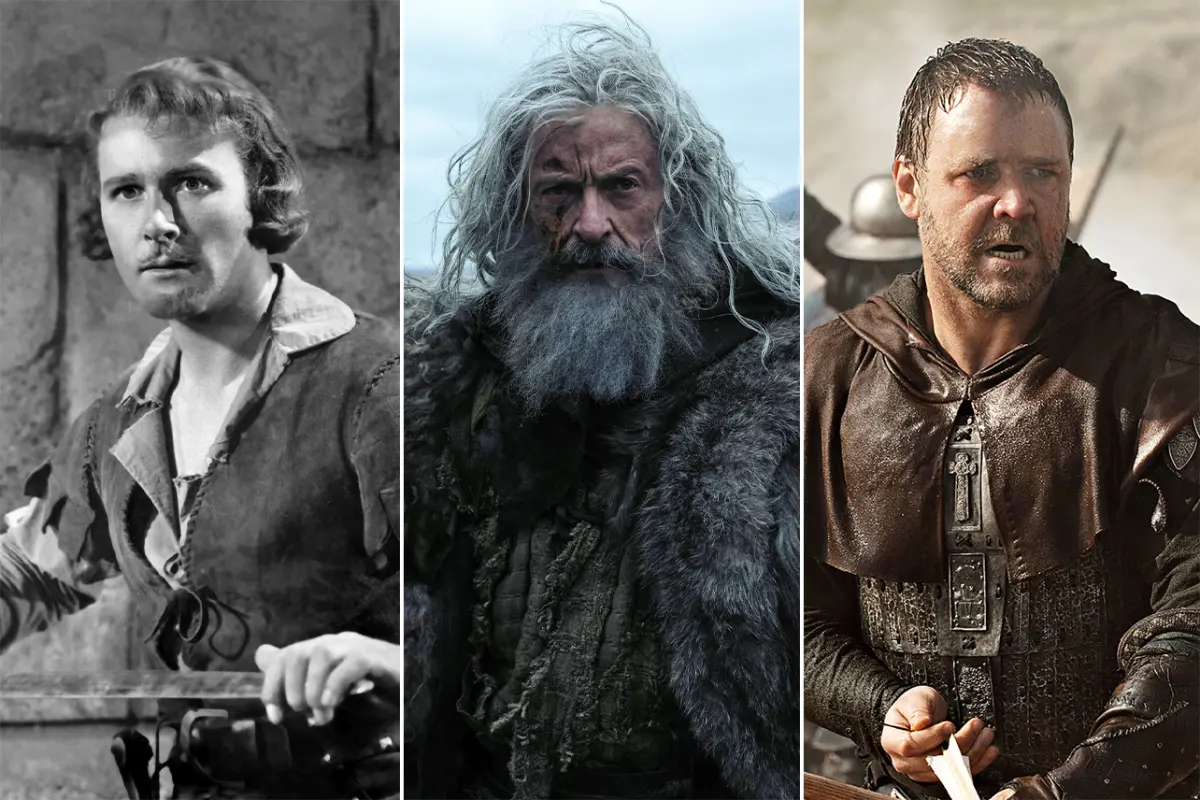
Hugh Jackman is the latest in a long line of legendary actors to take on a legendary character: Robin Hood, the folkloric twelfth-century outlaw who robbed from the rich and gave to the poor. Performers as varied as Errol Flynn, Sean Connery, Kevin Costner, and a sexy animated fox have all put their personal spin on the role. Jackman’s, in the new movie The Death of Robin Hood, is a darker, revisionist version more akin to his work as Wolverine than his peppy song-and-dance movies. That movie is playing in theaters and likely won’t stream at home for a few months. But plenty of other Robin Hood movies from over the years are currently available at home — more than enough to have an era-spanning Robin Hood marathon. Then again, a Robin Hood novice might want to start slowly with just one definitive (or at least high-quality) version of this oft-retold story.
That’s where Version Control comes in. What follows is a brief but well-stocked chronological evaluation of some of the biggest Robin Hood titles available, including the new Jackman movie, with a concluding verdict about which one to seek out if you’re only going to watch one.
-
An all-ages, all-time swashbuckler, this colorful standard-setter might look, at first, too kid-friendly for anyone who has been conditioned to expect medieval-themed adventures to be full of muck, blood, and grit. It might also remind certain viewers of Robin Hood: Men in Tights, which despite its post-Prince of Thieves release was actually patterning itself largely after this much-older movie. But despite its age, the film’s influential action and stunts — particularly its acrobatic swordplay — run rings around plenty of contemporary productions. Directed by master genre-shifter and workhorse Michael Curtiz (his other films include the proto-horror movie Doctor X, the musical Yankee Doodle Dandy, the melodrama Mildred Pierce, and, oh yeah, Casablanca) and starring Errol Flynn, The Adventures of Robin Hood has endured as a classic; it’s basically the Hollywood adventure movie of the studio era.
-
Photo: Disney Thousands of early crushes were apparently stirred by Disney’s compact 83-minute all-animal retelling of the Robin Hood story, which notably reuses some character designs, voices, and even actual animation from the studio’s better 1967 film The Jungle Book. Still, Disney Animation’s fallow 1970s period — the worst decade of their existence so far by a fair measure — ensures that this title remains their best of those years, even if it does feature the obligatory bunch of animals running around yelling “charge!” It’s also a great introduction to the character for younger kids, and apparently also a great introduction to the idea that cartoon foxes can be hot.
-
Robin and Marian (1976)
A Robin Hood story from Richard Lester, director of A Hard’s Night and The Three Musketeers, sounds like an irreverent romp. But while there are moments of sly wit and dashing swordplay in the movie that casts Sean Connery and Audrey Hepburn as an older Robin Hood and Maid Marian, respectively, it’s also surprisingly elegiac in catching up with these famous characters who themselves are reuniting decades after their prime. It’s a neat curiosity, though of course more of a companion piece to other Robin Hood mythologies than a stand-alone feature, something it shares with a much newer version. In fact, the original title of this one was… yes, The Death of Robin Hood.
-
©Warner Bros/Courtesy Everett Collection Is this the movie that has convinced so many studio executives since that a new Robin Hood project could be a blockbuster? Indeed, Kevin Costner’s teen-friendly version of the legend — too grim for actual kids, not necessarily sophisticated enough for the most discerning adults — was second only to Terminator 2: Judgment Day at the summer 1991 box office. It’s probably best-interpreted as a medieval Western from forever-cowboy Costner; his supposed Englishness sure doesn’t register much. Moreover, Costner’s longtime frenemy Kevin Reynolds (who also made Waterworld with Costner and The Count of Monte Cristo without) knows his way around a pulpy adventure, and a wildly over-the-top Alan Rickman stands as the best Sheriff of Nottingham. If the movie itself feels awkward positioned between revisionist and traditionalist, it nonetheless shares some common ground with the 1938 film in terms of pure entertainment value (though the stunts aren’t nearly as good). In a bizarre Version Control twist, there’s actually another 1991 Robin Hood movie just called Robin Hood, which never came out in American theaters for obvious reasons; there’s also an unrelated Disney TV movie starring a young Keira Knightley called Princess of Thieves. Don’t worry about either of those.
-
Photo: Everett Collection It felt like a commercial and creative slam-dunk: Rather than making Gladiator II (something that would come to pass much later), director Ridley Scott and star Russell Crowe instead reteamed for a new, Gladiator-ish take on the origin of Robin Hood, bringing along Cate Blanchett to boot. If a movie like that did $100 million domestic in 2026, as this one did in 2010, it would probably be considered a substantial success. But only a decade out from Gladiator’s summer-conquering, Oscar-winning success, it was considered a disappointment of a tenth-anniversary gift. And as solidly entertaining as the movie might be, that reputation is warranted. Crowe doesn’t really have the countenance to play a recognizable version of Robin Hood, whether it’s the stereotypically merry man or a grim-and-gritty reimagining. That said, he’d probably make a great Little John or Friar Tuck if you cast him today.
-
Photo: ©Lions Gate/courtesy Everett Collecti / Everett Collection This is, by far, the dumbest Robin Hood movie on this list. It’s also the most underrated, in the sense that it was a critically-pilloried box office bomb that failed to jump-start the hoped-for franchise, but is secretly a pretty fun time. This period-set but modern-sensibility version arrived at the tail end of a decade-plus where variations on fantasy and/or sword-and-sandal movies proliferated in hopes of reviving the fortunes of the big-budget Hollywood epic. Robin Hood doesn’t have any explicitly fantastical elements, but it does feature rapid-firing arrows, gratuitous slow-mo, and the not particularly period-appropriate stylings of Taran Egerton in the lead. It’s basically an unofficial companion piece to the wilder Guy Ritchie King Arthur movie that came out the year before. It robs from the Ritchie and gives to the poor man, if you will. At the same time, the passage of just seven years and change since its release have thrown its better qualities into sharp relief. Silly and dopey as it can be, this is a big-budget movie with actual sets and costumes, cool-looking stunt work, and a runtime that comes in under two hours. Style-wise, director Otto Bathurst (of Peaky Blinders) puts plenty of the then-dominant superhero movies of its era to shame. It probably shouldn’t be anyone’s first choice to introduce the character to a new generation, but honestly, a new generation can and has done a lot worse.
-
The Death of Robin Hood (2026)
Photo: Aidan Monaghan / © A24 / Courtesy Everett Collection Hugh Jackman has the rare gift of seeming able to play Robin Hood in any of the past versions’ chosen registers. He could be dashing and swashbuckling, like the Erroll Flynn one; more winkingly roguish, in the vein of the 2018 one; and he can sing, like the fox in the Disney version. Instead, Jackman’s take on the character skews hard toward Logan territory. This is a gruff, bearded Robin Hood, weary after a life of violence and willing to disabuse any listeners of the notion that he was once the mythical hero of old. This iteration is closest, in other words, to the Russell Crowe version by way of the darker parts of the Robin and Marian, though it also doesn’t particularly stand alone as a Robin Hood adventure. Unlike the Lester film, only bits and pieces of the mythology are referred to, with only Little John making a hilariously feral appearance on screen. For Jackman’s Robin Hood to register as the character at all, it would be preferable for viewers to have already experienced at least one more familiar iteration of his story.
This actually makes The Death of Robin Hood more interesting as an extreme bookend to the brightly colored and effortlessly cheerful entertainment of the 1938 film, despite (or because of) the fact that they have almost nothing in common in aesthetic, technique, or sensibility. Writer-director Michael Sarnoski imagines Robin Hood as more akin to a gunslinger out of a revisionist Western like Unforgiven, and his movie is similarly dark and muck-caked, especially in its brutal first half-hour. But The Death of Robin Hood gives way to a more sustained sense of grace, with very little action in its final hour, as a near-death Robin Hood doesn’t exactly make peace with his troubled past, but at least attempts to settle matters that may not be easy to resolve. Jackman is typically committed to both this bleakness and the character’s possible, partial redemption (or at least reckoning), and Jodie Comer plays well opposite him as a woman on a remote island who cares for the wounded stranger. Sarnoski knows how to use on-screen violence as a jarring attention-grabber, and then allow his characters intense periods of reflection, and if this movie isn’t as surprising as his similar work in Pig or A Quiet Place: Day One, it has a disciplined lyricism that lingers. The Death of Robin Hood wouldn’t make sense as anyone’s first Robin Hood movie, it makes a convincing case for being the last one (even though it won’t be).
The Version Control Verdict: The Adventures of Robin Hood (1938)
All of these movies are watchable to some degree, but it’s simply difficult to beat the original classic — not the first Robin Hood movie ever made, but the first one to really echo throughout film history. If you enjoy it, check out some of the others for contrasting visions of the character (with The Death of Robin Hood as a particularly effective postscript). But if you’re just going to steal some time with one Robin Hood, make it the Errol Flynn version.
Jesse Hassenger (@rockmarooned) is a writer living in Brooklyn. He’s a regular contributor to The A.V. Club, The Guardian, and GQ, among others. He podcasts at www.sportsalcohol.com, too.