

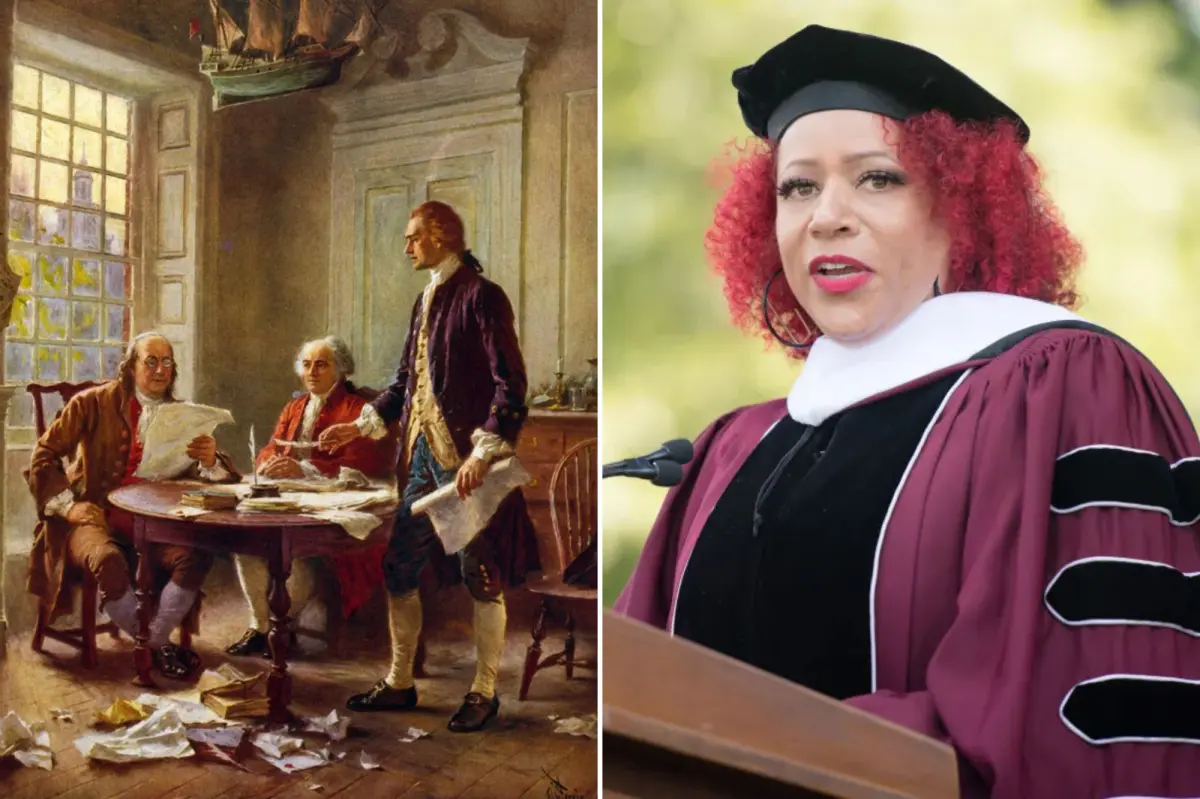

As they attached their signatures to the Declaration of Independence 250 years ago, the founders knew they were risking all. Bucking the king was treason, punishable by death.
Writing to John Adams in 1811, Dr. Benjamin Rush, Philadelphia’s leading physician, recalled the “pensive and awful silence which pervaded the house when we were called up, one after another, to subscribe what was believed by many at that time to be our own death warrants.”
The Declaration’s clarion calls — that all men are created equal, that our rights come not from man or government but from our Creator, that governments cannot exist without the consent of
the governed — inspire still.
And yet, more than a century of assaults by left-wing critics have bruised the founders, and the founding. In 1913, historian Charles Austin Beard began the onslaught with “An Economic Interpretation of the Constitution of the United States,” arguing the founders were motivated not by a desire for freedom, but by economic greed. Later generations added screeds about racism and misogyny. Historians issued a verdict that ours was not a real revolution — like the bloody one in France — merely a course correction.
But any reading of the American Revolution’s ideological roots shows that the concept of self-governance was much discussed among all classes. Edward Gibbon’s “History of the Decline and Fall of the Roman Empire” was a best-seller in America, promoting Enlightenment ideas of civic virtue. Rome’s ancient history became a roadmap for America’s ascendant future.
If Gibbon’s work directly influenced the founders, Tom Paine’s Common Sense sparked the fire for revolution among a wider public.
George Washington — named commander of the Continental Army even before the Declaration of Independence — had the book read to his troops. Congress, weighing independence, devoured it. Even critics who cringed at Paine’s feverish language conceded its impact.
At a time when many in British America were still loyalists, and others pined only for the rights of citizenship a seat in Parliament might have conferred, Paine demolished the concept of divine rights of kings. “The cause of America is in a great measure the cause of all mankind,” he said. “Tis time to part.” And finally, the penultimate call, “We have it in our power to begin the world over again. … The birthday of a new world is at hand.”
Against this proud history, the Left has promoted a deceptive counter narrative. Led by an agenda-driven writer, Nikole Hannah-Jones, advanced by The New York Times into classrooms across the country, the 1619 Project argues the founders came to America not for religious freedom but to perpetuate slavery. The Puritans would beg to differ.
This is what our children have been taught — and what President Trump seems keen to correct in his massive, prideful celebration of our 250th birthday. Under his builder’s eye, Washington DC, is getting a thorough clean-up — the algae-ridden water in the Tidal Basin will soon sparkle with American flag blue water. And heroes toppled by revisionists are standing again.
In Freedom Square, near 14th and Pennsylvania Avenue, Caesar Rodney is making his comeback. Gravely ill with a skin cancer, in constant pain, Rodney rode 80 miles through a storm to cast Delaware’s vote for Independence, ensuring one delegate from all 13 colonies had affirmed. Toppled during the 2020 riots, Rodney’s horse-riding statue is upright again.
As Trump pitches patriotism, radical Democrats protest the American experiment, where, as Secretary of State Marco Rubio recently put it, “you’re not limited by the circumstances of your birth, by the color of your skin, by your ethnicity.”
In New York, Mayor Zohran Mamdani has banned gatherings of more than 20 people for the celebration, marked by a Times Square ball-drop as July 3 turns to July 4.
And in Philadelphia, which gave birth to both the Declaration and the Constitution, the city’s namesake museum has a new exhibit that reads like an apologia for our history. Its theme: slaves built the country as white settlers colonized it. Plus ‘All men are created equal’ did not apply to all.
But at the time, Jefferson’s words did resonate. Slaves, Indians, women—all heard the call. John Adams worried the founders were opening a Pandora’s Box.
“There will be no end of it,” he wrote.
“New claims will arise; women will demand a vote; lads from twelve to twenty‐one will think their rights not enough attended to; and every man who has not a farthing will demand an equal voice with any other.”
In his original version of the Declaration, Jefferson’s grievances included one that would surprise his 21st century critics. It said King George “has waged cruel war against human nature itself, violating its most sacred rights of life and liberty in the persons of a distant people” in slavery. Fighting the mightiest military in the world — with a ragtag Army often marching barefoot — would not succeed if the Carolinas, Georgia and Virginia left the union. They would rise or fall together.
But why? Why did they risk life and fortune? Weighing the decision, Patrick Henry told the Second Virginia Convention in 1775: “I know not what course others may take; but as for me, give me liberty or give me death!”
Despite critics’ revisionism, that passion for liberty always defined America. And, Trump is betting, it still does.
Johanna Neuman is a historian and the author of ‘Trump’s Superpower: A Historical Novel About
the Founding Fathers and One Founding Mother” (Post Hill Press).