

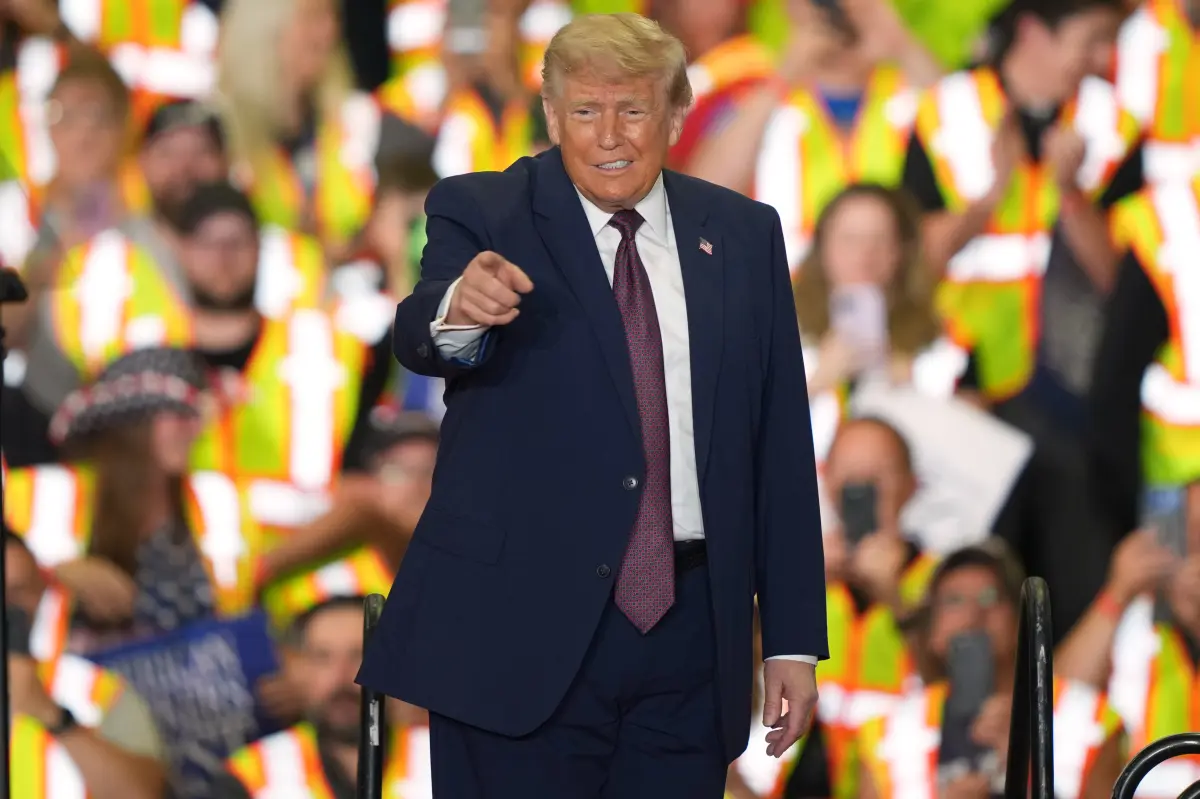

President Donald Trump has been musing about whether he’s the most powerful man in world history — and judging by the results lately, the answer is definitely “no.”
It’s certainly true that Trump has technical tools at his disposal that would have astounded famous pre-20th century contenders for the title of most powerful man, whether Julius Caesar, Alexander the Great, Charlemagne or Napoleon.
Trump’s power, though, isn’t defined by, say, the precision and explosive punch of the Tomahawk missile.
As the leader of a constitutional republic that disperses power and depends ultimately on democratic consent, Trump is operating under constraints that routinely blunt his ambitions.
If the theme of the first year of his second term was aggression on all fronts, his second year has so far been defined by significant retreats.
Late last year, Trump surged DHS forces into Minneapolis, seeking to make an example of the Twin Cities after Somali immigrants were implicated in welfare-fraud schemes.
When the operation was met by fierce opposition from city and state leaders and resistance in the streets, the administration steeled itself for a gargantuan test of wills — before Trump, realizing he was losing the battle of political optics, sent Tom Homan to Minneapolis to unwind the operation.
Last month, the Justice Department settled a $10 billion lawsuit that Trump filed against the IRS over the leak of his tax returns.
The department agreed to create a $1.8 billion fund for the compensation of victims of Democratic lawfare — a slush fund for his allies, presumably including Jan. 6 rioters.
Faced with adverse legal rulings and Senate opposition, the administration abandoned the scheme that it had initially touted as a means to “right the wrongs that were previously done while ensuring this never happens again.”
Then, of course, Trump signed a cease-fire with Iran that wasn’t close to the “unconditional surrender” he had once demanded.
The 14-point agreement included more American than Iranian concessions, and Trump admitted that Tehran’s closure of the Strait of Hormuz had forced his hand.
None of these were incidental initiatives.
They all involved core commitments of this president — to mass deportation, to turning on its head the lawfare campaign against him and to denying the Iranian regime a nuclear weapon.
They were also overreaches that displayed a heedlessness born of hubris.
Trump had already driven down overall migration when he surged ICE into Minneapolis; had already pardoned the Jan. 6 rioters when his DOJ created the weaponization fund; and had already struck a punishing blow against the Iranian nuclear program via Midnight Hammer when he launched Operation Epic Fury.
Trump isn’t one for incremental progress toward an objective.
He prefers the grand gesture and the big gamble.
He’s drawn to the bridge too far when a drive a couple of blocks down the street would do just fine.
The worry about Trump was that he’d be unconstrained in his second term, and indeed, he’s fashioned a team that is loath to tell him “no.”
But he’s subject to checks from the other branches of government — and, even more, from routine political pressures.
There was nothing that formally compelled him to remove DHS forces from Minneapolis, or to relieve the military pressure on Iran, both of which were within his legitimate powers.
It was the poor polling, and the potential damage to Republican prospects in the midterms, that obliged Trump to declare victory and go home.
The president may enjoy thinking of how he can do things that a Roman emperor never would have imagined — yet Marcus Aurelius wasn’t hyper-sensitive to how stories were playing in the mass media, or to the latest public-opinion surveys.
As the creature of a democratic republic, Trump inherently is mindful of those considerations, which is one reason that it’s been a year of retreats.
Trump, surely, doesn’t think of it that way.
As Gen. Oliver Smith put it during the Korean War, he’s merely attacking in a different direction — although not the one he’d intended.
X: @RichLowry