
(UPSC Ethics Simplified is a special series under UPSC Essentials by The Indian Express that examines current affairs and static concepts through the lens of ethics and governance. Today’s article asks: What do recurring fire tragedies tell us about public service ethics, institutional accountability, and the duty to safeguard citizens’ right to life?)
Recent, recurring fire incidents have created an alarming situation across the country. While every tragedy draws attention to lapses in infrastructure and disaster management, the larger concern lies elsewhere. What does it say about governance when preventable fires continue to claim lives? More importantly, when such incidents become routine rather than exceptional, they cease to be merely administrative failures and become ethical failures.

For UPSC aspirants, fire incidents should not be viewed only through the lens of disaster management. They offer an excellent opportunity to understand core concepts of GS Paper IV, including duty, accountability, integrity, justice, empathy and ethical leadership. Every major fire raises a fundamental question: What are the normative foundations of public service ethics?
The normative foundations of public service ethics are rooted in constitutional values and ethical virtues. Public administration derives its legitimacy not merely from law but from principles such as integrity, accountability, compassion, social justice and responsiveness. These values ensure that governance remains citizen-centric rather than procedure-centric.
When these foundations weaken, institutions may continue to function administratively but fail ethically. Rules may exist, inspections may be conducted and approvals may be granted, yet citizens remain unsafe. Ethical governance, therefore, demands more than compliance with regulations; it requires an unwavering commitment to protecting human life.
Rights, Duties and the Ethics of Public Service
The foremost ethical issue in every fire tragedy concerns the relationship between citizens’ rights and institutional duties.
Every individual possesses the fundamental right to life and dignity. While this right is protected constitutionally, it also carries a moral dimension. Every human being deserves protection simply by virtue of being human. During emergencies, safeguarding this right becomes the foremost responsibility of public institutions.
Story continues below this ad
Rights, however, become meaningful only when corresponding duties are discharged sincerely. During a crisis, waiting for formal instructions becomes secondary to the moral obligation of saving lives. Public servants are expected to act with courage, compassion and presence of mind.
This ethical duty was reflected in the response of senior officers, firefighters and police personnel who explored every possible means to rescue trapped students, even breaking through walls when necessary. Similarly, during the Malviya Nagar fire, a local shopkeeper willingly used his costly mattresses to cushion people jumping from the building. Neither action was motivated by recognition or reward. Both reflected a commitment to doing what was morally right.
Such actions closely resemble Immanuel Kant’s idea of duty. According to Kant, moral actions are performed because they are inherently right, not because they produce favourable consequences. His concept of the maxim refers to the personal principle that guides one’s conduct. The rescuers and the shopkeeper acted according to this principle, placing human life above personal convenience or material loss.
Looking beyond rescue operations
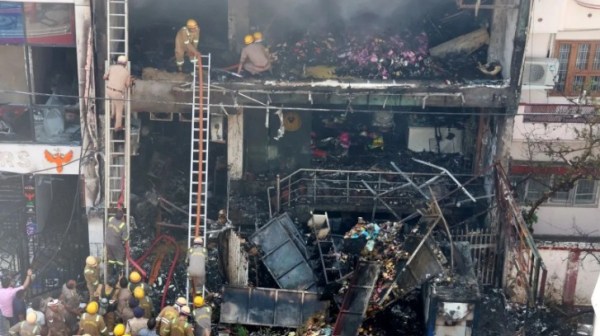 15 people were killed in a fire in a three-storey building in Lucknow’s Aliganj this month. (Express Photo)
While acts of bravery deserve appreciation, ethics also requires us to examine the circumstances that made such rescue operations necessary.
Story continues below this ad
Why are coaching institutes often allowed to function with inadequate emergency exits? Why do buildings continue to violate fire safety norms despite repeated inspections? Why do unsafe structures receive legal clearances? These questions extend beyond any single incident and reveal a deeper governance challenge.
Fires in apartments, hospitals, factories, buses and educational institutions have become disturbingly frequent. Such incidents cannot always be dismissed as unfortunate accidents. They often indicate failures in regulation, supervision and institutional responsibility. When society begins to treat these tragedies as inevitable, ethical complacency gradually replaces ethical governance.
Accountability, Responsibility and Blameworthiness
Another important ethical issue is accountability.
Accountability is often understood as the obligation to answer for one’s actions after an incident. However, ethical accountability begins much earlier. It requires institutions to anticipate risks, enforce safety standards and prevent foreseeable harm. In this sense, accountability is proactive rather than merely reactive.
Story continues below this ad
Legal liability determines whether laws have been violated and who is legally responsible. Ethical accountability, however, goes further by examining blameworthiness. It asks whether negligence, indifference or failure of leadership contributed to the tragedy. A building owner who ignores safety norms, an inspector who overlooks violations, an authority that grants approvals despite deficiencies and an institution that prioritises profit over safety may all share varying degrees of moral responsibility.
At the same time, accountability also demands that ethical leadership be recognised. Officers who acted decisively during rescue operations demonstrated integrity, courage and commitment to public service. Their actions illustrate that accountability is not only about assigning blame after a disaster but also about fulfilling one’s duty before and during a crisis.
Ethical failures behind fire tragedies
Every major fire reveals that disasters are rarely the consequence of a single lapse. They are usually the result of a chain of ethical failures that accumulate over time. Illegal construction may be the immediate cause, but beneath it often lie corruption during inspections, regulatory capture, conflicts of interest, weak ethical leadership and administrative apathy. Safety norms are ignored, violations become routine and institutions gradually lose sight of their moral purpose. The tragedy is not merely that lives are lost; it is that warning signs were often visible long before the disaster occurred. Such incidents expose an accountability deficit and remind us that governance is ultimately judged not only by administrative efficiency but by its ethical commitment to protecting human life.
Justice and Equity
Fire incidents also raise important questions of justice and equity.
The burden of such tragedies often falls disproportionately on vulnerable groups, including hospital patients, school children, factory workers, students and residents of informal settlements. Their safety depends almost entirely on the integrity and competence of public institutions. Ethical governance therefore requires special attention to vulnerable communities through stronger regulation, equitable enforcement of safety standards and inclusive disaster preparedness. Justice is achieved not when everyone is treated identically but when those facing greater risks receive greater protection.
Ethical reforms beyond technical compliance
Preventing future fire tragedies requires more than better equipment or stricter regulations. Technical reforms alone cannot create a culture of safety if institutions continue to compromise on ethics. Sustainable change begins when safety is viewed as a moral responsibility rather than a procedural requirement.
Story continues below this ad
This demands integrity in inspections, transparency in licensing, accountability for negligence and ethical leadership that places public welfare above private interests. Whistleblowers who expose safety violations should be protected rather than discouraged, while citizens should be encouraged to participate in monitoring public safety. Ultimately, institutions must move beyond rule-based compliance towards values-based governance, where respect for human life becomes the guiding principle behind every administrative decision.
Ethical conduct during disasters
The role of a public servant does not end with enforcing regulations. During disasters, ethical leadership becomes equally important. Officers must demonstrate empathy towards victims, compassion for affected families, calm decision-making under pressure, effective crisis communication and emotional resilience.
These qualities inspire public confidence and enable institutions to respond with both efficiency and humanity. The true measure of governance is not merely how efficiently it responds to disasters but how ethically it prevents them.
A preventable fire is not simply an accident. It represents a failure of public ethics, institutional integrity and the State’s duty to protect life. Every such tragedy reminds us that good governance cannot be measured only by the number of rescue teams deployed after a disaster. It must also be measured by the ethical commitment to ensure that the disaster never occurs in the first place.
Story continues below this ad
Ultimately, safer cities and stronger institutions will emerge not only from stricter laws but from ethical leadership, accountable governance, integrity in public administration and a citizen-centric culture that values every human life. Only when duty, accountability and compassion become institutional values—not merely legal obligations—can governance truly fulfil its constitutional promise.
POST READ QUESTION
A fire accident in a commercial building kills several people. Investigation reveals that fire exits were blocked and safety certificates were obtained through bribery. Discuss the ethical issues involved and suggest measures to prevent such incidents.
(The writer is the author of ‘Being Good’, ‘Aaiye, Insaan Banaen’, ‘Kyon’ and ‘Ethikos: Stories Searching Happiness’. He teaches courses on and offers training in ethics, values and behaviour. He has been the expert/consultant to UPSC, SAARC countries, Civil services Academy, National Centre for Good Governance, Central Bureau of Investigation (CBI), Competition Commission of India (CCI), National Judicial Academy, etc. He has PhD in two disciplines and has been a Doctoral Fellow in Gandhian Studies from ICSSR. His second PhD is from IIT Delhi on Ethical Decision Making among Indian Bureaucrats. He writes for the UPSC Ethics Simplified (concepts and caselets) fortnightly.)
Subscribe to our UPSC newsletter and stay updated with the news cues from the past week.
Story continues below this ad
Stay updated with the latest UPSC articles by joining our Telegram channel – Indian Express UPSC Hub, and follow us on UPSC section of The Indian Express on Instagram and X.
For your queries and suggestions write at manas.srivastava@indianexpress.com
PREVIOUS ARTICLES ON UPSC ETHICS SIMPLIFIED:
How can India’s civil services and governance rebuild Gen Z’s trust?
CBSE row as a case study on accountability when technology fails
NEET Paper Leak: What is ethical governance in public examinations?
Dear UPSC aspirants, how do you know what’s ethical in everyday life
Are humans failing ethically in the AI age?
How fake success claims by aspirants reveal a deeper moral crisis
Minister vs Civil Servant : In governance, mature conversation is the key