

Delhi mandates all new 2-wheelers be electric from ’28 to fight pollution
Syllabus:
Preliminary Examination: Current events of national and international importance
Mains Examination: General Studies II: Government policies and interventions for development in various sectors and issues arising out of their design and implementation.
What’s the ongoing story: No petrol motorcycles and scooters can be registered in Delhi after March 31, 2028, the Delhi government announced on Monday. The registration of new CNG auto-rickshaws will stop at the end of this year. Beginning April 2028, therefore, every new two- and three-wheeler sold in Delhi will have to be an electric vehicle (EV).
Key Points to Ponder:
• The Delhi EV Policy 2026-what are the major provisions?
• Why is the government pushing for EVs?
• How electric vehicles and public transportation reforms can help in reducing vehicular pollution in Delhi?
• Why Delhi pollution is always in News?
• Know the Geographical location of Delhi
• Being landlocked makes Delhi’s air pollution worse-How far you agree with this?
• What are the major sources of air pollution in Delhi?
• How do seasonal factors contribute to the air quality issues in the region?
• What are the public health impacts of Delhi’s air pollution?
• How does prolonged exposure to high pollution levels affect vulnerable groups such as children and the elderly?
• Discuss the effectiveness of regulatory bodies, such as the Central Pollution Control Board (CPCB), in enforcing air quality standards in Delhi.
• How can technology be leveraged to combat Delhi’s air pollution?
• Compare Delhi’s air pollution crisis with that of other major global cities such as Beijing or Los Angeles.
• What are some behavioural changes that citizens can adopt to mitigate air pollution in urban areas?
Key Takeaways:
• The decisions, part of the Delhi government’s EV Policy 2.0, represent a sweeping, first-of-its kind policy reform in the country, aimed at making a significant contribution to the Capital’s chronic air pollution problem.
• The policy will come into effect on July 1, following approval from Lt Governor Taranjit Singh Sandhu. Chief Minister Rekha Gupta, who announced the decision of the Delhi Cabinet on Monday, described the EV Policy as a major step towards making Delhi pollution-free by March 31, 2030. The government would spend Rs 15,000 crore on incentives and on strengthening the EV-charging infrastructure in the city, the CM said.
• A senior Transport Department official clarified that the notification of the new policy did not mean that existing non-electric two-wheelers would be forced off the roads. “We are not stopping any bike or scooty from plying in Delhi. Our only push is that no new registration will be allowed in the city (after the deadline). The government is giving enough time of two years for both the customers as well as manufacturers for a gradual transition towards EVs,” the official said.
• Delhi’s previous EV policy, brought by the Aam Aadmi Party government, expired two years ago, and was subsequently extended multiple times. The current extension runs out on Tuesday. It aimed to curb vehicular pollution and increase the share of EVs in new registrations to 25 per cent by 2024.
• The new policy expands the incentives and scrappage benefits to encourage a rapid transition to EVs. The government has proposed a cash incentive of up to Rs 30,000 for buying an electric two-wheeler in the first year of the new policy, and Rs 20,000 and Rs 10,000 for purchases made in the second and third years, respectively.
• For passenger three-wheelers (autos), the incentive will be Rs 50,000, Rs 40,000, and Rs 30,000 in the first, second, and third years, respectively.
• There are incentives for scrapping older vehicles as well. Owners who give up their BS-IV or older two-wheelers will receive Rs 10,000, while owners who scrap their three-wheelers will be eligible for Rs 25,000.
Do You Know:
• The Delhi Electric Vehicle (EV) Policy announced focuses on two priorities: a phased transition to mandatory electric two-wheelers, three-wheelers, and light-duty trucks, and a conscious emphasis on pure EVs over strong hybrid vehicles.
• The policy aims to achieve a minimum 30% electrification of Delhi’s vehicle fleet by March 31, 2030, when the policy runs out.
• The policy cleared by the Delhi Cabinet cites the latest report of the Commission for Air Quality Management (CAQM), ‘Identification of the Causes for Worsening AQI in Delhi-NCR’, which estimates that vehicular emissions contribute around 23% of Delhi’s PM2.5 pollution during winter, making transport the single largest pollution source within the city.
• The report notes that two-wheelers constitute nearly 67% of Delhi’s vehicle stock, making their rapid electrification critical for reducing emissions.
• It also identifies three-wheelers, commercial cars and ‘N1’ category goods vehicles — with a gross vehicle weight of up to 3.5 tonnes — as priority segments because of their high daily utilisation and mileage, which result in disproportionately high emissions.
• A draft report by the nonprofit The Energy and Resources Institute (TERI) in 2021 identified vehicles as the single
largest contributor to Delhi’s PM2.5 pollution through much of the pollution season.
• Within the transport sector, two-wheelers were the largest contributors to PM2.5, PM10, sulphur dioxide and carbon monoxide emissions. Three-wheelers were found to be the largest source of volatile organic compounds (VOCs), while buses contributed the highest nitrogen oxides (NOx).
Other Important Articles Covering the same topic:
📍Two-wheelers constitute two-thirds of Delhi’s vehicles, why this shift matters
Previous year UPSC Prelims Question Covering similar theme:
1) Consider the following types of vehicles: (UPSC CSE, 2025)
I. Full battery electric vehicles
II. Hydrogen fuel cell vehicles
III. Fuel cell-electric hybrid vehicles
How many of the above are considered as alternative powertrain vehicles?
(a) Only one
(b) Only two
(c) All the three
(d) None
2) In the context of electric vehicle batteries, consider the following elements: (UPSC CSE, 2025)
I. Cobalt
II. Graphite
III. Lithium
IV. Nickel
How many of the above usually make up battery cathodes?
(a) Only one
(b) Only two
(c) Only three
(d) All the four
3) Which one of the following is the exhaust Pipe emission from Fuel Cell Electric Vehicles powered by hydrogen? (UPSC CSE, 2024)
(a) Hydrogen peroxide
(b) Hydronium
(c) Oxygen
(d) Water vapour
Previous year UPSC Main Question Covering similar theme:
📍How is efficient and affordable urban mass transport key to the rapid economic development in India? (UPSC, 2019)
Politics
3-decade-old problem resolved, says Shah as Rajasthan, Haryana sign Yamuna water-sharing pact
Syllabus:
Preliminary Examination: Current events of national and international importance.
Mains Examination: General Studies II: Functions and responsibilities of the Union and the States, issues and challenges pertaining to the federal structure, devolution of powers and finances up to local levels and challenges therein.
What’s the ongoing story: Haryana and Rajasthan signed a memorandum of understanding (MoU) on Monday to operationalise water-sharing as per the long-delayed 1994 Upper Yamuna River Board Agreement. Under the MoU, Haryana will supply 580 million cubic metres of water from the Yamuna canal to Rajasthan through three underground pipelines from July to October every year, officials said.
Key Points to Ponder:
• The 1994 Upper Yamuna River Board (UYRB) Formula-know in brief
• What is the MoU between Rajasthan and Haryana water agreement?
• What are the Constitutional Provisions for interstate water disputes?
• What Article 262 of the Constitution says about interstate water disputes?
• Map Work-Yamuna River
• What are the key reasons behind the Yamuna water dispute between Rajasthan and Haryana?
Key Takeaways:
• Haryana Chief Minister Nayab Singh Saini and his Rajasthan counterpart, Bhajan Lal Sharma, signed the MoU in the presence of Union Home Minister Amit Shah and Union Jal Shakti Minister C R Patil.
• Shah said drinking water would now be supplied to the districts of Sikar, Churu, and Jhunjhunu in Rajasthan, as well as the Bhiwani and Fatehabad areas in Haryana. “The water that was earlier going to waste will now quench people’s thirst and be stored in large ponds to recharge groundwater,” he added.
• Union government officials said the MoU would accelerate the construction of the Renuka, Kishau, and Lakhwar dams, envisaged by the 1994 agreement. “These projects will enhance water storage capacity in the Yamuna basin, improve drinking water supply, and increase the availability of water for irrigation,” an official said in a statement.
• The 1994 agreement allocated Yamuna waters as follows: Haryana: 40.6 per cent, Uttar Pradesh: 35.1 per cent, Rajasthan: 10.4 per cent, Delhi: 6.3 per cent, and Himachal Pradesh: 1.7 per cent.
• Officials said the two states would construct approximately 300 km of underground pipelines from Hathinikund to Rajasthan to facilitate the transfer of water. “The project is estimated to cost around Rs 3,900 crore. The agreement provides that both states will jointly determine responsibilities related to land acquisition, pipeline construction, monitoring, operation, and maintenance,” an official said.
Do You Know:
• The 1994 Yamuna Water Agreement (formally the Memorandum of Understanding on the sharing of utilisable surface waters of the Upper Yamuna Basin) is a historic interstate pact signed on May 12, 1994, by Uttar Pradesh, Haryana, Rajasthan, Himachal Pradesh, and Delhi. Uttarakhand was later included after its creation in 2000.
• The agreement established a framework for allocating the Yamuna River’s surface water among the participating states to meet drinking water and irrigation needs.
Other Important Articles Covering the same topic:
📍Water sharing dispute between Punjab and Haryana: what happened, why
Previous year UPSC Mains Question Covering similar theme:
📍Constitutional mechanisms to resolve the inter-state water disputes have failed to address and solve the problems. Is the failure due to structural or process inadequacy or both? Discuss. (UPSC, 2013)
The Editorial Page
Next UN chief’s job: Keep conversations alive when others stop talking
Syllabus:
Preliminary Examination: Current events of national and international importance.
Mains Examination: General Studies II: Important International institutions, agencies and fora- their structure, mandate.
What’s the ongoing story: Shashi Tharoor, E D Mathew Writes-The next UN chief will take office as the restraints that have helped contain international rivalry since 1945 visibly weaken.
Key Points to Ponder:
• Who is the current general secretary for the UN?
• What is the role of the UN Secretary-General in maintaining international peace and security?
• How is the Secretary-General of the United Nations appointed?
• What are the major limitations faced by the UN in conflict resolution?
• What is the Security Council?
• Non-permanent members and permanent members-compare and contrast
• Who are the 15 members of the UNSC?
• How Voting System works in United Nations Security Council
• On what basis was Security Council permanent membership granted?
• How are the non-permanent members of the Security Council selected?
• Are UN resolutions binding?
• How does the Security Council determine the existence of any threat to the peace, breach of the peace, or act of aggression?
• “Veto power was granted in the UN Charter 77 years ago to encourage each other, but it has turned out that the power is being used to block”-Analyse
• “UN Security Council (UNSC) has become “paralysed” and “dysfunctional” in its “present form”, as it has not been able to take any decision since the Russia-Ukraine war started”-How far you agree with the given statement?
• India and United Nations-Know in detail
• What has been India’s stand on UN reformation?
Key Takeaways:
Shashi Tharoor, E D Mathew Writes-
• Dag Hammarskjöld, the United Nations’ second secretary-general, once offered what remains perhaps the clearest statement of the organisation’s purpose. The UN, he said, “was not created to take mankind to heaven, but to save humanity from hell”. The remark reflected the hard lessons of the first half of the 20th century, when two world wars, genocide, imperial conquest and the horrors of the Holocaust and Hiroshima devastated much of the globe. The UN was never intended to create a perfect international order; it was designed to prevent the recurrence of such catastrophes. Eighty years after its founding, that mission looks increasingly precarious.
• Armed conflicts are multiplying. Nuclear risks have returned to strategic calculations. International law is under pressure, while the Security Council, the world’s principal instrument of collective security, is frequently paralysed by the rival interests of its permanent members. When cooperation is most needed, faith in multilateralism is ebbing as great-power rivalry thrives. Against this backdrop, the race to succeed António Guterres, whose term ends in December 2026, has assumed unusual significance.
• The next UN chief will take office as the restraints that have helped contain international rivalry since 1945 visibly weaken. For all its shortcomings, the post-war order achieved something remarkable: It prevented World War III. Proxy wars, regional conflicts and repeated crises occurred, but direct military confrontation between the major powers was avoided.
• The secretary-general still commands a global platform unmatched by most political leaders. Yet the office has become increasingly cautious in using that authority. When governments hesitate to speak uncomfortable truths, excessive caution carries its own risks. The next secretary-general should not merely respond to crises but identify dangers before they erupt.
• The UN must also adapt to a changing landscape in which cities, universities, philanthropic foundations, civil-society organisations and private-sector actors possess capabilities once associated almost exclusively with states. During periods of governmental deadlock, these networks often remain capable of advancing cooperation. Perhaps the greatest challenge lies not within institutions but in political culture.
• The secretary-general cannot end wars by decree or reshape international politics alone. What the office can do is create opportunities for diplomacy, preserve lines of communication and expand the political space in which compromise becomes feasible. The job remains impossible. The alternative, however, is a world in which nobody is left trying to save humanity from hell.
Do You Know:
• The process of appointing and selecting the next Secretary-General is based on General Assembly resolutions and guided by the principles of transparency and inclusivity.
• The UN Secretary-General is officially appointed by the General Assembly upon the recommendation of the Security Council, as outlined in Article 97 of the UN Charter. In practice, the process is a secretive, highly political procedure dominated by the five permanent, veto-wielding members of the Security Council (the US, UK, China, Russia, and France).
• The selection process involves:
—Nominations: Member states submit candidates who participate in dialogues and submit vision statements.
—Straw Polls & Veto Power: The Security Council holds secret ballots, with coloured ballots indicating veto power from the P5 members. A single “discourage” vote from a permanent member ends a candidacy.
—Recommendation: The Council recommends a candidate who secures nine votes with no vetoes.
—General Assembly Appointment: The 193-member Assembly officially appoints the candidate, usually by consensus.
Other Important Articles Covering the same topic:
📍 Explained: António Guterres re-elected for second term; how is the UN Secretary-General appointed?
Previous year UPSC Prelims Question Covering similar theme:
4) With reference to the “United Nations Credentials Committee”, consider the following statements: (UPSC CSE, 2022)
1. It is a committee set up by the UN Security Council and works under its supervision.
2. It traditionally meets in March, June and September every year.
3. It assesses the credentials of all UN members before submitting a report to the General Assembly for approval.
Which of the statements given above is/are correct?
(a) 3 only
(b) 1 and 3
(c) 2 and 3
(d) 1 and 2
5) With reference to the United Nations General Assembly, consider the following statements: (UPSC CSE, 2022)
1. The UN General Assembly can grant observer status to the non-member States.
2. Inter-governmental organisations can seek observer status in the UN General Assembly.
3. Permanent Observers in the UN General Assembly can maintain missions at the UN headquarters.
Which of the statements given above are correct?
(a) 1 and 2 only
(b) 2 and 3 only
(c) 1 and 3 only
(d) 1, 2 and 3
Previous year UPSC Mains Question Covering similar theme:
📍What are the main functions of the United Nations Economic and Social Council (ECOSOC)? Explain different functional commissions attached to it. (UPSC, 2017)
Nation
Goats, cattle constitute half of cheetah prey in Kuno; chital 42%, reveals report
Syllabus:
Preliminary Examination: General issues on Environmental ecology, Bio-diversity and Climate Change.
Mains Examination: General Studies-III: Conservation, environmental pollution and degradation, environmental impact assessment.
What’s the ongoing story: Goats and cattle together make up 50%, while Chital (spotted deer) formed 42% alone of the detected kills by 19 free-ranging cheetahs under Project Cheetah in the Kuno National Park and wildlife division landscape, according to the latest Project Cheetah progress report, which also identified continuous prey augmentation and improvements in habitat as central to sustaining reproductive cheetahs and the growing size of cubs.
Key Points to Ponder:
• Cheetah in India- Background
• Extinction of Cheetah from Indian Landscape-know the reasons
• How Reintroduction of the cheetah in India was executed?
• Map Work World-South Africa, Kenya, Namibia and Botswana
• Map Work India-Kuno Palpur National Park and Gandhi Sagar Wildlife Sanctuary
• What Project Cheetah progress report says?
• What are the challenges posed by livestock depredation in the successful implementation of Project Cheetah?
• What is the role of prey availability in determining the success of species reintroduction programmes?
• How does ecosystem restoration contribute to biodiversity conservation?
Key Takeaways:
• Reflecting dietary diversity and prey availability challenges faced by the project, the progress report for September 2024 to December 2025, released by the Union Environment Ministry on Sunday, noted that the dietary diversity reflects ‘ecological adjustments’, with evidence of small Indian civet kills, as well as opportunistic preying of birds and other small mammals.
• India has 53 big cats under Project Cheetah. “Continuous monitoring of the cheetahs, as found during the previous two years, showed that the main prey species hunted by cheetahs in and around Kuno NP was chital. In the free-ranging environment, chital accounted for 42% of detected kills, followed by goat (30%), cattle (20%), Nilgai (2%), hare, sambar, chinkara, sheep, and wild pig (1% each),” the report stated.
• Free-ranging mothers with cubs, such as Jwala and Gamini, demonstrated higher hunting frequencies, indicating elevated energy demands, the report noted. “Notably, certain free-ranging groups exhibited predation on domestic livestock, particularly goats and cattle… underscoring the importance of proactive negative interaction mitigation
and community engagement measures,” the report noted.
• Jwala and her cubs, released into free-ranging areas in early 2025, predominantly relied on domestic goat kills, accounting for 40%, followed by cattle and chital. Agni and Vayu, male cheetahs fed mostly on chital (39%), followed by domestic cattle (26%), domestic goats (19%), sheep (10%), and Nilgai and wild pigs (3% each).
• Detailed tracking and analysis of their movements also showed the free-ranging cheetahs are moving far and wide, with some, like the male cheetah Agni, exploring a vast area of 3,198 sq km in the first 30 days since its release from the enclosed area. This was also witnessed recently in April as KP-2, a young male cheetah, made his way into Ranthambore’s tiger forest and had to be immobilized to get him back to Kuno.
• Project Cheetah Director Uttam Kumar Sharma said it is natural for cheetahs to explore long distances and vast territories, and they have been found to have covered 12 districts, six each in Madhya Pradesh and Rajasthan.
Do You Know:
• Kuno National Park in Sheopur district is spread over 748.76 sq km with adjoining forest areas falling within Kuno wildlife division, collectively covering 1,235 sq km, now increased to nearly 1,800 sq km. The national parks form part of the larger Sheopur-Shivpuri dry deciduous open forests spanning 6,800 sq km, and the Kuno River traverses the park area.
• Initiated in 2022, Project Cheetah saw the introduction of African cheetahs in Indian grassland and dry forest landscapes in Kuno through the first intercontinental translocation. A founder population of 20 cheetahs – 8 from Namibia and 12 from South Africa – was imported for the project. From 20, the population has now grown to 53, comprising 13, 17 sub-adults, and 23 cubs.
• Along with Kuno, three cheetahs are also hosted at Gandhi Sagar Sanctuary in Neemuch and Mandsaur districts, Madhya Pradesh.
Other Important Articles Covering the same topic:
📍Project Cheetah: Where things stand after two years
Previous year UPSC Prelims Question Covering similar theme:
6) Consider the following: (UPSC CSE, 2012)
1. Black-necked crane
2. Cheetah
3. Flying squirrel
4. Snow leopard
Which of the above are naturally found in India?
(a) 1, 2 and 3 only
(b) 1, 3 and 4 only
(c) 2 and 4 only
(d) 1, 2, 3 and 4
Explained
Behind Europe’s heatwave, climate change the culprit
Syllabus:
Preliminary Examination: Current events of national and international importance
Main Examination: General Studies I: Important Geophysical phenomena such as earthquakes, Tsunami, Volcanic activity, cyclone etc., geographical features and their location-changes in critical geographical features (including water-bodies and ice-caps) and in flora and fauna and the effects of such changes.
What’s the ongoing story: A new study has confirmed what was already evident — climate change is behind the scorching heat in large parts of Europe right now.
Key Points to Ponder:
• What exactly World Weather Attribution (WWA) says?
• How climate change to be “unequivocally to blame” for the Europe heatwave?
• What are the causes behind the increasing frequency and intensity of heat waves across the Europe?
• What is the relationship between global warming and record-breaking heat events in Europe?
• How does climate change influence the occurrence of compound extreme weather events?
• How do heat domes and jet stream disruptions contribute to prolonged heat waves?
• What is the impact of Arctic amplification on global weather patterns?
• How El Niño is impacting Europe?
• How does the Mediterranean Sea influence climatic conditions in Europe?
• What is heat dome?
• Why heat dome is also called as Omega Block?
• How heat dome is different from heatwave?
Key Takeaways:
• A study by World Weather Attribution (WWA), a group of scientists that examines the causes of extreme weather events worldwide, has found climate change to be “unequivocally to blame” for the Europe heatwave, which has seen several places record unprecedented temperatures in recent days. WWA said this was the most severe heatwave ever recorded in Europe.
• This is the third time in five years that Europe finds itself in the grip of an intense heatwave. Similar scenes were witnessed in 2022 and 2023 as well. More than 1,00,000 people are estimated to have died owing to extreme heat in those two years.
• The WWA study, however, was categorical in assigning the cause of this heatwave. It said it was not because of El Niño, which is still to reach its peak, or any other reason, but climate change. “Both the daytime highs and overnight temperatures seen during this heatwave would have been virtually impossible to occur at this time of year as recently as 1976 – just 50 years ago,” it said.
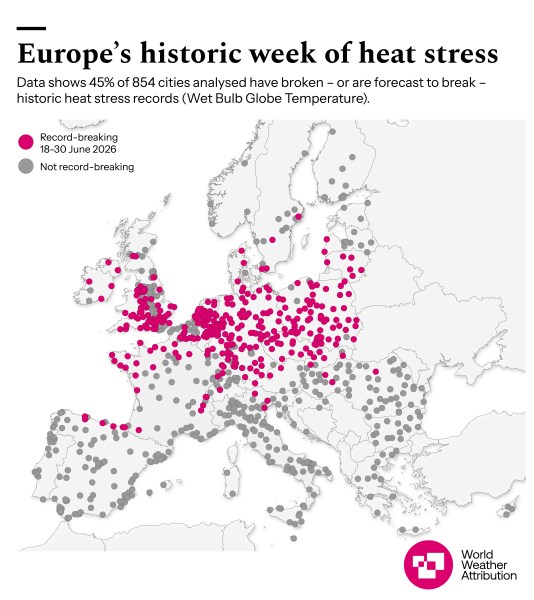 A map of Europe’s heatwave hotspots, prepared by World Weather Attribution.
• Many of the temperature records now being broken in Europe were set in 1976, when the region had experienced an unusually hot summer. Europe experienced its first heatwave of this century in 2003. The study said the 2003 heatwave was nothing in comparison to what the region is witnessing now. The record-breaking high temperatures during the night are almost 100 times more likely today than they were in 2003, it said. The day-time peak temperatures observed during the current spell are almost ten times more likely.
Do You Know:
• For the longest time, Europe has expressed an aversion to air-conditioning, with the French in particular viewing ACs as garish and American. A longstanding belief in France is that continued exposure to cold air can make you sick, while the appliance is widely regarded as a luxury product. For many, homes with thick stone walls, wooden shutters and open windows reflected good architecture, making mechanical cooling seem unnecessary rather than aspirational.
• Countries in southern Europe built their cities to manage the heat, with thick walls, shaded windows and well-ventilated street layouts. These cities also feature light-coloured facades and reflective surfaces that reduce heat absorption, helping interiors to stay cool. By contrast, northern Europe, which for decades experienced relatively mild summers, designed its buildings to trap heat during long winters.
• Policymakers and climate experts have long argued that widespread air-conditioning creates a vicious cycle: it increases electricity demand, much of which is still met by fossil fuels, while also releasing waste heat outdoors and making cities even hotter.
That thinking has also shaped European climate policy. The European Union has committed to reaching net-zero emissions by 2050, while governments have focused on improving energy efficiency, expanding renewable energy and reducing energy demand. Encouraging millions of new air-conditioners therefore, sits uneasily with Europe’s broader climate goals.
• For the longest time, the European summer has meant long evenings, open windows and holidays built around warm, but bearable, weather. As Europe warms faster than any other continent, that experience is becoming less common.
Other Important Articles Covering the same topic:
📍Europe’s worst heatwave would have been impossible without climate change
Previous year UPSC Prelims Question Covering similar theme:
7) What are the possible limitations of India in mitigating global warming at present and in the immediate future? (UPSC CSE, 2010)
1. Appropriate alternate technologies are not sufficiently available.
2. India cannot invest huge funds in research and development.
3. Many developed countries have already set up their polluting industries in India.
Which of the statements given above is/are correct?
(a) 1 and 2 only
(b) 2 only
(c) 1 and 3 only
(d) 1, 2 and 3
Why more medicines will now have QR codes on their packets
Syllabus:
Preliminary Examination: Current events of national and international importance.
Mains Examination: General Studies II: Government policies and interventions for development in various sectors and issues arising out of their design and implementation.
What’s the ongoing story: The Centre has recently mandated that all vaccines, antimicrobials, narcotics and addictive drugs, and anti-cancer drugs carry a bar code or QR code, which can enable the tracking of each vial or blister pack of the medicine. This type of track-and-trace mechanism allows regulators as well as the companies to follow the entire journey of every single unit of the product right from the manufacturing plant to the retail store.
Key Points to Ponder:
• What is QR code?
• What is the purpose of the QR code?
• How does the QR code-based tracking system for medicines work?
• Why QR code on all vaccines, antimicrobials, narcotics and addictive drugs, and anti-cancer drugs?
• Why is it needed?
• What are challenges with implementing the system?
Key Takeaways:
• The tracking mechanism will be implemented for the new categories of products over the next two years — by July 2027 for vaccines, narcotics, and anticancer drugs and by July 2028 for antimicrobials, according to the recent gazette notification.
• Manufacturers of all medicines listed under the Schedule H2 of the Drugs Rules are required to affix a unique bar code or QR code on the primary package of the medicine, or in case of dearth of space, on the secondary packaging. A new schedule H2 was created in the Drug Rules, 1945 four years ago when the tracking mechanism was first initiated. This schedule lists the top 300 brands — and now the four new category of products — which have to implement the tracking system.
• In addition to the unique identification number for the particular blister pack or vial, the QR code or bar code also has to carry the following information: the brand name and generic name of the drug, name and address of the manufacturer, batch number, date of manufacturing, date of expiry, and manufacturing licence number.
• While most drugs in the market already carry this information on their pack, the QR code based tracking system requires the manufacturers, wholesalers, distributors, and retailers to log these products on specialised track and trace platforms.
Do You Know:
• The main aim of making the journey of the medicines traceable is to prevent counterfeiting. A drug can be counterfeited by either releasing products into the market with no active ingredient or diluting a drug to increase quantities for sale.
• A track and trace mechanism can help regulators identify whether the spurious drug was manufactured by a company trying to cut costs or was a completely fake product packaged like a known brand. It can also help regulators identify whether a product was contaminated at the source — at the manufacturing plant of a company — or was tampered with.
• Importantly, the possibility of tracking every single unit also means that regulators and companies know exactly where to find their products in case there is a recall.
Other Important Articles Covering the same topic:
📍Every cancer drug vial, vaccine, antibiotic to get unique QR code under new anti-counterfeit rules
Iran to charge fee for using the Strait of Hormuz: What international law says
Syllabus:
Preliminary Examination: Current events of national and international importance
Mains Examination: General Studies II: Bilateral, regional and global groupings and agreements involving India and/or affecting India’s interests.
What’s the ongoing story: With the signing of the framework agreement between the US and Iran on June 15, the Strait of Hormuz has been reopened for the ships of the world and the US blockade on Iranian ships lifted. Still, there are fundamental legal concerns relating to the Strait that require answers.
Key Points to Ponder:
• Map Work– Strait of Hormuz
• Which country has jurisdiction over Strait of Hormuz?
• Is it legal to blockade international waters?
• How has Iran blockaded the Strait of Hormuz?
• What is Exclusive Economic Zone?
• Iran’s ‘toll-booth system’ in the Strait of Hormuz-why it is said so?
• Is collecting formal tolls for the Strait of Hormuz legal?
• What United Nations Convention on the Law of the Sea (UNCLOS) says?
Key Takeaways:
• After the US and Israel imposed war on Iran on February 28, 2026, Iran has used the Strait as both chokepoint and bargaining chip to put pressure on the US and its allies to end hostility against it in all forms. Owing to this imposed war, Iran was collecting toll per transit against the users of the Strait, which it can use to compensate for all damages caused by the war.
• Now, Iran has agreed to reopen the Strait without toll charge but it will still charge a navigation fee and the charge with respect to protection of the environment. This situation prompts a larger question: whether Iran’s action qualifies the litmus test of international law relating to a “right of transit passage” codified in the 1982 United Nations Convention in the Law of the Sea (UNCLOS) and the customary international law.
• Articles 37 to 44 of the UNCLOS that govern “Straits used for International Navigation” hold that all ships and aircraft have a “right of transit passage”: the freedom of continuous, swift navigation and overflight through and over international straits. They “shall not be impeded”, and “there shall be no suspension of transit passage” through a strait. The reasoning behind this framing is that when a considerable portion of global trade depends on a narrow corridor, bordering states are not allowed to use that corridor as leverage.
• The Strait of Hormuz is generally considered as one such “international strait”, a narrow waterway connecting to the rest of the world. Even before the UNCLOS, the International Court of Justice laid down in the Corfu Channel (United Kingdom v. Albania) case of 1949 that “when a strait between two parts of the high seas is used for international navigation, ships enjoy unrestricted passage during peacetime, so long as the transit does not threaten a coastal state’s security”.
• The agreement, which still includes a navigation charge and the environment protection charge, can be treated as an attempt on Iran’s part to consolidate its attempt to convert a natural prolongation of strait into a managed and revenue generating-entry point administered by it with Oman’s support and assistance.
Do You Know:
• As the Strait is within the combined territorial waters of Iran and Oman, freedom of navigation as enjoyed on the
high seas is not available in the territorial sea. Still, the ships of all states are entitled to the “right of innocent passage”: a principle under UNCLOS that allows foreign vessels to navigate through another coastal state’s territorial sea, thus balancing national sovereignty over coastal waters with the global necessity of free maritime transit.
• But this is subject to the satisfaction of the coastal state that it is not going to prejudice its peace, good order, or security (Article 19 of the UNCLOS). The grounds enumerated in the article are broad enough, which Iran or a coastal state can use to deny the right of innocent passage in the face of a tense standoff.
• Iran can use the analogy from the Suez and Panama canals as both of them charge transit fees. The analogy does not support Iran’s case as these canals — unlike Hormuz, which is a natural prolongation — are artificially engineered waterways constructed, maintained, and administered through sovereign territory. Also, their functioning is governed by specific treaty regimes, not by the strait’s provisions of the UNCLOS.
• Iran signed the UNCLOS but never ratified it. While signing the UNCLOS, the Iranian government declared that it does not treat codification of the regime relating to transit passage as customary international law — rather, they were quid pro quo bargains for treaty parties. Iran can use the “persistent objector” argument, which states that a sovereign nation is exempt from a newly emerging norm of customary international law if it has clearly, consistently, and persistently objected to the rule while it was still in the process of formation.
Other Important Articles Covering the same topic:
📍India joins 60 nations at UK meeting calling for opening Strait of Hormuz
Previous year UPSC Prelims Question Covering similar theme:
8) With reference to the United Nations Convention on the Law of Sea, consider the following statements: (UPSC CSE, 2022)
1. A coastal state has the right to establish the breadth of its territorial sea up to a limit not exceeding 12 nautical miles, measured from baseline determined in accordance with the convention.
2. Ships of all states, whether coastal or land-locked, enjoy the right of innocent passage through the territorial sea.
3. The Exclusive Economic Zone shall not extend beyond 200 nautical miles from the baseline from which the breadth of the territorial sea is measured.
Which of the statements given above are correct?
(a) 1 and 2 only
(b) 2 and 3 only
(c) 1 and 3 only
(d) 1, 2 and 3
|
PRELIMS ANSWER KEY |
| 1.(c) 2.(c) 3.(d) 4.(c) 5.(d) 6.(b) 7.(a) 8.(d) |
For any queries and feedback, contact priya.shukla@indianexpress.com
Subscribe to our UPSC newsletter. Stay updated with the latest UPSC articles by joining our Telegram channel – IndianExpress UPSC Hub, and follow us on Instagram and X.