

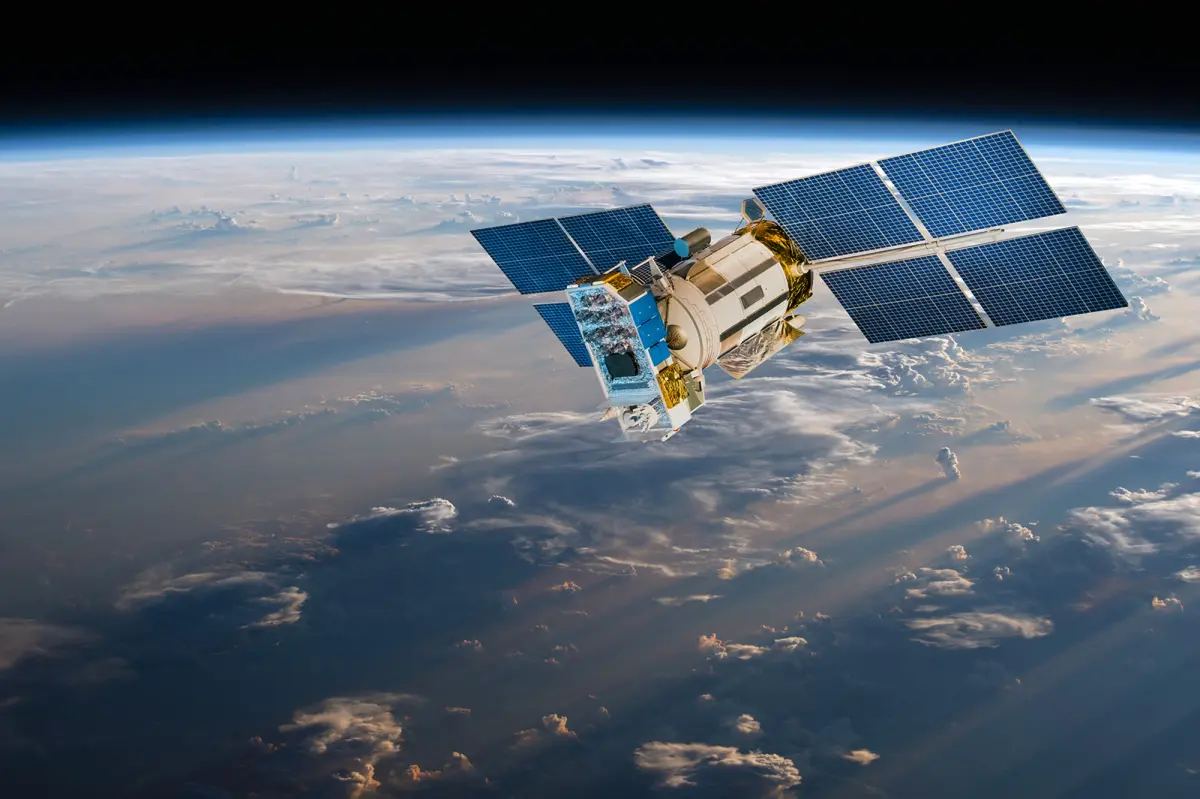

Science fiction author Arthur C. Clarke wrote in 1977: “The impact of telecommunications satellites on the entire human race will be at least the same impact as the advent of the telephone in so-called developed societies.”
Today, that prediction has long been reality. Few people realize how deeply daily life already depends on space infrastructure. If all satellites suddenly failed, navigation systems would collapse. Smartphones and vehicles could no longer determine location accurately. Weather forecasts would become unavailable. Airports would descend into chaos without GPS-based time and positioning data. Traffic signals would desynchronize, leading to chaos on the roads. Supply chains that depend on satellite-supported logistics would disintegrate.
Even financial transactions would grind to a halt, as precise time signals via satellites are vital for synchronizing debits and credits. For instance, trading on the New York Stock Exchange relies on time stamps accurate to billionths of a second that are synchronized via satellite technology; without these signals, automated trading systems would fail.
And this is only the beginning. Satellite mega-constellations such as Starlink, OneWeb, Kuiper and Sat Net are rapidly expanding internet access across the globe. Nearly one-third of humanity still lacks reliable internet connectivity. Space-based communications systems may soon change that, with enormous economic consequences. Space capitalism is no longer a vision of the future. It already exists. Several companies, including SpaceX, Google, Nvidia and Planet Labs, are working on data centers in orbit.
To understand where this could lead, it helps to look back 15 years: In 2011, after the Space Shuttle program ended, the U.S. was no longer able to launch its own astronauts to the International Space Station from American soil using American rockets. It was reliant on outdated Russian Soyuz rockets, and the Russians were demanding monopoly prices. It was an uncomfortable reality for the world’s leading technological power. Government space programs had reached a dead end. It wasn’t until 2020 that the Second Space Age — the era of private spaceflight — began, when a private Falcon rocket launched by SpaceX carried Americans to the ISS.
Today, six years later, space capitalism is a reality. Compared to the Space Shuttle, Elon Musk has cut costs by 95 percent. Last year, 165 of 324 rocket launches worldwide were conducted by SpaceX. If SpaceX were a country, it would be No. 1, far ahead of China (88 launches). And SpaceX is not alone. Another private company, Rocket Lab, founded by New Zealander Peter Beck, carried out 21 launches last year — three times as many as Europe’s government space program.
But this is only the beginning. Musk has big plans; he wants to settle 1 million people on Mars. Science fiction? Perhaps not. NASA researcher Harry W. Jones argues that there are no more fundamental problems on the way to Mars. Technologically, humanity could reach Mars today.
So why aren’t we already there? And why haven’t we been back to the moon since 1972? Why isn’t there already a thriving mining industry on asteroids, despite enormous mineral wealth — such as platinum — waiting to be extracted?
Because there’s no economic incentive! Money makes the world go round — and space is no exception. The 1967 Outer Space Treaty prohibits national ownership of celestial bodies or land on celestial bodies. Space is supposed to belong to everyone—a socialist idea. But socialism has never worked on Earth. Why should it work on the moon or Mars?
What will the future look like? As a historian, I look to the past, to the history of America. Squatters conquered the West. They took land; legal frameworks such as the Homestead Act and other laws, came later. We need space squatters; we need private property rights in space.
Governments shouldn’t be allowed to own property—I agree with that. But private companies should! For example, if SpaceX reaches Mars, it should claim a piece of land. Not the whole planet, of course. Maybe an area the size of Singapore. That would still leave plenty for others, since Mars is 200,000 times larger than Singapore.
The company that acquires this area will list it on the stock exchange as a publicly traded real estate investment trust, or REIT. Yes, let’s take Mars public on the NYSE! Then it would belong to everyone who buys shares in a Mars REIT — maybe even you.
Rainer Zitelmann is the author of the newly published book “New Space Capitalism” (Skyhorse).