

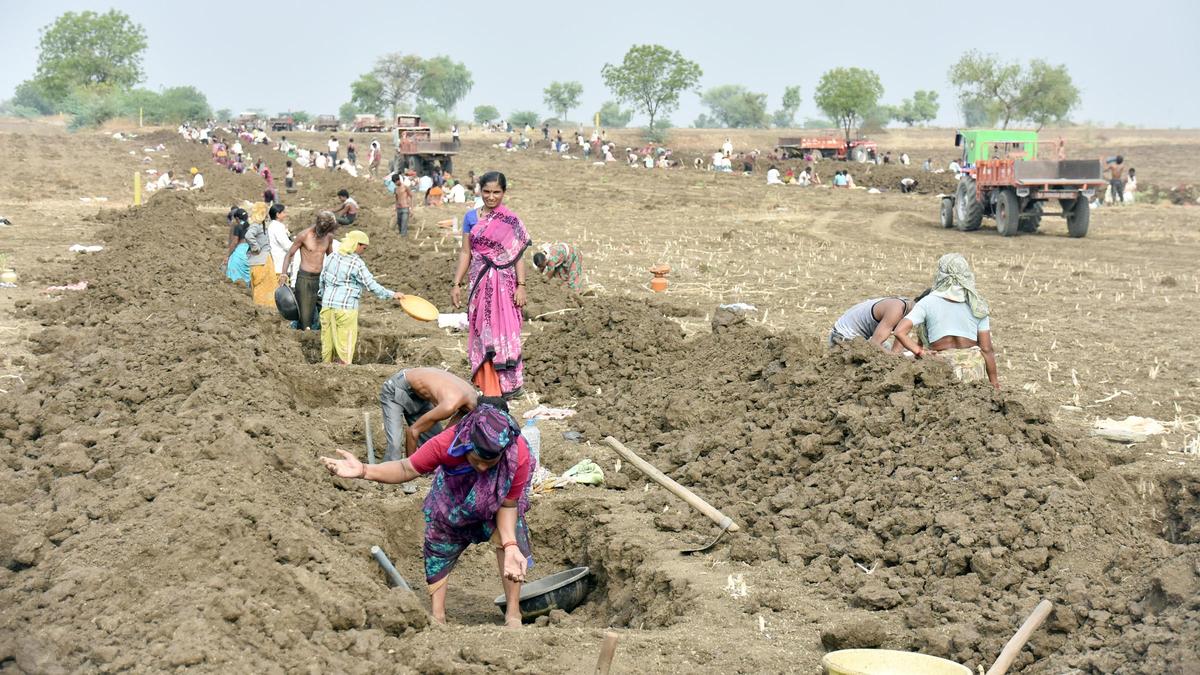

At least three States — Madhya Pradesh, Bihar, and Jharkhand — have questioned the shift in the financial model, which now requires a majority of States to bear 40% of the total expenditure, in contrast to MGNREGA, where the Centre bore 100% of the wage bill and the States had to pay only a part of the material bill, which accounted for only 10% of the total budget. File
| Photo Credit: The Hindu
The story so far: On July 1, Viksit Bharat Guarantee for Rozgar and Ajeevika Mission (Gramin) (VB-G RAM G) will become operational, replacing the Mahatma Gandhi National Rural Employment Guarantee Act (MGNREGA). The Union Rural Development Ministry notified the draft rules for the new employment scheme on May 22, giving a month to stakeholders to submit their feedback.
Spotlight | VB-G RAM G: when a policy shift meets rural realities
How is VB-G RAM G different from MGNREGA?
VB-G RAM G marks a shift from a “demand-driven framework” to a “supply-driven scheme.” Under the new system, allocations will be capped within a fixed budget determined by the Union government based on “objective parameters”.
While the Bill increases the number of guaranteed workdays from 100 to 125, it also significantly raises the financial burden on States from the current 10% share to 40% of total expenditure. Under MGNREGA, the Union government was responsible for 100% of the labour wages and 75% of the material wages. In practice, this translated to a 90:10 cost share between the Centre and the States.
Section 5(1) empowers the Union government to “notify rural areas in a State” where the scheme will be implemented. This is a departure from MGNREGA, which was universal. Another departure from MGNREGA is that the new Bill allows for a blackout period, pausing the programme during peak agricultural seasons to “facilitate availability of labour.”
Also Read | In a U-turn, Punjab government notifies VB-G RAM G scheme
What are the objections raised by the States?
At least three States — Madhya Pradesh, Bihar, and Jharkhand, two of them with BJP-led governments — questioned the shift in the financial model, which now requires a majority of States to bear 40% of the total expenditure, in contrast to MGNREGA, where the Centre bore 100% of the wage bill and the States had to pay only a part of the material bill, which accounted for only 10% of the total budget.
Five States have sought a revision of wage rates, and four have flagged reservations over the provision of 60 non-working days during the peak agricultural season.
Almost all States have also pointed to delays in wage and related payments, seeking early clearance of dues. Bihar, for example, has sought that wages should increase from the present ₹255 to ₹413. Jammu & Kashmir, meanwhile, wants an increase in wages from ₹272 to ₹311. Both Jharkhand and Punjab argued that wages should be competitive and in line with market conditions. Uttarakhand underlined the tough landscape that workers have to work on and sought a compensatory hike. At least four States, including Punjab, Karnataka, and Telangana, ruled by Congress governments, have sought a reconsideration of this blackout period. Nearly all States have highlighted delays in clearing the wage and material bill by the Centre and have advocated that under VB-G RAM G such delays should be avoided.
Also Read | States to get VB-G RAM G funding based on 16th Finance Commission formula, ‘performance criteria’
What gives the Centre more control?
One of the key concerns raised by academics and activists associated with NREGA Sangarsh Morcha and others who have closely followed the implementation and monitoring of MGNREGA is that the new rural employment guarantee programme gives disproportionate power to the Centre.
As per the draft rules on inter-State distribution of funds, the Central government will adopt objective parameters utilised for horizontal devolution among States as recommended by the 16th Finance Commission.
The exact application methodology for this inter-State distribution is determined at the discretion of the Central government, a clause that academics have flagged as concerning.
The rules also state that, starting from the financial year immediately succeeding the first year of the Act’s commencement, a specific portion of the normative allocation is dynamic and tied directly to measurable performance criteria such as timely wage payments to workers, strict compliance with social audit guidelines, the overall percentage of physical works completed within that respective financial year, and any other performance-related metrics specified by the Central government over time. This again leaves a lot of power in the Centre’s hands.
Published – June 29, 2026 11:41 am IST